Annual Business Budget: How to Create One Step by Step
Learn how to create an annual business budget step by step, forecast revenue and expenses, plan cash flow, compare scenarios and manage costs effectively.
TL;DR
An annual budget translates what your business expects to sell, spend, invest and pay in taxes during the coming financial year into monthly figures in euros. For an SME or a self-employed professional with a small team, October and November are the ideal months to prepare it: you already have nine or ten months of actual data from the current year and still have time to make decisions before January. The method is always the same: start with historical data, set sales targets under three scenarios (conservative, realistic and optimistic), budget revenue, fixed and variable costs, investments, taxes and contributions as separate items, and finish with a monthly cash flow forecast that includes a financial buffer.
An annual budget is useless if it is left in a drawer. Its value lies in monitoring: comparing actual figures with projections every month, explaining variances and adjusting forecasts through rolling forecasting when the business changes. From what we see at our Madrid business centres, the items that cause the greatest discrepancies are those that are not broken down in sufficient detail, and workspace is one of them: renovation work, minimum contract terms and building expenses make conventional office rental difficult to forecast, whereas a fixed monthly fee makes it predictable.
What is an annual business budget and what is its purpose for an SME?
An annual budget is a financial plan that sets out expected revenue, projected expenses, investments, and tax and contribution payments for the following twelve months. It is not an accounting record of the past, but a roadmap for the future expressed in figures. Accounting tells you what happened; an annual budget tells you what you want to happen and allows you to measure, month by month, whether you are on track.
For an SME, a budget serves three practical purposes. The first is anticipating liquidity problems: knowing in October that a major supplier payment and a quarterly VAT payment will coincide in March allows you to negotiate payment terms or arrange financing in advance. The second is organising decisions: hiring another employee, changing offices or investing in new equipment becomes more than a matter of intuition and turns into a figure that either fits or does not fit within the plan. The third is providing a common reference point for the team and, where applicable, partners, banks or investors.
It should not be confused with a business plan, which analyses the market and strategy over several years, or with a standalone cash flow forecast. An annual budget connects both elements for a specific financial year. If your business is just starting out, the business plan will be the starting point; if you already have historical data, the budget becomes a day-to-day management tool.
When should a company prepare its annual budget?
The ideal time is between October and November. By then, you have actual data for almost the entire year, allowing you to forecast year-end results with reasonable accuracy and use them as a starting point. At the same time, there is still time to make decisions before January: renegotiate contracts, decide whether to renew a lease, plan recruitment or adjust prices for the new financial year.
Waiting until December is often costly. It is a short month, with public holidays, project deadlines and year-end commercial activity, so the budget ends up being prepared in a rush or postponed until January, when the financial year has already started without a plan. In our experience, companies that dedicate two or three working sessions to budgeting in October reach January with decisions already made rather than unresolved questions.
A realistic timetable would be: the first half of October to gather historical data and estimate year-end results; the second half to define targets and scenarios; the first half of November to calculate costs, investments and taxes; and the second half to prepare the monthly cash flow forecast and review it with partners or advisers. If your financial year does not coincide with the calendar year, apply the same approach two or three months before your year-end date.
How can you forecast revenue using historical data and three scenarios?
Every annual budget begins with revenue, because it determines how much you can afford to spend. The starting point is historical data: turnover from the previous two or three years, broken down by business line, major customer and month. This breakdown reveals seasonality (strong and weak months), customer concentration and trends in each service, information that a single annual figure would conceal.
With the historical data in front of you, the next step is to set sales targets for the following year. It is useful to separate recurring revenue (maintenance contracts, subscriptions and regular customers) from one-off revenue (projects and new sales). Recurring revenue can be forecast with reasonable confidence, adjusting for expected cancellations and price increases. One-off revenue requires greater caution: look at how many proposals you converted into sales this year, your conversion rate and your average transaction value, and build your forecast from those figures rather than from what you would like to sell.
Finally, create three scenarios. The realistic scenario represents your best estimate; the conservative scenario assumes a reasonable decline compared with the realistic one; and the optimistic scenario reflects what would happen if outstanding opportunities materialised. The key is to see how operating profit changes in each case, because fixed costs do not fluctuate with sales.
The following example uses hypothetical figures for a service-based SME with variable costs of 15% and fixed costs of €312,000:
| Scenario (hypothetical example) | Revenue | Variable costs (15%) | Fixed costs | Operating profit |
|---|---|---|---|---|
| Conservative (−10%) | €405,000 | €60,750 | €312,000 | €32,250 |
| Realistic | €450,000 | €67,500 | €312,000 | €70,500 |
| Optimistic (+10%) | €495,000 | €74,250 | €312,000 | €108,750 |
A 10% decline in sales reduces operating profit to less than half. This is the most useful lesson of scenario planning: it forces you to decide in advance which costs could be reduced or postponed if the conservative scenario materialises. We recommend approving the annual budget based on the realistic scenario, while documenting which measures would be activated if sales approach the conservative scenario for two or three consecutive months.
How can you budget fixed and variable costs without overlooking anything?
Variable costs are those that increase or decrease with business activity: raw materials, subcontractors, sales commissions, transport and payment processing fees. The most reliable way to budget them is as a percentage of sales, calculated from historical data. If subcontracting has represented between 14% and 16% of turnover over the past two years, using 15% in the annual budget is reasonable, and the amount will automatically adjust in each scenario.
Fixed costs are those you pay even when you make no sales: staff, workspace, software, telephone services, professional advice, insurance, bank charges and basic marketing. A typical mistake is budgeting them as a single amount ("general expenses: €3,000 per month"). It is better to list each item separately, review existing contracts and record upcoming renewals and expected increases, because many subscriptions renew with automatic price rises.
Staff costs are usually the largest fixed expense and deserve a separate calculation. Gross salary alone is not enough: you must add employer Social Security contributions, additional salary payments if they are not distributed across the year, increases under collective bargaining agreements, and any variable remuneration or bonuses. According to the Social Security contribution rates published for 2026, employer contributions for common contingencies, unemployment under a permanent contract, the Wage Guarantee Fund (FOGASA), vocational training and the Intergenerational Equity Mechanism (MEI) alone total 30.65% of the contribution base. Contributions for occupational accidents must also be added and vary according to the activity. The MEI is scheduled to increase gradually over the coming years, so confirm the applicable rates when preparing the next financial year's budget.
Annual budgets rarely fail because of the major expenses everyone monitors. They fail because of the small items nobody breaks down, which together erode profit margins.
To complete your list of expenses without omissions, we recommend reviewing bank statements from the previous twelve months and identifying every recurring charge. It is a tedious exercise that takes one or two hours, but it often reveals forgotten subscriptions, duplicated services and expenses that could be renegotiated. For further information, our article on how to reduce fixed costs in a business reviews the most common ways to achieve savings.
Why is workspace one of the most difficult expenses to budget?
Workspace appears to be a straightforward cost: monthly rent multiplied by twelve. In practice, a conventional office lease involves additional expenses that arise at different times. At the beginning, there are deposits and guarantees required by the landlord (a bank guarantee equivalent to several months' rent is common), renovation work, furniture and network installation. During the lease, there may be building community fees and property tax (IBI) if passed on to the tenant, utilities, cleaning, maintenance, insurance and internet. At the end, there may be costs associated with restoring the premises to their original condition.
Minimum contract terms are another factor. Conventional office rental agreements are often signed for long periods with several years of mandatory commitment. This works well for established companies that want their own headquarters and can forecast staffing needs several years ahead. However, for a small team that does not yet know whether it will have five or nine employees next year, it commits a significant part of the annual budget with little room for adjustment.
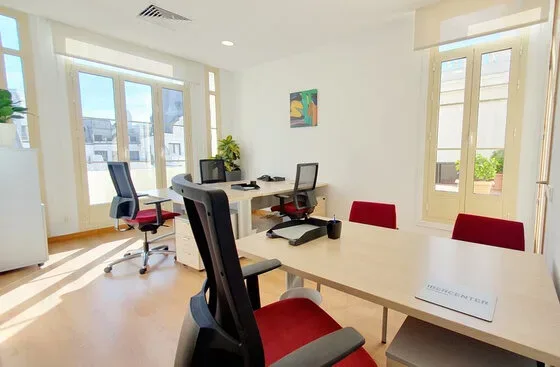
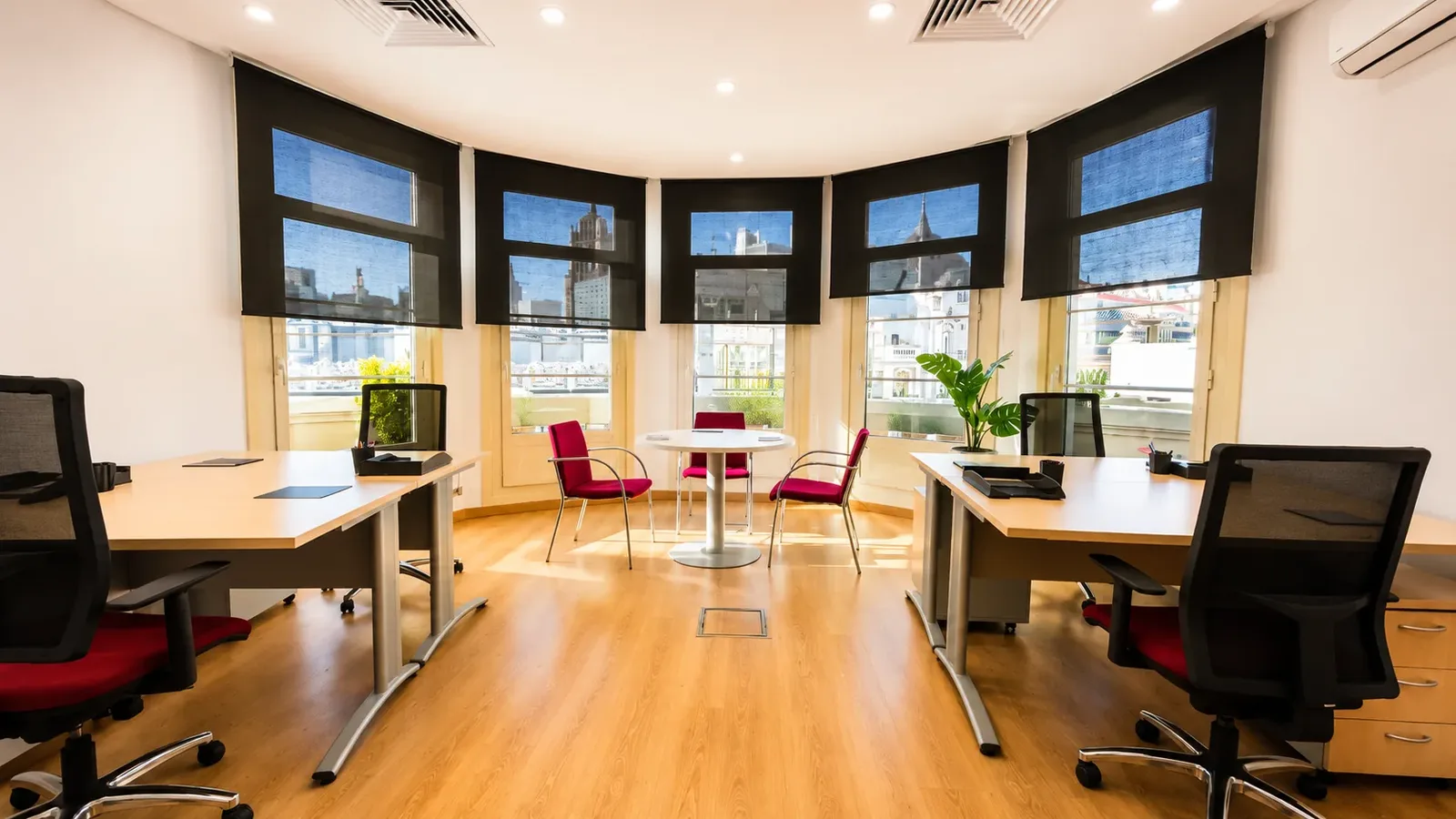
The alternative is a flexible workspace with a fixed monthly fee. In a private office at our Azca, Gran Vía or Velázquez centres, the fee includes furniture, fibre-optic internet, air conditioning, daily cleaning, utilities, maintenance, reception and mail handling, without any initial investment in renovation work. Private offices start at €1,350 per month, depending on the location and number of workstations. For budgeting purposes, the difference is clear: one fixed, known expense instead of a dozen separate items, with the possibility of increasing or reducing workstations if the business scenario changes.
| Item | Conventional office rental | Flexible workspace with a fixed fee |
|---|---|---|
| Initial costs | Deposit, guarantees, renovation work, furniture and network installation | No renovation work or initial furniture investment |
| Monthly fee | Rent plus recharged expenses, utilities, cleaning, internet and maintenance billed separately | One fee with services included |
| Duration | Long-term, with several years of mandatory commitment | Monthly or annual terms, with options to expand or reduce |
| Predictability | Medium: variable and extraordinary expenses | High: amount known in advance |
| Adjustments if staffing changes | Difficult until the contract ends | Workstations can be added or reduced |
| Best suited to | Established companies with stable teams | Growing teams or businesses needing flexibility |
Two additional items are worth considering. If your team works remotely but you need a registered business address and mail reception, a virtual office is the minimum expense required for a business address: our plans range from €40 + VAT per month (Basic) to €90 (Business) and €150 (Premium). And if you only meet clients occasionally, meeting room rental by the hour can be included in the budget as a variable expense linked to actual activity, rather than a fixed cost for space you do not use. For a detailed breakdown, see how much a flexible office costs in Madrid.
How should investments, taxes and contributions be included in the annual budget?
Investments (equipment, machinery, vehicles, software and renovation work) belong in a separate section from operating expenses: for accounting purposes, they are depreciated or amortised over several years, but from a cash flow perspective they are paid in one instalment or a few payments. Mixing them with monthly expenses distorts operating results; forgetting them puts pressure on cash flow. For each investment, record the amount, payment month and financing method.
Taxes and contributions deserve their own section in the annual budget, with a payment calendar. For a company whose financial year coincides with the calendar year, the usual schedule includes quarterly VAT (Form 303), filed in April, July and October, with the fourth quarter filed in January; withholding tax on employees and professionals (Form 111) and, if you rent premises, rental withholding tax (Form 115), generally filed quarterly by most SMEs; Corporate Income Tax instalment payments (Form 202), during the first twenty calendar days of April, October and December; and the annual Corporate Income Tax return (Form 200), filed in July by companies whose financial year ends on 31 December.
If you are self-employed, the schedule is different: quarterly Personal Income Tax (IRPF) instalment payments (Form 130 under the direct assessment system), the annual income tax return in spring and monthly self-employed Social Security contributions. Under the system based on actual income, these contributions depend on expected net earnings and are subsequently adjusted. The exact deadlines are published each year in the Spanish Tax Agency's taxpayer calendar. Once the calendar for the new financial year is published, it is advisable to transfer the deadlines to your monthly cash flow forecast.
Regarding tax rates, the standard Corporate Income Tax rate is 25%, with reduced rates for microenterprises and small companies that are being progressively lowered under transitional arrangements. As tax legislation changes frequently and each company has its own circumstances, this section is for guidance only: verify the calendar and amounts with your tax adviser before finalising the annual budget.
One important detail: the VAT you collect is not your income; it belongs to the tax authorities. Budget sales excluding VAT, but include VAT collected and input VAT in the cash flow forecast, because the balance is paid quarterly.
How can you plan monthly cash flow and a financial safety buffer?
An annual budget can show a profit and still leave your business without sufficient liquidity in a particular month. The reason is that revenue is invoiced at one point and collected later, while salaries, contributions and taxes have fixed payment dates. That is why, in addition to a budgeted profit and loss statement, you need a month-by-month cash flow forecast: opening balance, expected receipts, expected payments and closing balance.
For the cash flow forecast to be realistic, use your customers' actual payment terms, not merely the dates shown on invoices: if customers pay after an average of 60 days, revenue invoiced in January will be collected in March. Apply the same approach to payments: suppliers, additional salary payments if not distributed across the year, quarterly VAT and tax instalments. Months in which several major payments coincide are the ones that must be identified in advance.
The financial safety buffer is the minimum cash balance you decide never to fall below. There is no universal figure, but in our experience, a prudent reference for service-based SMEs is to cover between three and six months of fixed costs, with a larger buffer for businesses that are more seasonal or depend heavily on a small number of customers. If your forecast shows that cash will fall below that threshold in any month, you have time to act: accelerate collections, postpone an investment, negotiate a credit facility or reduce fixed costs by converting expenses such as workspace into more flexible monthly fees.
What structure should an annual budget template have?
A good annual budget template has rows organised from top to bottom according to the logic of the profit and loss statement, and columns that allow comparison and monitoring.
The rows should include revenue by business line and total revenue; variable costs; gross margin; fixed costs broken down by item; operating profit; and, below these, investments, taxes and contributions, and cash flow. The columns should include the estimated year-end results for the current year, the following year's budget, the difference between the two and the twelve months of the new financial year.
The following example shows the annual section of a template, using hypothetical figures for a service-based SME with five employees. The twelve months would then be displayed in additional columns, allocating each item according to seasonality rather than simply dividing by twelve:
| Item (hypothetical example) | Estimated 2026 year-end | 2027 budget | Change | 2027 monthly average |
|---|---|---|---|---|
| Recurring services | €330,000 | €360,000 | +9.1% | €30,000 |
| One-off projects | €95,000 | €90,000 | −5.3% | €7,500 |
| Total revenue | €425,000 | €450,000 | +5.9% | €37,500 |
| Variable costs | €65,000 | €67,500 | +3.8% | €5,625 |
| Gross margin | €360,000 | €382,500 | +6.3% | €31,875 |
| Staff (salaries and Social Security) | €238,000 | €252,000 | +5.9% | €21,000 |
| Workspace (fixed fee) | €19,200 | €19,200 | 0.0% | €1,600 |
| Software, telephone services and subscriptions | €6,600 | €7,200 | +9.1% | €600 |
| Marketing and sales | €15,000 | €18,000 | +20.0% | €1,500 |
| Professional advice, insurance and banking | €9,000 | €9,600 | +6.7% | €800 |
| Other general expenses | €6,200 | €6,000 | −3.2% | €500 |
| Total fixed costs | €294,000 | €312,000 | +6.1% | €26,000 |
| Operating profit | €66,000 | €70,500 | +6.8% | €5,875 |
Two design recommendations are worth following. First, separate assumptions (prices, conversion rates, variable cost percentages and salary increases) from calculations in different spreadsheet tabs, so that changing an assumption updates the entire annual budget without modifying formulas. Second, add twelve columns for actual figures and one for variances alongside the twelve budgeted months: the same template will serve both planning and monitoring purposes.
How should you monitor the budget monthly, and when should you adjust it using rolling forecasts?
Monitoring is what turns an annual budget into a management tool. Every month, once the accounts have been closed (usually during the first half of the following month), compare budgeted and actual figures item by item, calculating the variance in euros and as a percentage. A long meeting is not necessary: with half an hour and a well-designed template, you can identify what has changed and why.
| Item, March (hypothetical example) | Budget | Actual | Variance | Variance % |
|---|---|---|---|---|
| Total revenue | €37,500 | €33,800 | −€3,700 | −9.9% |
| Variable costs | €5,625 | €5,100 | −€525 | −9.3% |
| Staff | €21,000 | €21,000 | €0 | 0.0% |
| Workspace | €1,600 | €1,600 | €0 | 0.0% |
| Marketing and sales | €1,500 | €2,300 | +€800 | +53.3% |
| Operating profit | €5,875 | €1,900 | −€3,975 | −67.7% |
In this example, the remaining items are in line with the budget. What matters is not the figure itself, but the explanation: has revenue fallen because a project was postponed until April, or because a customer was lost? Is the additional marketing expenditure a one-off or will it continue? Set thresholds, for example analysing only variances above 10%, and always record the cause and the action decided.
When variances stop being isolated events, it is time to adjust the forecast. Rolling forecasting means keeping the approved annual budget as a reference while updating the forecast for the remaining months every month or quarter using the information now available. Some companies always extend their forecast twelve months ahead so that they do not lose visibility as year-end approaches.
We recommend reviewing forecasts at least quarterly and conducting an additional review when major changes occur: losing an important customer, making an unplanned hire or moving offices.
What common mistakes should you avoid when preparing an annual budget?
The most common mistake is systematic optimism: projecting the sales you would like to achieve rather than those supported by historical data, while calculating expenses accurately. The result is an annual budget that is unrealistic from the outset and that the team stops taking seriously by March. The solution is straightforward: use scenarios, actual conversion rates and a critical review by someone who did not prepare the figures.
The second mistake is dividing everything by twelve. Sales are seasonal, taxes are paid quarterly and some investments require large one-off payments. A flat monthly budget hides precisely those months that are most challenging for cash flow. The third mistake is overlooking expenses: software licence renewals, salary increases under collective agreements, inflation-linked adjustments, annual insurance premiums or equipment replacement.
Other mistakes we frequently encounter include:
- Confusing profit with cash and failing to prepare a monthly cash flow forecast.
- Not allocating a separate budget item for taxes and reaching a quarterly VAT payment deadline without sufficient liquidity.
- Committing to long-term fixed costs, such as an office lease with several years of mandatory commitment, based on the optimistic scenario.
- Preparing the budget and not opening it again until the following year.
- Failing to involve department managers in preparing their respective figures.
Which tools should you use: a spreadsheet or management software?
For most SMEs and self-employed professionals with small teams, a well-structured spreadsheet is sufficient. It is flexible, familiar to most users and allows you to build a customised template with tabs for assumptions, budgeted figures, actual results and variances. Its main weakness is dependence on the person maintaining it and the risk of formula errors, so it is advisable to protect calculation cells and save dated versions.
As the business grows, management software offers clear advantages. Accounting programs and ERP systems usually include budgeting modules that draw on accounting data, allowing budget-versus-actual comparisons to update automatically. Financial planning tools are also available that connect to bank accounts and simulate cash flow scenarios. When choosing a solution, consider its integration with your accounting system, its scenario planning capabilities and whether your accounting adviser can access it easily.
Whatever tool you choose, the method matters more than the software. A simple annual budget reviewed every month is more valuable than a sophisticated model that nobody updates. We recommend starting with a spreadsheet, establishing a consistent monitoring routine over one financial year and only then considering software that automates repetitive tasks. And the more expenses you convert into predictable monthly fees, the easier budget monitoring becomes.
Frequently asked questions about annual business budgets
What is the difference between an annual budget and a cash flow forecast?
An annual budget records the revenue, expenses, investments and taxes for the financial year according to when they are recognised, producing a forecast profit or loss. A cash flow forecast looks at when money actually enters and leaves the business, month by month. A company needs both: it may show a budgeted profit and still run out of cash in a particular month because of payment terms or the concentration of outgoing payments.
When should an annual budget be prepared?
Ideally, between October and November of the preceding year, when nine or ten months of actual data are already available and there is still time to make decisions before January. If the financial year does not coincide with the calendar year, preparation should begin two or three months before the year-end date.
Which items must be included in an SME's annual budget?
Revenue by business line, variable costs, staff costs including employer Social Security contributions, workspace, software and utilities, professional advice, insurance and banking, marketing, investments, taxes and contributions with their payment schedule, and a monthly cash flow forecast with a minimum cash buffer.
How are conservative, realistic and optimistic scenarios calculated?
Start with the realistic scenario, based on historical data and sales targets, then apply a reasonable reduction for the conservative scenario and an improvement for the optimistic one. Variable costs are recalculated as a percentage of sales in each scenario, while fixed costs remain unchanged, showing how much operating profit is affected when sales fall.
How often should an annual budget be reviewed?
Monitoring should take place monthly, comparing budgeted and actual figures as soon as the month's accounts are closed. The forecast for the remaining months should be updated at least quarterly through rolling forecasting, and additionally whenever significant changes occur, such as losing an important customer or moving offices.
How should office costs be budgeted?
With a conventional lease, you must add rent, recharged expenses, utilities, cleaning, maintenance, insurance and internet, as well as initial costs (deposit, guarantees, renovation work and furniture). With a flexible workspace, a fixed monthly fee covers the included services. If you do not need physical space, a virtual office provides a business address, while meeting rooms rented by the hour can be budgeted as a variable expense.