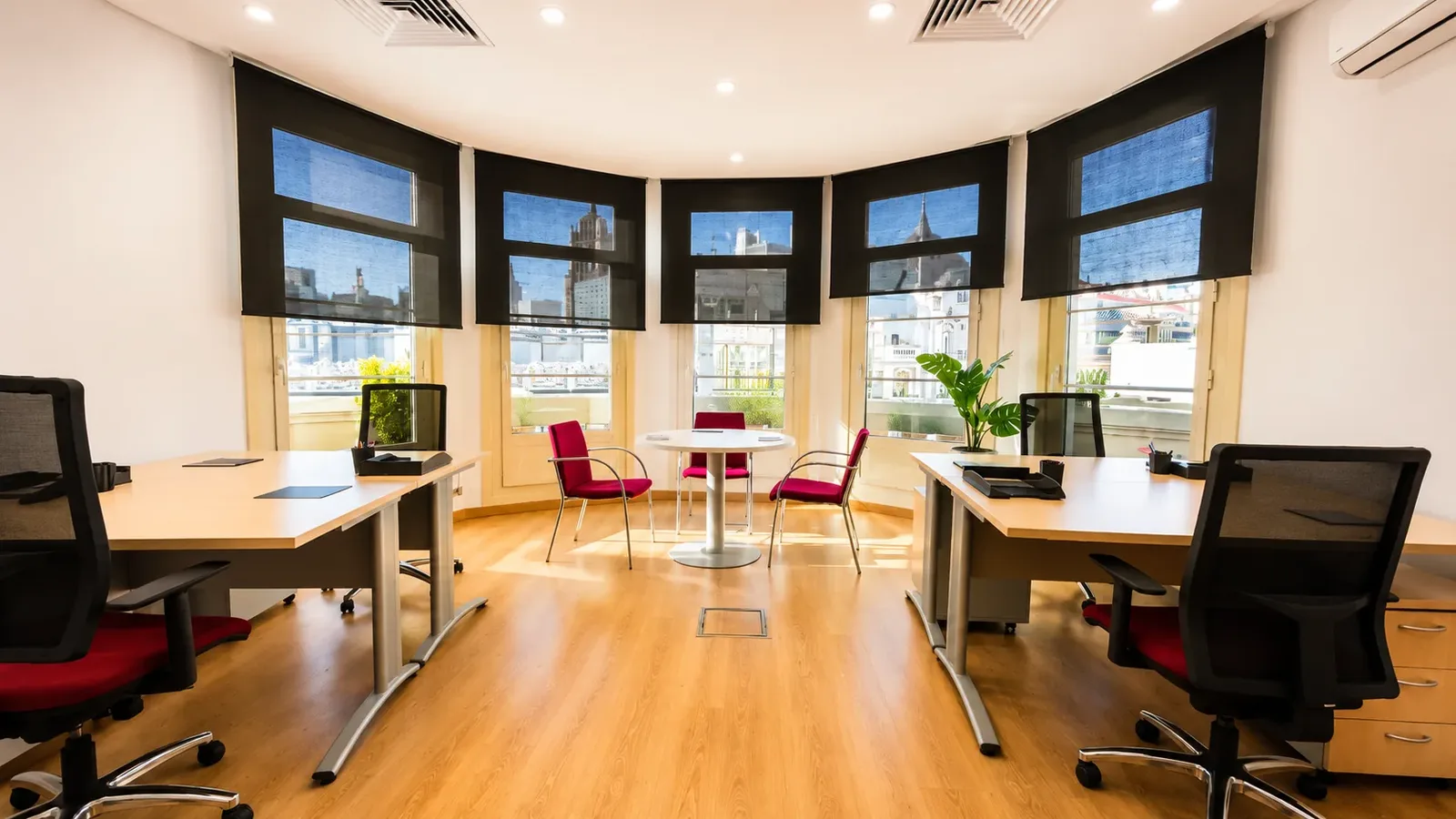
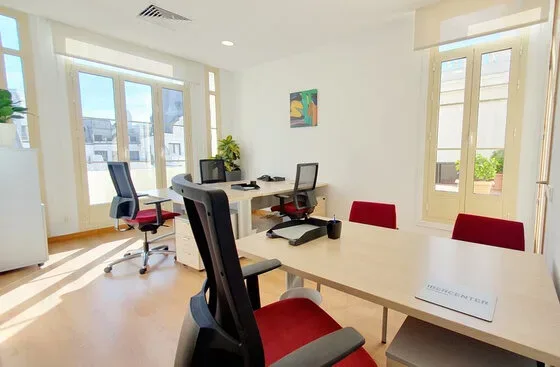
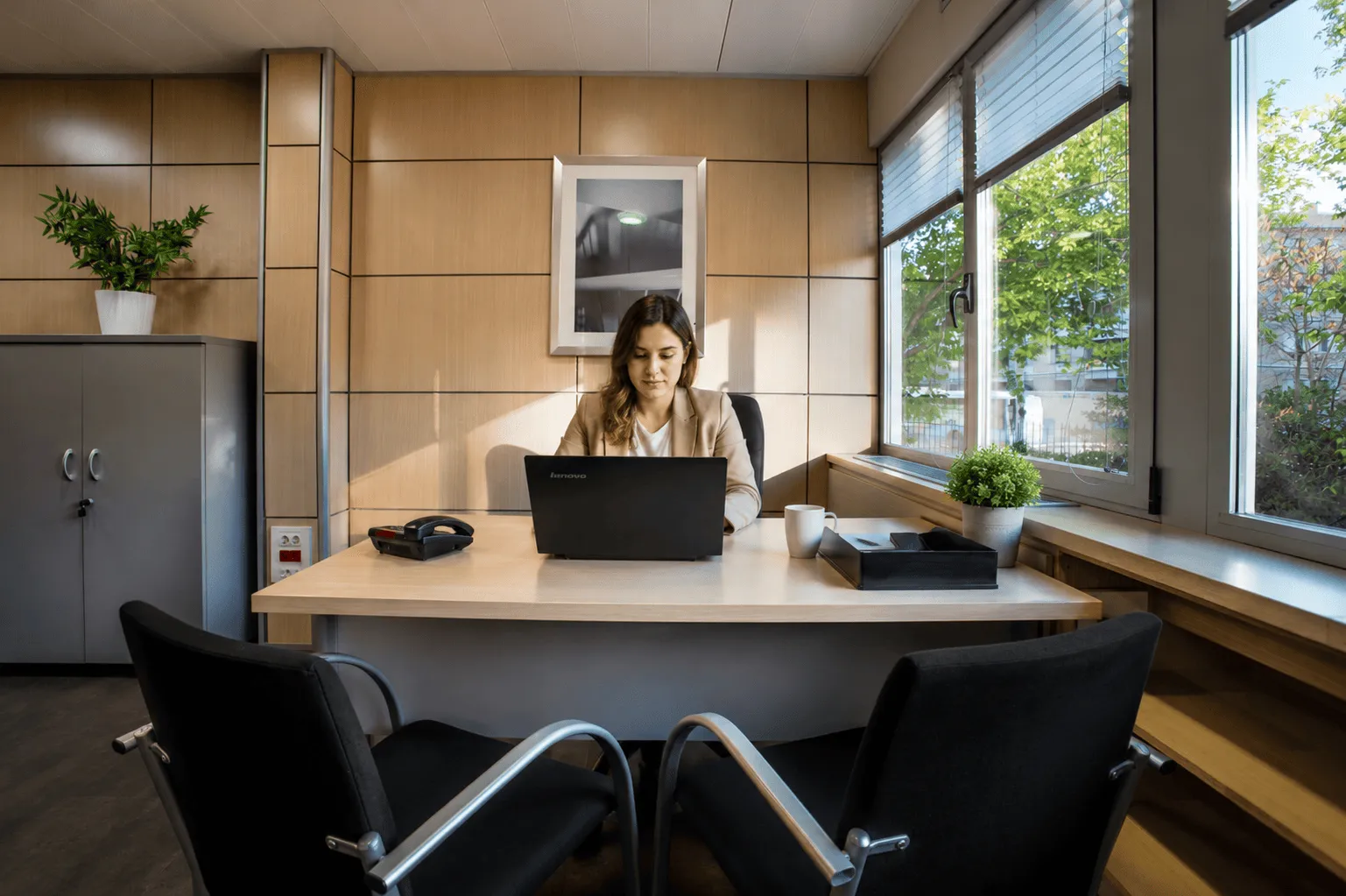
Coworking Trends 2026: Flexible Offices in Madrid
Discover the key coworking trends shaping 2026: flexible contracts, hybrid work, workplace wellbeing, AI and technology, sustainability, premium services and professional communities, and how they are transforming flexible offices in Madrid.
TL;DR
Coworking in 2026 is no longer a low-cost alternative for freelancers, but the way companies of all sizes meet their workspace needs without committing to long-term contracts. The seven trends defining the year are clear: genuine contractual flexibility, the consolidation of hybrid work, wellbeing-focused design, technology and artificial intelligence in workspace management, certified sustainability, premium services that remove friction, and community as a differentiating value. Private offices within flexible workspaces have become the leading product, ahead of shared desks.
For a company looking for a base in Madrid, understanding these trends matters because they are changing what businesses should expect from a workspace: a central location, contracts without lengthy commitments, rooms equipped for hybrid meetings and a corporate image that conveys solidity. In our experience with our Azca, Gran Vía and Velázquez locations, the decision is no longer "private office or coworking", but rather which combination of flexibility, privacy and services best suits each stage of a business. This analysis explores coworking trends in 2026 and looks ahead to what can be expected in 2027.
What is changing in offices and coworking in 2026?
The fundamental change is one of perception. For years, coworking was associated with shared desks, an informal atmosphere and low entry prices. That image is now outdated. Coworking in 2026 is, above all, a flexible office model used by established companies as their main headquarters, as a satellite workspace or as a solution while they decide on their long-term real estate strategy.
Industry data confirms this. According to the Radiografía del sector de coworking y oficinas flexibles en España, prepared by JLL together with the Spanish Coworking Association, based on a sample of 181 spaces and more than 304,000 square metres across 20 cities, industry turnover is expected to grow by around 15.8% in 2026. This is not the growth of a niche market, but of a format that has become mainstream.
The same report reveals a figure that sums up the transformation of coworking in 2026: private offices within flexible workspaces now account for 54% of the total area and generate close to 75% of revenue among large operators, with stable occupancy rates of around 80%. Individual shared desks, the classic image of coworking, have lost ground and their occupancy rate is around 50%. In other words, companies want the flexibility of coworking, but with the privacy and image of a private office.
Why has flexibility become the norm in coworking in 2026?
Flexibility has gone from being an advantage to becoming a requirement. No company negotiating its workspace today readily accepts a traditional five-year lease with fit-out costs at its own expense and substantial bank guarantees. Economic uncertainty, changes in headcount and the speed at which projects evolve are driving demand for shorter, scalable contracts. This is the first of the coworking trends in 2026 and the one underpinning all the others.
Flexibility means several things at once. It means being able to contract space for days, months or years without disproportionate penalties. It means being able to grow from two to ten workstations without changing location or renegotiating the entire contract. And it means a single monthly fee that includes utilities, cleaning, maintenance, reception and internet, without setup fees or technical charges appearing later. This transparency is now as important a decision-making factor as price.
Flexibility is no longer measured solely by the length of the contract, but by a workspace's ability to accommodate the growth or contraction of a company without friction or hidden costs.
For many organisations, the answer lies in combining different formats. A team can have a private office as its base and book additional rooms only on the days when they are needed. This "pay for what you use" approach is behind the rise of office rental by the hour and meeting room rental, allowing companies to align expenditure with actual use. In coworking in 2026, flexibility is both contractual and operational.
How has hybrid work consolidated the flexible office model?
Hybrid work is the structural force that explains why coworking is growing in 2026 while the traditional office model is being questioned. Five years after remote working was regulated in Spain, the hybrid model is no passing trend, but the standard way of organising office work across a significant number of sectors.
Official figures show a model that has stabilised rather than declined. According to INE remote-working data, in 2025, 14.8% of employed people aged between 16 and 74 had worked remotely during the week prior to the survey, while 7.9% had done so for more than half of their working days. In total, more than 3.2 million people work remotely in Spain, a figure approaching 3.5 million when those who do so occasionally are included, with an average of close to three days per week spent in the office. That balance —neither five days in the office nor fully remote working— is precisely what flexible coworking addresses best.
When employees go to the office two or three days a week, maintaining underused square metres for the rest of the time no longer makes economic sense. The hybrid office is being redesigned: fewer fixed desks, more meeting rooms, more collaboration areas and smarter occupancy management. That is why, among coworking trends in 2026, demand for well-equipped hybrid meeting spaces —with good audio, cameras and screens— is growing faster than demand for individual workstations. The office is becoming a place people go to do what cannot be done at home: meet, make decisions and create as a team.
What role do design and wellbeing play in offices in 2026?
If working in the office has become optional, the office has to be worth the journey. This is the logic that has placed design and wellbeing at the heart of coworking trends in 2026. Simply lining up desks and chairs is no longer enough: the space must support concentration, allow private conversations and convey an image that reflects the standards of the company occupying it.
In practice, this translates into very specific decisions. Plenty of natural light, because it directly affects mood and productivity. Proper acoustic treatment, because noise is the number one complaint in shared spaces. Separate areas for focused work, calls and collaboration. Ergonomic furniture, air quality and a stable temperature. Wellbeing has ceased to be a marketing extra and has become a criterion for selecting a workplace.
This priority is also reflected in building certification. International standards such as WELL, focused on the health of the people using the space, and LEED, focused on the building's environmental performance, have become important factors for companies with ESG strategies. A certified building not only consumes less and generates less pollution: it demonstrates to clients and employees a tangible commitment to wellbeing and sustainability.
For occupiers, design and wellbeing have a direct effect on talent retention. A well-designed working environment helps attract and retain professionals at a time when many employees value workplace conditions almost as much as salary. In our experience, the perceived quality of a location —from reception to meeting rooms— increasingly influences the decision of a company seeking to project solidity without giving up flexibility.
How are technology and AI transforming workspaces?
Technology, together with flexibility, is the trend that is redefining the coworking experience most significantly in 2026. High-speed connectivity and cybersecurity are now taken for granted; what is new is how intelligent management and artificial intelligence are optimising the use of space and services.
At the management level, flexible workspaces are incorporating applications for booking rooms and workstations in real time, controlling access from mobile devices, managing visitors and measuring the actual occupancy of each area. This data makes it possible to adjust supply to demand: identifying which rooms reach capacity, at what times and with what equipment, in order to size the space more effectively. AI is beginning to be used to anticipate needs —suggesting the most suitable room based on the number of attendees, for example— and to automate administrative tasks that previously occupied reception staff.
For companies using these spaces, the impact goes beyond the building itself. Artificial intelligence has become integrated into the daily work of consultancies, professional firms and marketing teams, and this changes what they need from their office: less physical storage, more bandwidth, more rooms for high-quality video calls and more technological support. A workspace without solid digital infrastructure is no longer competitive. Among coworking trends in 2026, technology is not an add-on, but the foundation on which flexibility and services are built.
It is important, however, to remain realistic about expectations: AI optimises management and removes friction, but it does not replace the human relationships that sustain a professional community. The most successful spaces combine a strong technological layer with a human team that solves problems, welcomes people and provides support. This balance between automation and personal service is one of the less visible, but most decisive, factors of the year.
Why is sustainability no longer optional in coworking in 2026?
Sustainability has gone from being an added value to becoming a market requirement. Companies, driven by their own ESG policies, regulation and the expectations of clients and investors, are looking for workplaces that reduce their footprint and can demonstrate this with data. This is one of the coworking trends in 2026 that is changing workspace selection criteria most rapidly.
Coworking has an advantage in this area. Sharing infrastructure —reception, meeting rooms, kitchens and climate-control systems— reduces consumption per company compared with each organisation maintaining its own underused office. Building energy efficiency, the use of renewable energy, waste management and low-impact materials in refurbishment projects have become common questions during workspace negotiations.
Location also contributes to sustainability. A centrally located office with good public transport connections reduces car journeys for employees and helps support work-life balance. Sustainability in coworking in 2026 is measured not only by a building's certification, but also by how it fits into the city. Locating an office in areas such as Azca, Gran Vía or the Salamanca district, with metro, commuter rail and bus services on the doorstep, is also a sustainable decision.
What are premium services and why do they make a difference?
The fourth major trend is the professionalisation of services. As coworking attracts more established companies, the range of services has expanded to resemble that of a business centre more than an informal workspace. Premium services are now one of the areas where much of the differentiation in coworking in 2026 takes place.
What is meant by premium services? Professional reception that welcomes visitors and handles calls on behalf of the company, mail and parcel management, bookable and fully equipped meeting and training rooms, catering for events, administrative support and telephone answering services, together with a carefully managed corporate image from start to finish. All of this is included within a predictable fee, with no surprises. Virtual offices and business address services are the gateway to this range of services for companies that do not yet need physical workspace but do require a prestigious address and professional management of their correspondence.
For clients, the value of these services lies in the time they free up. A small company that outsources reception, maintenance and office logistics can focus its resources on its business rather than managing premises. That is the underlying promise of the model: you choose how you want to work and the centre makes sure everything runs smoothly. The following table summarises how service expectations have evolved.
| Aspect | "Classic" coworking (a few years ago) | Coworking in 2026 |
|---|---|---|
| Main product | Shared desk in an open-plan area | Private office within a flexible workspace |
| Contract | Monthly, limited scalability | By days, months or years, scalable and without long-term commitments |
| Services | Wi-Fi, coffee and little else | Reception, equipped rooms, virtual office, business address, telephone answering services |
| Client profile | Self-employed professionals and freelancers | Self-employed professionals, SMEs, subsidiaries and large companies with satellite offices |
| Design | Informal, startup atmosphere | Corporate-premium, with a focus on wellbeing and acoustics |
| Technology | Internet connection | Intelligent management, real-time bookings, applied AI |
How important are community and networking in coworking in 2026?
Although private offices are gaining ground, community remains a differentiating factor. The difference compared with renting an isolated office lies precisely in the environment: sharing a building with other companies creates opportunities for business, collaboration and learning that a standalone office cannot provide. Community is one of the coworking trends in 2026 that continues to thrive despite the growing demand for privacy.
However, the concept of community has matured. It is no longer so much about constant social events as it is about valuable professional connections: access to suppliers, potential clients, partners and talent within the same space. For a foreign subsidiary establishing itself in Spain, a consultancy looking for clients or a startup seeking to surround itself with other professionals, this ecosystem is a genuine asset. Well-designed networking saves time and opens doors.
Community also provides a less obvious benefit: it combats the isolation of remote working. Many professionals who could work from home choose a shared workspace precisely because of the human contact, routine and separation between their personal and professional lives. This human factor, difficult to replicate in a home environment, explains why coworking in 2026 continues to attract people who have the option to work remotely but still prefer an office.
How do you choose a coworking space in Madrid that reflects these trends?
Understanding trends is of little use unless they translate into decision-making criteria. To choose a coworking space in Madrid that is aligned with the direction of coworking in 2026, it is useful to organise the decision around five questions: location, contract flexibility, quality of the space, included services and the ability to grow without changing location.
Location remains a determining factor, and not all areas are equivalent. A workspace in Azca, close to Castellana and Nuevos Ministerios, connects a company with the city's financial district; a location on Gran Vía, right in the centre, offers prestige and accessibility; and the Salamanca district, in Velázquez, conveys the solidity sought by professional firms and international companies. Choosing an area means choosing the image the company projects and how easily clients and employees can reach the office. In our experience, this decision influences everything else.
On that basis, flexibility and services determine whether the space is the right fit. It is advisable to check that the contract allows the number of workstations to be increased or reduced without renegotiating everything, that the fee is transparent and that meeting rooms are equipped for hybrid meetings. Depending on the stage of each company, the solution may be a private office as its headquarters, a combination of flexible office space with bookable meeting rooms, or starting with a virtual office and moving into physical space when the time is right. What matters is that the workspace supports growth rather than limiting it.
What can we expect from coworking and offices in 2027?
Looking ahead, coworking trends in 2026 point towards even greater consolidation in 2027. Large operators are clear about this: according to the aforementioned report by JLL and the Spanish Coworking Association, around 58.8% of those managing spaces of more than 2,000 square metres in central areas of Madrid and Barcelona plan to open new centres or expand their offering. Expansion is not stopping; it is becoming more refined.
Three main developments are expected. First, geographical expansion beyond Madrid and Barcelona, with growth in cities such as Valencia, Málaga and Alicante. Second, even deeper integration of artificial intelligence into workspace management and the user experience. And third, increasing convergence between coworking, traditional offices and business centre services, until the labels become less important and what matters is the degree of flexibility, service and quality each company contracts.
By 2027, the boundaries between "coworking", "flexible office" and "business centre" will become increasingly blurred. Clients will not buy a format with a particular name, but rather a combination of location, flexibility, image and services tailored to their stage of development. Companies that understand and take advantage of coworking trends in 2026 will be better prepared for this scenario, with offices that can grow, shrink or relocate without friction. It should be remembered, however, that industry forecasts may vary depending on economic developments and should be considered alongside the situation in each market at the time a decision is made.
Frequently asked questions about coworking trends in 2026
What are the main coworking trends in 2026?
The seven trends defining coworking in 2026 are genuine contractual flexibility, the consolidation of hybrid work, wellbeing-focused design, technology and artificial intelligence in workspace management, certified sustainability, premium services and professional community. The common denominator is that coworking is no longer a low-cost option and has become a way for companies of all sizes to meet their workspace needs.
Is coworking still only for freelancers and startups?
No. One of the most significant changes in coworking in 2026 is that established companies, SMEs and subsidiaries of foreign companies use these spaces as their main headquarters or as satellite offices. In fact, private offices within flexible workspaces have become the dominant product, ahead of the shared desks traditionally associated with coworking.
Why is hybrid work driving coworking?
Because when employees come into the office two or three days a week, maintaining fixed, underused square metres is no longer cost-effective. Flexible coworking allows companies to pay for the space they actually use, increase or reduce the number of workstations easily and access rooms equipped for hybrid meetings. According to the INE, more than 3.2 million people work remotely in Spain, with an average of close to three days per week spent in the office.
What role does artificial intelligence play in offices?
AI optimises workspace management: real-time room bookings, access control, occupancy measurement and the automation of administrative tasks. It also changes what companies need from their offices, with greater bandwidth and more rooms for high-quality video calls. Technology reduces friction, but it does not replace the human team that sustains the community.
Is coworking more sustainable than a traditional office?
Generally, yes, because sharing infrastructure reduces consumption per company compared with maintaining an underused private office. This is complemented by building energy efficiency, the use of renewable energy and a well-connected central location that reduces car journeys. Many buildings demonstrate their commitment through certifications such as WELL or LEED.
How do I choose a coworking space in Madrid that reflects these trends?
Structure the decision around five criteria: a well-connected location with the right image, contract flexibility and transparency, the quality of the workspace and its design, included services and the ability to grow without changing location. In Madrid, areas such as Azca, Gran Vía and the Salamanca district combine prestige and accessibility, key factors within coworking trends in 2026.