Individual executive office in central Madrid: when you need it and what it costs in 2026
TL; DR
An individual executive office in the centre of Madrid is a private, closed and equipped office for a single person, located in a representative building on the Castellana-Serrano-Genoa-Recoletos axis and managed under a flexible service contract that includes reception, meeting rooms, connectivity and professional address. In 2026 the reasonable price range for an individual executive office in central Madrid is between 950 and 2,400 euros per month depending on the building, meters, orientation and level of services; below there is usually a commitment in location or confidentiality and above that the brand of the property is already being paid more than product. This article explains which profiles need it, which areas concentrate the serious offer, what services should be included, where the most common mistakes are and when moving from home to the office has a real return.
What exactly is an individual executive office and how is it different from a shared office?
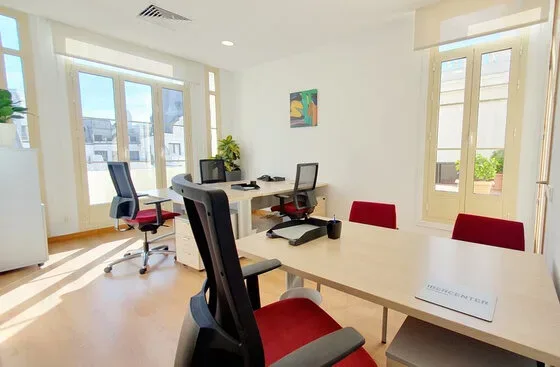
An individual executive office is a private physical space, with a closed door, managerial furniture and capacity for one person (sometimes two with a one-off visit), integrated within a business center that provides common infrastructure: attended reception, bookable meeting rooms, corporate-level connectivity, secretarial services, coffee room and tax domiciliation. The critical difference compared to a shared office is not only in having walls: it is in the contract, in the confidentiality and in the representativeness of the environment. In an individual executive office in Madrid center, the user controls who enters, what is heard and what is seen; In a shared office, that border disappears.
When Ibercenter receives an executive office consultation, the first question asked is not how many meters the professional needs, but what conversations he or she is going to have there. An M&A consultant who talks about purchase and sale transactions, a law firm partner who handles sensitive litigation or a manager in a transition period cannot work in a space where the neighbor listens to the calls or where the client crosses an open space to get to the meeting. An individual executive office is designed precisely to shield that conversation: acoustic insulation, controlled access and a reception that knows how to receive a visitor without exposing the agenda of the rest of the apartment.
The economic model also changes. A traditional rental office requires a deposit equivalent to two months, an additional bank guarantee, a long-term contract (usually five years with partial resignation), connections on behalf of the tenant and all the capex of furniture and technology. An individual executive office in a business centre comes under a service contract with a short term – between three and twelve months in most premium operators in the centre of Madrid – without capex and with all supplies and cleaning included. For a professional who bills for his time, the savings are not in the price per meter but in not having to manage the building.
Which professional profiles are best suited to an individual executive office in the centre of Madrid?
The first profile that fits naturally with an individual executive office is that of the independent senior consultant. He has usually come out of a large firm – strategic consulting, investment banking, auditing, financial management of a multinational – and has set up his own practice. You invoice high tickets, your customers are corporate and you need a place to receive them that is at the level of the interlocutor. That professional cannot receive at home or in a hotel cafeteria because the client reads the environment as part of the proposal. An executive office in the centre of Madrid offers you just that: a recognisable address, an adjoining meeting room and a reception that treats you as a partner, not as a coworking user.
The second profile is the executive in transition or the interim manager. In Madrid there is a lot of movement in the C-level layer: CEOs who leave a company and start a new stage, general managers who take on interim mandates in companies owned by funds, former executives who begin to set up boards. They all share a pattern: they need a professional operating base for six or twelve months, without committing to signing a traditional lease. A Madrid executive office fits because it is scalable – entering and leaving with short notice – and because the representativeness of the building allows them to maintain the level to which their interlocutors are accustomed.
The third profile, which is increasingly common, is that of the liberal professional specialising in sensitive matters: criminal or family lawyer, mediator, executive coach, high-end clinical psychologist, wealth advisor. All of them handle confidential information where sound insulation and discretion of reception are requirements, not advantages. This is also where the international consultant comes in, who needs a base in Madrid because his Spanish client requires a physical presence – compliance guidelines, work sessions with local teams, due diligence interviews – but whose real headquarters are in another European capital. This profile intersects with the operational one that is explained in depth in the specific analysis of , where the confidentiality requirement is even stricter due to deontological duty.
In which areas of central Madrid should you look for an executive office and why?
Madrid centre for executive use is not all Madrid centre. The relevant axis is a very specific quadrilateral formed by Paseo de la Castellana, Recoletos, Génova, Serrano and the perpendicular streets that connect them. Outside this perimeter, part of the value that justifies paying for an executive firm is lost: the proximity to corporate headquarters, law firms, private banking, family offices and international consulting firms that are —at the same time— the natural ecosystem of the client and the competitor. An office ten minutes walk from the Castellana does not compete with one in the Castellana itself in the perception of a corporate interlocutor.
Within the axis, each area has a recognizable identity that should be understood before deciding. La Castellana Alta – the stretch between Colón and Cuzco – is the area most associated with corporate, banking and strategic consulting; buildings such as Torre Europa, Castellana 200 or Serrano Galvache project a very formal image. La Castellana baja and Recoletos – between Cibeles and Colón – combines the institutional (embassies, ministries, employers' associations) with the legal and professional services sector. The Salamanca neighbourhood in its Serrano-Velázquez-Ortega y Gasset strip is home to elite law firms, wealth managers and boutique consultancies, and has a more discreet character than the Castellana. Génova and its surroundings have a high weight in consultancies, family offices and institutional communication firms.
The choice of area should follow the customer portfolio. A consultant who works with IBEX companies will get more performance from a firm in the Castellana axis; a wealth advisor whose client lives in the Salamanca neighbourhood gains proximity by staying in Serrano-Velázquez; a business lawyer who combines meetings with the court and with corporate can benefit from the Genoa-Recoletos mix. When these criteria are crossed with the very practical requirement of road access and parking – important if the customer comes by car, it can be developed as detailed in – the reasonable perimeter is quite narrow. As a useful external reference, CBRE Madrid's quarterly office market reports allow us to follow how demand moves within this central axis.
What services do an executive expect to find in a premium law firm in the centre of Madrid?
The first block of services that a professional who pays for a premium executive office takes for granted is that of reception and visitor service. That means reception attended by people – not by tablet – at least from 8:30 a.m. to 7:00 p.m., capable of receiving the customer by name, offering them coffee or water, notifying the executive discreetly and managing courier and parcels without interruption. That detail, which seems minor, is what makes the client perceive the firm as a professional extension of the manager. A business center where the visitor arrives at an empty counter breaks that perception in the first minute.
The second block is the technical infrastructure and spaces. It should include symmetrical dedicated fiber connectivity with backup line, segmented professional Wi-Fi network with separation between guests and occupants, structured cabling in case the user prefers ethernet, and bookable meeting rooms of at least two types – one of four to six people for close negotiation and another of eight to twelve for presentations or committees. In an individual executive office in central Madrid, it is common to have a monthly quota of room hours included in the quota, plus the possibility of contracting additional hours with transparent billing. The rooms must have videoconferencing with a fixed system and decent audio quality; a TV and HDMI cable are not enough.
The third block is the operational-fiscal one. An executive office should come with the possibility of setting the registered and tax address there – a figure whose complete operation is detailed in -, management of certified mail, electronic notifications and private mailbox. In addition, in premium centres, secretarial services are added on demand, translation support for meetings with international interlocutors, catering for meetings and bar-café service in the common area. The sum of these services is what turns an office into a real job and not a simple rented room.
How much does an individual executive office cost in Madrid center in 2026?
In 2026, the individual executive office market in central Madrid moves, within the Castellana-Serrano-Genoa-Recoletos axis, in a reasonable range of between 950 and 2,400 euros per month according to five very specific variables: building, useful office meters, orientation (interior or with direct natural light), floor plan and level of services included. The low band corresponds to individual offices of 9-12 useful meters, indoor or with medium light, in secondary buildings of the axis. The medium band, between 1,200 and 1,700 euros, groups offices of 12-16 meters with natural light, in recognizable buildings and with full services. The high band, above 1,800 euros, reflects spacious offices on the façade of an iconic building with an expanded service package.
Interpreting these prices requires understanding what is being compared. In a traditional rental, an equivalent office costs less in pure rent but adds up to a real cost when supplies, cleaning, maintenance, insurance, taxes, amortized furniture and the proportional part of a reception and a meeting room are included. When this total calculation is made – as the consulting firm Cushman & Wakefield has been documenting in its reports on Madrid offices – the differential between traditional rental and executive office in a business centre is greatly reduced, and in some cases it is reversed when the occupant is a single person. The price published by a serious center is not "expensive": it is an all-inclusive price that avoids surprises.
The following indicative table summarises the ranges observed in the market in the central axis of Madrid at the beginning of 2026. The amounts are monthly installments excluding VAT and assume a standard service contract with a permanence between 3 and 12 months.
| **Typology of executive office ** | Useful meters | Natural light | Monthly range (€/month) |
|---|---|---|---|
| Standard interior single | 9-11 m² | No | 950-1.200 |
| Single with Medium Light | 10-13 m² | Partial | 1.150-1.450 |
| Single with direct natural light | 12-16 m² | Yes, outside | 1.400-1.850 |
| Large individual on the façade | 14-18 m² | Yes, iconic building | 1.700-2.400 |
| Single room with reserved annex room | 12-15 m² + 6 m² | Yes | 2.000-2.80 |
*"When the occupant is a single person, the differential between traditional rental and executive office in a business center is greatly reduced, and in some cases it is reversed." *
How is an executive office different from a private coworking or a virtual office?
The confusion between executive office, private coworking and virtual office is constant in the market, and a good part of the bad experiences of professionals who "try a coworking" are born from having bought the wrong category for their case. A coworking space, even in its private room version, is designed for teams and for high densities; The economic model depends on putting a lot of people in a short meter. A virtual office, on the other hand, does not offer physical space as a workstation, but a home and some administrative services. An individual executive office is an intermediate product designed specifically for a person who needs a real position, image and confidentiality.
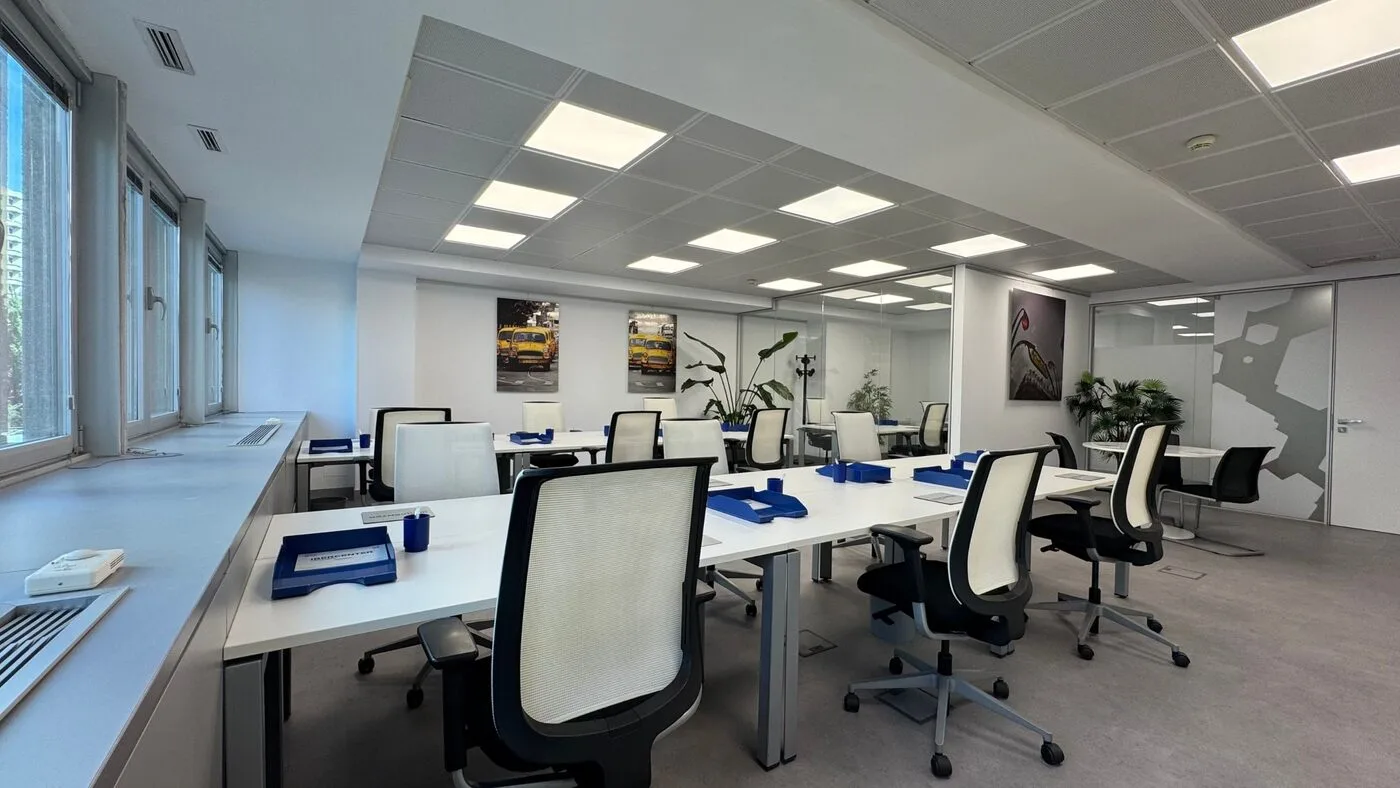
Private coworking makes sense for teams of two to ten people who value community energy, do a lot of collaborative work, and don't receive critical corporate visits. In a private coworking room, you pay per seat and the unit price goes down when you climb. But even in private formats, patterns persist that an executive does not always accept: glass wall towards the open space, entry and exit of people through common areas, variable noise levels and a reception designed for agility, not representativeness. For a professional who bills by the hour advising a board, that environment takes away authority.
The virtual office, on the other hand, is the previous step. It gives commercial and fiscal address, mail management and sometimes specific room hours. It is an excellent solution to start with, to try Madrid as a headquarters or for professionals who work on the road and just need a stable address. When the activity grows and the professional begins to receive clients regularly, it is necessary to make the leap to the physical office. The following table summarizes the operational differences that are usually decisive.
| Appearance | Virtual Office | Private coworking | Individual executive office |
|---|---|---|---|
| Permanent physical position | No | Yes, shared in the room | Yes, exclusive and with a door |
| Acoustic confidentiality | Not applicable | Low-medium | High |
| Fiscal/social domicile | Yes | Usual | Yes |
| Reception of visitors | Limited | Community | Formal and personalized |
| Typical contract | Monthly | 3-12 months | 3-12 months |
| Monthly cost of reference Madrid centre | 60-180 € | 350-700 €/position | 950-2.400 € |
| Ideal profile | Itinerant freelancer | Collaborative small teams | Manager, consultant, professional partner |
What technical and confidentiality requirements must an executive firm meet?
An individual executive office in the centre of Madrid that is sold as such should meet a minimum list of technical requirements that many professionals take for granted and then discover that they are not there. In connectivity, the reasonable reference is symmetrical dedicated fibre with guaranteed minimum throughput, active backup line (usually 4G/5G corporate) and Wi-Fi with at least two SSIDs separating occupants and visitors, with individualised authentication. The network should be segmented by VLAN per tenant, something that is not a luxury but a basic security requirement when sharing a building with other users who handle sensitive information.
In terms of physical confidentiality, there are three elements that should be checked in situ before signing. The first is the actual sound insulation of the door and partitions: you check by asking someone to speak in the adjoining office while you listen from inside. The second is the policy of access to the plant: how the visitor is registered, if there is control by card or key, if the executive can set times when his office is closed even for internal cleaning staff. The third is the reception protocol: if the reception announces the visitor before letting them in, if it has its own waiting room and if it knows how to handle situations where two clients of the same professional should not cross paths at the door.
In terms of data, the business centre should offer basic processing guarantees in line with the GDPR and with the guidelines published by the Spanish Data Protection Agency: a clear policy on recording reception calls, managing visitor data, periodic deletion of records and a data processor contract where applicable. An office that does not know how to answer these questions is not an executive office, it is a room for rent. The operation that is applied in law firms – where these requirements are particularly enforceable – is developed in more detail in .
When does it make sense to switch from working from home to a one-on-one executive office?
Working from home is a legitimate option and in many cases even more productive for background tasks. The right question is not "home or office" but when the hidden cost of working from home exceeds the explicit cost of an executive office. That point comes when at least three signals concur. First: the professional is rejecting or delaying face-to-face meetings because they have nowhere to receive with dignity. Second: the conversation with customers or partners begins to mix with domestic noise – children, construction sites, doorbell – and that is affecting their perception. Third, the line between personal and professional life has been blurred to a level that is beginning to be untenable.
There is a fourth, less discussed signal, which is usually the most important in senior profiles: the reputational effect on recruitment. A consultant who wants to sell himself to a listed company cannot appear in the proposal with a residential development address; a lawyer specializing in corporate operations cannot receive the CFO in the living room; A wealth advisor cannot meet their client in the hotel cafeteria. In these cases, the executive office is not an optional expense: it is the asset that sustains the commercial proposal. A consulting firm in the centre of Madrid is paid only when it allows you to close a single additional term of office per year.
The economic calculation that is recommended before deciding is simple: add the target annual turnover, calculate what percentage represents the cost of the office (usually between 2% and 6% for high-ticket professionals) and compare it with the opportunity cost of not having a physical presence in central Madrid. When that percentage is below 6% and the activity generates at least two or three face-to-face meetings a week with customers or partners, the return is direct. A useful complementary analysis is applied to the specific case of small teams in the initial phase in the article .
What mistakes do professionals make when choosing an executive office in the centre of Madrid?
The first mistake, and probably the most expensive, is prioritizing price over location. It is tempting to accept an office 20% cheaper ten minutes walk from the Castellana-Serrano axis; On paper, the savings are evident. In practice, this distance translates into the client arriving by taxi instead of by Metro, in which the 9:00 meeting starts fifteen minutes late because the visitor has deviated, in which the postal address no longer fits in the professional's electronic signature. The published price of the office is only a part of the total cost: the friction of a mediocre location more than pays for the difference at the end of the year.
The second mistake is to contract without visiting the office at the actual time of use. Many professionals visit at 10:30 a.m., when the center is quiet and the rooms empty, and then discover that at 12:30 p.m. the common coffee area is a meeting intersection with noise levels incompatible with a work call. The correct check is to visit at the time you are going to be working – usually between 10:00 and 13:00 and between 16:00 and 18:00 – and on Tuesdays or Wednesdays, not Fridays. Any serious center allows that visit without problem and asks for little commitment in return.
The third, more subtle mistake is not checking what is included and what is billed separately. A price of 1,400 euros that then adds hours in the room, coffee per consumption, printing per page, calls to landlines and special cleaning can end up at 1,900 real euros. The fair comparison is made by asking the center for the all-inclusive price for a typical monthly use – 80 hours of work, 8 hours of meeting room, 200 printed pages, 20 meeting cafes – and contrasting that figure between operators. It's the only way to compare pears to pears. This same error, applied to other profiles, appears in detail in .
What to look for in a premium business center if you need executive office?
A premium business center suitable for executive use should prove five things before the professional signs on. The first is the coherence of the building: representative façade, well-kept portal, lifts in good condition, sober signage. The second is reasonable density: a center that can accommodate two hundred people and there are lines for coffee is not a premium center no matter how many services it offers. The third is a reception capable of treating a general manager with the same familiarity with which he attends to a messenger, without confusing the registers. These three clues are seen on the first visit.
The fourth is the ability to grow without changing headquarters. A professional who starts in an individual office and in two years needs a double office or a module for himself and his assistant greatly values being able to move within the same building without renegotiating the service contract. A centre with a wide range of options – singles, doubles, modules of four to eight seats, rooms for project teams – facilitates this evolution. This connects with the scaling logic that also appears in the analysis for young teams and with the very practical requirement of having parking spaces in the building or in a very short radius.
The fifth and last is commercial transparency. A premium center should send a written proposal with an all-inclusive price, monthly fee, services included, billable services separately with a clear rate, duration, notice and annual increase regime. When the proposal arrives in writing, with explicit conditions and without small print, it is a sign of a serious operator. When you ask to sign against the verbal sheet or summary, you have to ask why. Savills Spain's market repotrs are useful for having external references of prices and conditions when negotiating.