Leadership in the Age of Hybrid Work: Strategies for In-Person and Remote Work Teams
Learn how leadership in the era of hybrid work transforms the management of in-person and remote teams. Strategies, tips and tools to lead successfully and hand in hand with Ibercenter.

Leadership in the Age of Hybrid Work: How to Manage Successful In-Person and Remote Work Teams
The world of work has taken a 180-degree turn, the era of hybrid work is not the future, it is the present. The pandemic accelerated a model that had already been in the making: the balance between the physical office and the flexibility of remote work. But with big changes comes big responsibilities, and leadership in this new landscape has become an epic adventure. And here comes the big challenge:
How do you exercise effective leadership when your team is no longer always under the same roof?
Spoiler: hybrid leadership is not about controlling, but about inspiring, organizing, and connecting. In this article we are going to break down how you can become that leader capable of guiding both those who are in the office and those who work from home or from a coworking space in Madrid.
What is leadership and where does this concept come from in business?
Before we delve into the complexities of hybrid leadership, let’s take a short pause to understand what we’re talking about.
Although the idea of guiding others is as old as humanity itself (think tribal, military, or religious leaders), the concept of “leadership“ as we understand it in business and management is relatively more recent. The word “leader” has its roots in the Old English “lædan,” which means “to guide” or “to direct.” However, its systematic application to the business world began to gain strength in the late nineteenth and early twentieth centuries, with the emergence of large corporations and the need to optimize production and efficiency.
At first, it was used in military and political contexts, but it soon moved into the business world, when companies needed not only bosses to give orders, but people capable of motivating, organizing, and guiding teams toward common goals.
In business literature, leadership began to gain prominence in the 1930s and 1940s, especially in the United States, when companies such as General Electric or Ford began to study what made a good leader other than a simple “manager.”
Today, leadership in business is understood as the ability to influence, inspire, and guide a group of people to achieve shared goals. It’s not just about formal authority, it’s about building trust, fostering collaboration, and bringing out the best in each team member.
With the advent of hybrid work, leadership has evolved even more: now it is not just about managing processes, but about connecting different realities (face-to-face and remote) under the same culture.
The new leadership: beyond face-to-face
Forget about the boss who supervises from his office. The leader of the 21st century is a juggler, an amateur psychologist, a digital strategist and, above all, a champion of communication. In a hybrid environment, leadership goes beyond assigning tasks; it’s about building bridges, fostering trust, and ensuring that every team member, wherever they are, feels part of something big.
Traditionally, leadership was measured in visibility: the boss in his office, daily face-to-face meetings, and teams in a row of desks. Today, success is measured in results, confidence and adaptability.
- The office is no longer a physical space; it is an ecosystem of productivity.
- Trust outweighs control.
- Talent seeks flexibility, not rigidity.
And this forces us to transform our mentality: leadership is not about commanding; it is about connecting.
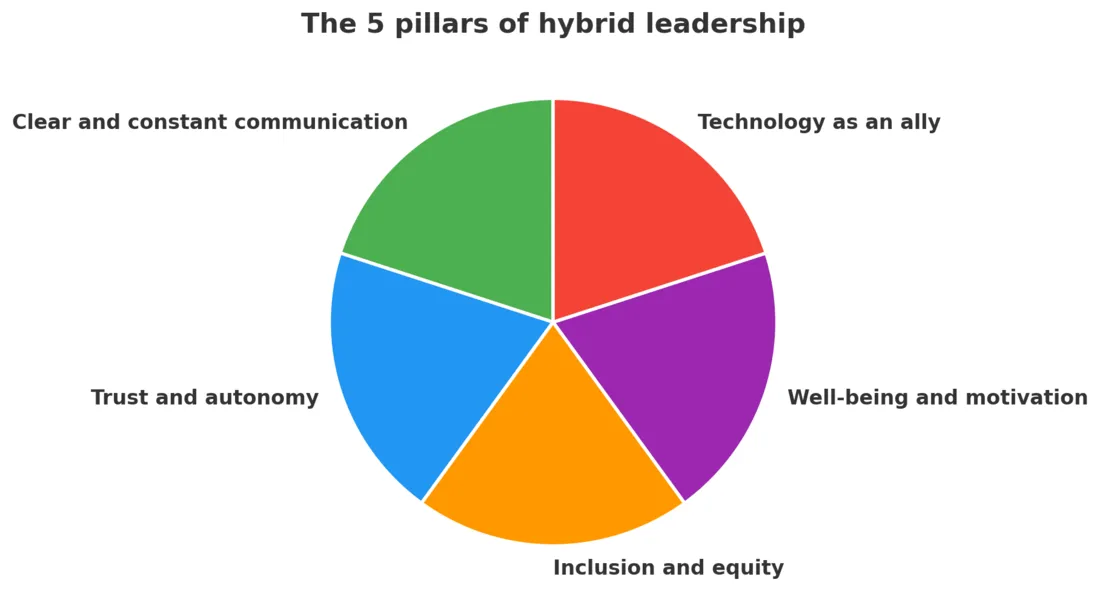
The 5 pillars of hybrid leadership
To manage a hybrid team successfully with leadership, you need five solid foundations:
1. Clear and consistent communication
If in the past communication was important, now it is the backbone of everything. In a hybrid environment, the lack of information multiplies. Good hybrid leadership requires a robust and well-thought-out communication strategy. It’s not just about sending emails or having video call meetings; it is about intentionality, you must reinforce communication with different channels (Slack, Teams, WhatsApp, short online meetings).
- Crystal clear: Instructions should be so clear that even a fish will understand them. Don’t assume that people “already know.” In a hybrid environment, ambiguity is the worst enemy. Define expectations, deadlines, and goals explicitly.
- Frequency and consistency: Establish a regular communication rhythm. Weekly team meetings, individual check-ins, active Slack or Teams channels… The key is consistency. The leadership cannot afford administrative silence.
- Appropriate channels for each purpose: Is it an important announcement? A quick discussion? A brainstorm? Choose the right tool. Not everything needs a video call, nor is everything solved with an email. Learn to discern.
👉 A good leader does not saturate, he organizes.
2. Trust and autonomy
One of the biggest challenges of hybrid leadership is the temptation of “micromanagement”. That need to know what each one is doing at all times. Error! A true leader trusts his team and grants them autonomy.
- Results, not hours: Focus on the results and not on the time they spend in front of the screen. Good leadership measures impact, not presence.
- Empowerment: Empower your team to make decisions. When people feel empowered, they take ownership of their work and perform much better. This is especially crucial for Ana, our creative entrepreneur, who values flexibility and freedom. Its success is fueled by autonomy.
- Feedback culture: Create an environment where feedback is welcome and constant. This not only helps to improve, but also builds confidence. Leadership that listens is strong leadership.
3. Inclusion and equity
This is a critical point. In a hybrid model, it’s easy for those in the office to feel more “connected” than those who are remote. A conscious leadership must actively work to avoid that gap.
- Equal opportunities: Make sure everyone has an equal opportunity to participate in meetings, projects, and events. If half of the team is remote, the meeting should be designed to be remote as well, with collaborative tools and clear speaking turns.
- Inclusive hybrid events: Hosting an activity? Think about how colleagues who are remote can participate. From online games to shared experiences at a distance, creativity is your best ally.
- Visibility for all: Ensure that everyone’s achievements, in-person and remote, are equally recognized and celebrated. Good leadership is a beacon that illuminates the entire team.
4. Wellbeing and motivation
Empathetic leadership understands that flexibility is a necessity, not a luxury. Hybrid work offers the opportunity to improve work-life balance and employee well-being.
- Promoting balance: encourage your team to disconnect. Leadership is not only concerned with production, but also with the mental and physical health of its employees. Lean on your HR team to remind them to stretch their necks, backs, and legs, and take visual pauses from the screen every hour. Making your employees aware that you care about their health will make them do the same and that will have an impact on a more productive and healthy job for everyone.
- Active listening: Ask your team what they need. Pulse surveys, one-on-one meetings, and anonymous suggestion boxes can be powerful tools. In order to develop and grow, people need to be able to speak and be heard without fear of being judged or punished. Protection plays a fundamental role, when you feel safe, you can give 100% of yourself.
- Quality spaces for everyone: For those who opt for face-to-face meetings, or who need a place for one-off meetings, the quality of the space is essential. This is where Ibercenter’s expertise shines. Fully equipped private offices, high-level meeting rooms, and a professional and representative environment in strategic locations in Madrid (Azca, Gran Vía and Velázquez) are an invaluable asset. Smart leadership understands that a good physical environment directly impacts productivity and morale. At Ibercenter we care and strive every day to have a well-kept space, with the most cutting-edge digital resources and a dedicated team to make it easier for meetings with your colleagues to become a very good experience.
5. Technology as an ally
Hybrid leadership must be an architect of collaboration. Technology is our best friend here, but it’s not the only answer.
- Collaborative tools: platforms such as Miro, Notion, or project management tools such as Asana or Trello, are essential. They allow everyone to contribute, review, and advance projects in sync, no matter the location.
- Spaces for co-creation: even if part of the team is remote, it is vital to have moments for face-to-face co-creation. This is where companies find invaluable in solutions such as those offered by Ibercenter. Imagine a global team that needs to set up shop in Madrid: it needs private offices with premium infrastructure and executive meeting rooms. Ibercenter in Azca, Gran Vía or Velázquez offers precisely those spaces equipped, with state-of-the-art technology (projectors, whiteboards, flipchart) and additional services such as coffee breaks and catering, creating the perfect environment for strategic meetings or intensive ideation sessions. Our leadership translates into offering an environment that maximizes productivity and connection, eliminating the “pain points” of managing your own office.
- Hybrid “rituals”: Small rituals, such as a virtual morning coffee or a relaxed “Friday talk” session, can do wonders for team cohesion and reinforce leadership.

5 Practical Hybrid Leadership Strategies
Now, the practical part: how do we use this every day?
1. Smart meetings
No more eternal meetings. Use the “if it can be an email, it’s not a meeting” rule. And when there are meetings:
- Define objective and maximum duration.
- Alternate between in-person and virtual meetings.
- Use interactive dynamics (surveys, digital whiteboards).
2. Culture of continuous feedback
Hybrid leadership demands frequent feedback. Don’t wait for the annual evaluation.
- Give constructive feedback in real time.
- Recognize achievements publicly.
- Make one-to-one reviews to motivate, listen, and integrate improvements and grow your business.
3. Full transparency
Uncertainty is poison for productivity. Share with your team:
- Company goals.
- Progress and results.
- Strategic changes.
An informed team is an aligned team.
4. Hybrid team dynamics
Leadership also means creating community. Some tips:
- Have monthly face-to-face meetings.
- Host 15-minute virtual coffees.
- Propose collaborative challenges (e.g. internal projects, creative contests).
5. Flexibility with clear boundaries
Flexibility is attractive, but without limits it becomes chaos. Defines:
- Minimum availability hours.
- Clear teleworking policies.
- Performance expectations.
Hybrid leadership success stories and trends
Global companies have already adopted this model:
- Microsoft implemented “radical flexibility”: each team defines when they go to the office.
- Spotify offers “Work from Anywhere” – the employee decides their location.
- BBVA opted for a hybrid model with branches as collaboration hubs.
They all have one thing in common: leaders who understand that physical space is a resource, not an obligation.
Ibercenter: the ally of hybrid leadership in Madrid
Here comes the key to make your leadership real: you need a space that adapts to your hybrid model.
At Ibercenter, we offer flexible private offices, meeting rooms, and event spaces in the heart of Madrid (Azca, Gran Vía, and Velázquez). All inclusive: technology, furniture, coffee break and administrative support.
Why is it key to your leadership?
- Because you can receive your customers in a professional and premium environment.
- Because your team has a hybrid space: office when you need it and flexibility for day-to-day life.
- Because you don’t waste time on management, you focus on leading.
In the era of hybrid work, leading is also choosing where you work well.

Some tools of the hybrid leader of the future
If you want to boost your leadership, here is a basic toolkit:
- Zoom/Teams: agile meetings.
- Slack/Discord: instant communication.
- Asana/Trello: project organization.
- Notion/Miro: creative collaboration.
- Ibercenter: your physical and professional base in Madrid.
Conclusion: hybrid leadership is human and flexible
Leadership in hybrid work isn’t about tracking or measuring connected hours. It’s about inspiring, giving confidence, and giving your team the tools and spaces they need to shine.
The traditional office as we knew it is left behind. Today, leading means understanding that people can work from anywhere… as long as it has a leader who sets the course.
And if you are looking for a space that will help you strengthen your leadership, at Ibercenter you have the perfect option for your hybrid team to run like clockwork.
Because in the end, true leadership is not about being everywhere, but about making everyone feel part of something big.
Write to us on WhatsApp and find out how Ibercenter can help you.