Office for advisory and accounting firms in Madrid: what a professional practice really needs
What an advisory or accounting firm really needs from an office in Madrid: confidentiality, meeting rooms, reception, business address services and flexibility for peak periods.
TL;DR
An office for an advisory or accounting firm should not be chosen by square metres or price per workstation, but according to three conditions that this sector needs and others do not: genuine confidentiality in conversations with clients, a suitable space in which to receive them, and the ability to absorb peak-season workloads without paying for them twelve months a year. It is a professional practice that handles third-party tax, employment and personal data, receives clients by appointment and sees its workload multiply during specific quarters.
That is why the model that usually works best is a private office sized for the permanent team, with meeting rooms available by the hour for peak periods and client visits, and reception and business address services taken care of.
Why does an advisory firm need something different from other businesses?
Let us start with what makes this sector different, because it explains all the decisions that follow. An advisory or accounting firm works with sensitive third-party information: payroll records, tax returns, contracts, corporate situations and, sometimes, personal or family conflicts that emerge in a conversation about an inheritance or a dismissal.
That makes confidentiality an operational requirement, not a preference. A phone conversation about a client's Personal Income Tax cannot be overheard from the next desk, especially if someone from another company is sitting there. This is why open coworking, which works very well for many profiles, is a poor fit for this sector except for occasional tasks that do not involve exposure of data.
The second difference is that an advisory firm receives visitors regularly, and those visitors have expectations. A client who comes in to sign accounts or review a tax inspection forms an impression of the firm from the place where they are received. Luxury is not necessary, but a room with a door, quiet surroundings and a table where documents can be spread out certainly is.
And the third difference is seasonality, which is more pronounced in this sector than in almost any other. The workload of an advisory firm is not flat: it surges at quarterly closings, during the income tax campaign and at year-end accounting closings. A structure sized for peak demand is oversized for nine months; one sized for quieter periods becomes overwhelmed at peak times.
What should an office for an advisory firm in Madrid include?
With the above in mind, these are the five criteria that an office for an advisory firm in Madrid should meet and which, in our experience, determine whether a space works for a professional practice.
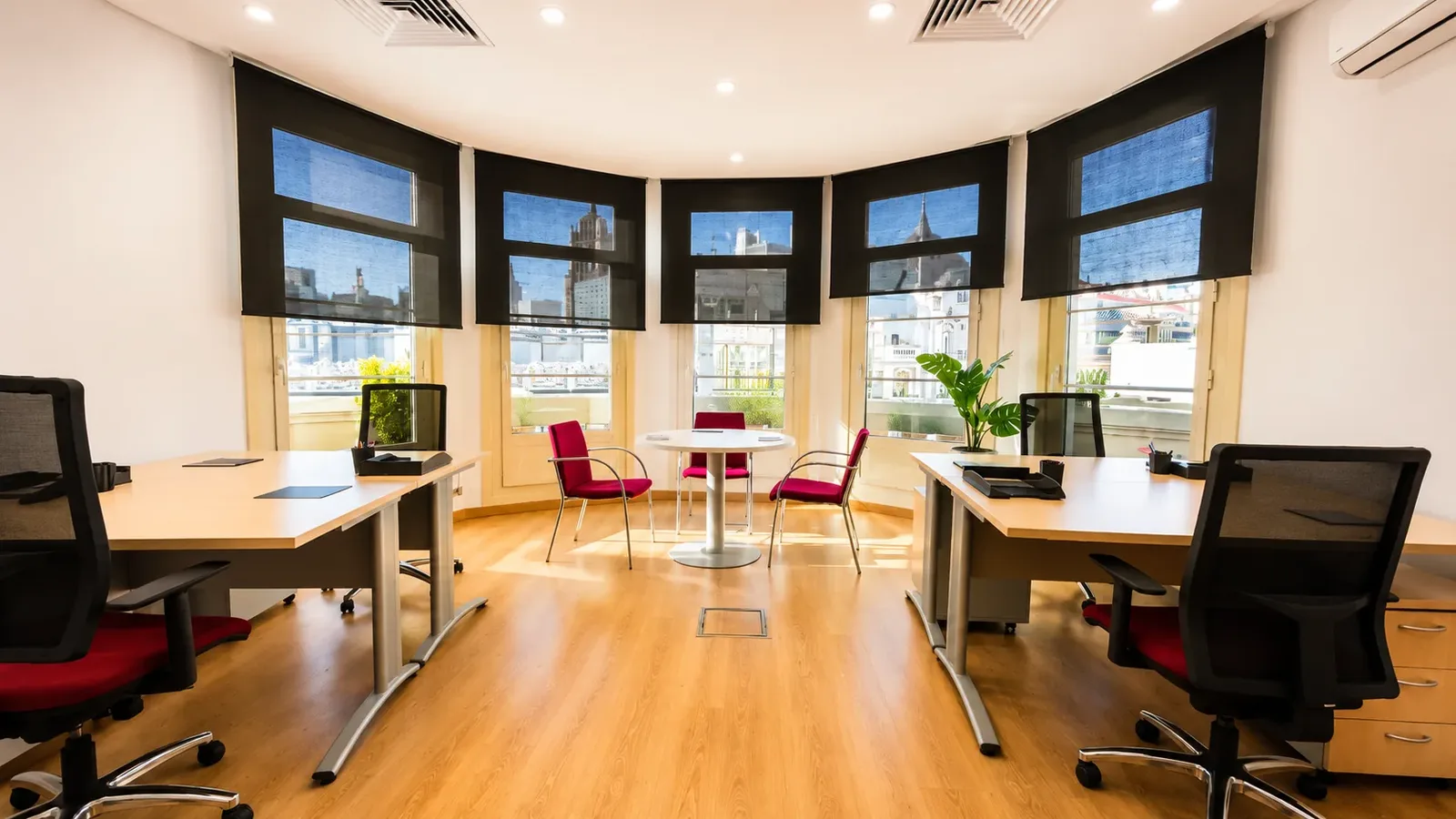
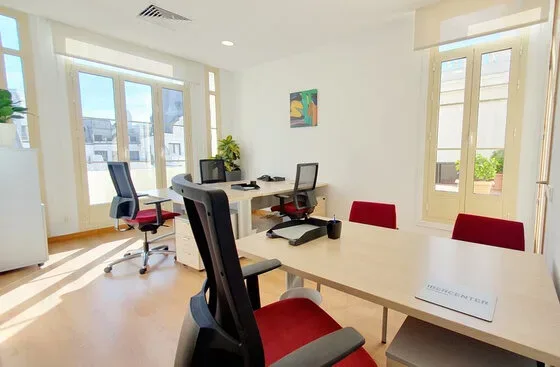
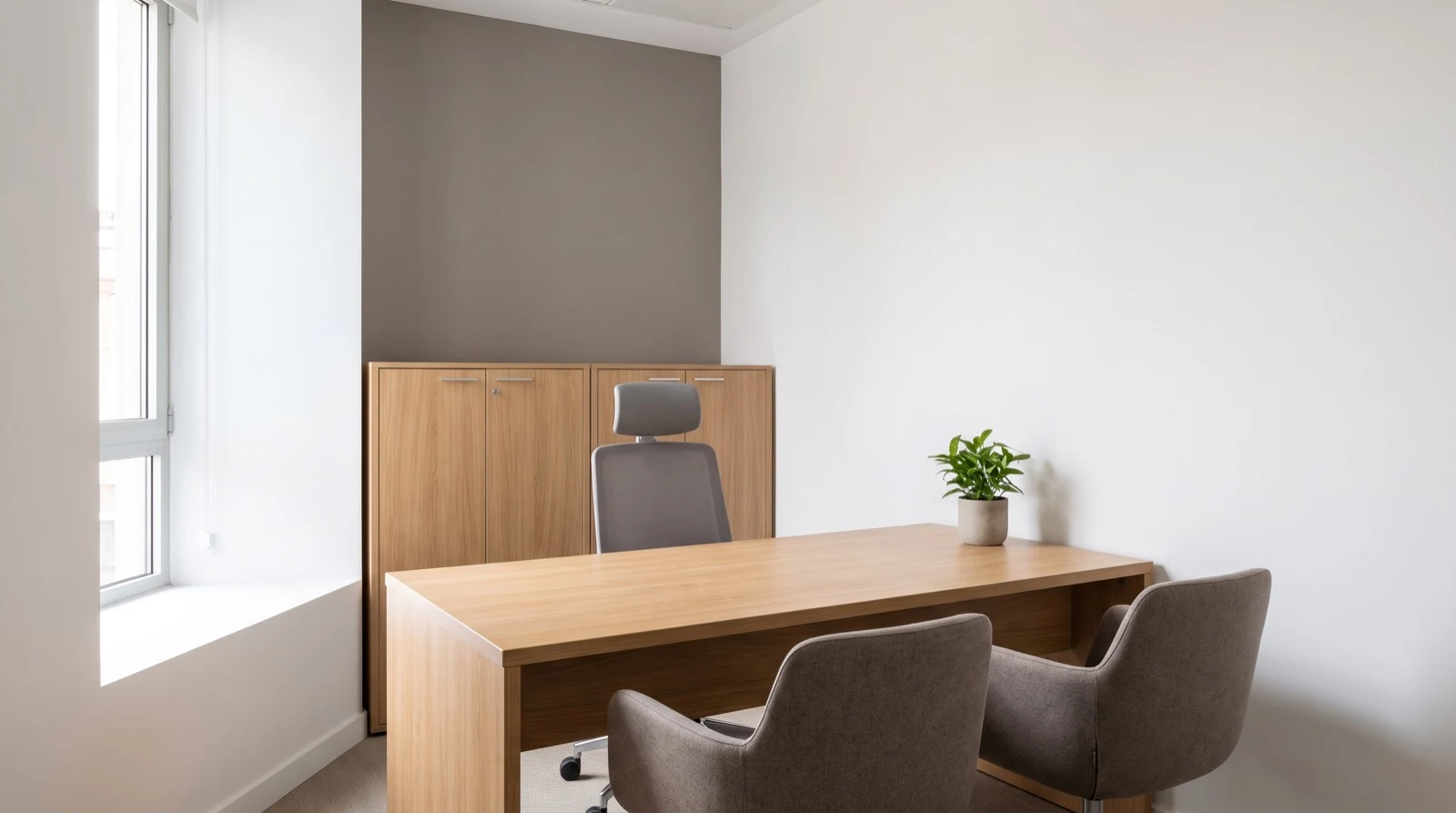
A closed private office, not an open-plan workstation. This is the starting point because of what we have explained about confidentiality. It is also worth checking the actual acoustic insulation, not just whether there is a door: an untreated glass partition provides visual separation but does not prevent a conversation from being overheard.
Access to meeting rooms without having to maintain one permanently. An advisory firm needs a meeting room several times a week, not several hours every day. Maintaining your own meeting room means paying for square metres that are empty most of the time. Being able to book one when needed changes the equation completely and also allows you to choose the size according to the meeting.
A reception service that genuinely handles clients. There is one detail that this sector values particularly highly: a significant proportion of advisory-firm clients are older and call by phone rather than writing. Having someone answer the phone, identify the firm and take a message is not an extra; it is part of the service the client perceives.
Mail handling and business address services. A professional practice receives notifications that cannot be lost, both its own and, on occasion, those of companies it serves. Reliable receipt of registered mail is a basic requirement.
Contractual flexibility. This is what makes it possible to absorb seasonality without oversizing. A contract that allows you to expand during peak season and scale back afterwards is worth much more in this sector than a slightly lower price per square metre.
How much does it cost and how should it be compared?
Let us talk numbers, because this is the question that always comes up. And it is worth starting with the right comparison, which is almost never the one people make: it is not about comparing the price per square metre of a traditional lease with that of a business centre, but the total monthly cost of having the office fully operational.
With a conventional lease, the rent must be supplemented by the deposit and bank guarantee, works or fit-out, furniture, connection and recurring utility costs, business internet, cleaning, insurance and, if you want someone to answer the phone, a receptionist. Many of these costs are fixed and do not fall even when the firm has quieter months. And there is one cost that is rarely accounted for: the partner's time spent managing all of this instead of billing client hours.
In a business centre, these items are included in the fee and the time commitment is shorter. In return, the price per square metre is higher. That is why comparing by square metre is misleading: you are comparing different things.
At Centro de Negocios Ibercenter, to give you concrete reference points: business address services start at €49 per month and meeting rooms are booked by the hour, ranging from €19 to €128 per hour depending on size and location. Private offices are quoted according to the number of workstations and the location, because an office for two people is not the same as one for eight. In any case, the figure worth calculating is always the same: how much the fully operational office costs you each month, with everything included, and how many management hours it saves you.
Which option works best depending on the size of the practice?
Not all advisory firms need the same office, and grouping them all together is the most common mistake. These are the four scenarios we see most often.
The solo professional. A self-employed tax or employment adviser who works from home most of the time and mainly needs two things: a professional address that is not their home address —for privacy and image— and a suitable place to meet a client when necessary. Here, the combination of a business address service plus meeting rooms by the hour meets the full need for a fraction of the cost of an office.
The small practice, with two to five people. This is the most common profile in the sector and the one that best fits a private office in a business centre: a closed, dedicated space for the team, with meeting rooms, reception and shared services. It is also the size at which setting up your own office is least efficient, because fixed costs are spread across only a few people.
The medium-sized practice, with six to fifteen people. Here, both options can make sense and the decision depends on the time horizon. If the team is stable and predictable, a dedicated lease starts to make economic sense. If it is growing, or if seasonality is strong, flexibility continues to justify the premium.
And the practice with extreme seasonality, which doubles its team during the income tax campaign with temporary reinforcements. This is the case where the flexible model wins most clearly, because it allows the firm to expand during the campaign months and return the extra space afterwards, instead of paying all year for square metres that are only used for three months.
Which area of Madrid is best?
When choosing an office for an advisory firm in Madrid, location matters more than is often admitted, and not because of prestige: because of the convenience of the client coming to see you. A practice that is difficult to reach or where parking is difficult becomes a problem: it loses visits and creates friction at every appointment.
The Velázquez corridor and the Salamanca district are traditional areas for professional practices, with a brand association that carries weight in this sector: a client who visits an advisory firm in that area arrives with a certain expectation. It is very well connected by metro and convenient for clients from the city centre and the north of Madrid.
AZCA and the Nuevos Ministerios area are the reference point for practices with corporate clients. Their main advantage is connectivity: Nuevos Ministerios connects with Chamartín and the airport, which makes it very practical if you serve companies from outside Madrid.
And Gran Vía offers the best public-transport accessibility in the entire city, which is useful when your clients come from very different areas. Ibercenter has locations in all three —Velázquez 157, AZCA and Gran Vía 6—, and the recommendation we always give is the same: choose based on where your clients are, not where you live. The convenience of your own commute is solved once a day; your clients' convenience matters at every visit.
What should you ask before signing?
These are the questions that, in our experience, prevent the most unpleasant surprises in this particular sector. It is worth asking all of them before making a commitment.
About the space: does the office have genuine acoustic insulation or only visual separation? Can I keep documents under lock and key? What happens if I need one more workstation for three months?
About the meeting rooms: how many hours are included in the fee and how much does an additional hour cost? How far in advance do they need to be booked at peak times? Are there rooms of different sizes or only one?
About the services: does reception answer using my firm's name? What happens to a registered item that arrives when I am not there? Is cleaning included and how often?
And about the contract: what is the minimum commitment and the notice period for leaving? What is included in the fee and what is billed separately? How is the price reviewed on renewal? That last question is the one asked least often and the one that causes the most surprises the following year.
What does data protection mean for the physical workspace?
This is an aspect that is almost never considered when choosing an office and that should be decisive in this sector. An advisory firm processes third-party personal data on behalf of its clients, and data protection regulations require appropriate technical and organisational measures. Organisational measures include the workspace.
In practice, this translates into very specific questions about where you are going to work. Where is paper documentation stored? A practice that handles physical files needs lockable cabinets, and that furniture needs to be inside a room that also locks. Who has access to the office outside working hours? It is worth knowing the building's access policy and who comes in to clean, and under what supervision.
And the most overlooked question: where do conversations take place? A call discussing the payroll of a client company or an individual's tax situation should not take place in a common area. This is the underlying reason why we insist so strongly on a closed office: it is not about comfort, but about the fact that a large part of an advisory firm's daily work involves talking about information that does not belong to it.
Our practical recommendation is simple: when you visit a space, walk through it with a specific file in mind. Where it enters, where it is stored, who can see it and where it is discussed. If any of those answers make you uncomfortable, that space does not fit your professional obligations, however attractive the price may be.
How does remote work affect the decision?
The sector has changed in recent years and this needs to be factored into the calculation, because many practices are still sizing their space as if the whole team were present five days a week, and hardly any are anymore.
A large part of an advisory firm's work —bookkeeping, preparing tax returns, reviewing documentation— can be done perfectly well remotely. What does not transfer as well is face-to-face client service, supervision of junior staff and the quick resolution of questions between colleagues, which in a practice happens every day and through proximity.
That is why the dominant model in this sector today is hybrid, with attendance concentrated on certain days and during peak campaign periods. And that has a direct consequence for the workspace: you need fewer fixed workstations and more occasional capacity. An office for an advisory firm in Madrid sized for the historical maximum occupancy is money tied up for most of the year.
The opposite mistake also exists and is worse: reducing so much that on the busiest days the team does not fit, or there is nowhere to seat a client. The balance that works best, from what we see, is to size the office for the number of people who are there together on a normal day and handle peak days with meeting rooms or additional workstations. It is worth calculating this using real attendance data from recent months, not anyone's perception.
What signs show that your office has become too small?
Before considering a move, it is worth recognising the signs, because they appear well before the space becomes physically insufficient and often show up as problems that seem to be about something else.
The first is the meeting room becoming a bottleneck. If client appointments have to be planned around when the room is free, rather than when it suits the client, the space is already limiting the business. It is the earliest warning sign and the one that silently costs the most revenue.
The second is confidential conversations taking place where they should not: in the corridor, in the kitchen or in a common area. When that starts happening because of a lack of space, it is not a comfort issue; it is a compliance risk.
The third is delayed recruitment. If you have postponed hiring someone because you do not know where to seat them, the space has stopped being a cost and has become a brake on growth, which is a different category of problem.
And the fourth, more diffuse but very revealing: feeling uncomfortable about a client seeing your office. In a sector that sells rigour and trust, the space communicates before you start speaking. If you avoid inviting clients to your office and prefer to go and see them, that is already costing you time and money, even if it does not appear in any budget line.
Is it worthwhile sharing space with other professional practices?
This is a question we are often asked and the answer is more nuanced than it seems, because it combines two different things: sharing a building and sharing an office.
Sharing a building with other professional practices is usually a net advantage, and in this sector more than in almost any other. An advisory firm that shares a centre with lawyers, consultancies or auditors naturally ends up generating referrals in both directions: the employment lawyer who needs someone to handle a client's accounts, the advisory firm that needs a corporate lawyer for a transaction. It is not forced networking at events; it is proximity. At our locations, this coexistence between professional practices happens every day and is one of the reasons this profile returns.
Sharing the physical office with another practice is a different matter, and here we are more cautious. It can work between professionals who know and trust each other, but it introduces a serious confidentiality issue: two different advisory firms in the same room means conversations and documentation relating to one firm's clients are within reach of the other. If both also provide similar services, there is a potential conflict that is worth facing directly before signing anything.
Our recommendation is the middle ground, and it is the one that delivers the best results: your own closed space for work, shared common areas for everything else. This preserves the confidentiality the profession requires while retaining the advantages of being surrounded by people working in related fields. It is, in essence, the logic of a business centre as opposed to an isolated office.
Frequently asked questions about offices for advisory firms in Madrid
Can I use a business address service for my advisory firm without renting an office?
Yes. A business address service is an independent service that provides a professional address, receipt and handling of correspondence without the need to rent physical workspace. It is the usual solution for professionals who work from home and only need somewhere to meet clients occasionally, which can be handled by booking a meeting room by the hour when needed.
Is coworking suitable for an accounting firm?
For work involving confidential documentation and client calls, we do not recommend it: an open space cannot guarantee that a conversation about tax or employment data will not be overheard. It can work for tasks that do not involve exposure of data, but the core work of an advisory firm requires a closed space.
How are peak periods during the income tax campaign managed?
The formula that works best is to size the office for the permanent team and cover temporary reinforcement with additional workstations during the campaign months, returning them afterwards. It is worth asking about this possibility before signing, because not all contracts provide for it and once the campaign has started there is no room for negotiation.
What is the difference between a registered office and a tax address?
They are different concepts that often coincide but do not have to. The registered office is the one stated in the articles of association and entered in the Commercial Registry; the tax address is the one notified to the Spanish Tax Agency and determines where administrative management is centralised. As a professional practice, you will know this better than we do, but it is worth being clear about it when arranging a business address service and checking exactly what the service covers.