How to use artificial intelligence in work meetings and gain productivity?
We tell you how to apply artificial intelligence in work meetings In many companies, meetings are part of everyday life, […]

We tell you how to apply artificial intelligence in work meetings
In many companies, meetings are part of everyday life, but they don’t always provide the value they should. Lack of structure, unclear decisions or excessive time spent are common problems that directly affect productivity. In this context, artificial intelligence in work meetings is consolidating itself as a key solution to transform these meetings into truly efficient spaces, where every minute counts and every decision has a purpose.
The integration of artificial intelligence in work meetings not only makes it possible to automate tasks, but also to improve organization, follow-up, and decision-making. At Ibercenter, where we have been helping companies to optimise the way they work from our spaces in Madrid for years, we know that the combination of technology and a suitable professional environment makes the difference. Because today, more than ever, it’s about focusing on the business while everything else — including meetings — runs smoothly and effectively.
What is artificial intelligence applied to work meetings?
Artificial intelligence in work meetings refers to the use of technologies capable of automating, analyzing, and optimizing all processes related to a meeting, before, during, and after it takes place. This is not just a technological trend, but a natural evolution in the way companies manage their time, their teams and their decision-making.
In practical terms, artificial intelligence applied to meetings allows many of the tasks that traditionally consumed time – such as taking notes, organizing ideas, generating minutes or following up on agreements – to be carried out automatically and with a high level of accuracy. Thanks to advanced algorithms, these tools are able to transcribe conversations in real time, identify the key points discussed during the meeting and even summarize the most relevant information to facilitate their subsequent reference.
But the true value of artificial intelligence in work meetings goes beyond automation. These solutions also provide a layer of analysis that allows you to better understand how meetings are taking place: how long they last, who participates the most, which topics generate the most debate or if the established objectives are really being met. This information is especially useful for companies looking to optimize their internal processes and improve the efficiency of their teams.
In addition, artificial intelligence makes it possible to prepare meetings in a much more strategic way. For example, you can suggest agendas based on previous meetings, prioritize topics based on their relevance, or even recommend which profiles should attend to make the meeting truly productive. This avoids unnecessary encounters and ensures that each meeting has a clear purpose.
Another key aspect is integration with other business tools. Many AI solutions connect with calendars, project managers, or communication platforms, making it easier for all information to flow consistently within the organization. Thus, the decisions made in a meeting do not remain in the air, but are automatically converted into tasks, reminders or concrete actions.
At Ibercenter we understand that artificial intelligence in work meetings does not replace the value of human contact, but rather enhances it. When combined with a suitable professional environment, such as well-equipped meeting rooms and spaces designed to promote concentration and collaboration, the result is much more than just an operational improvement: it is a new way of working that is more agile, more focused and, above all, more productive.
Benefits of using artificial intelligence in meetings
The incorporation of artificial intelligence in work meetings is not only a matter of innovation, but a real competitive advantage for companies looking to optimize their time and improve their results. In an increasingly demanding business environment, where efficiency makes the difference, having tools that improve the quality of meetings translates directly into productivity.
One of the main benefits is time savings. Many meetings go on longer than necessary or lack a clear structure. Artificial intelligence makes it possible to define agendas automatically, focus the conversation on key points and avoid unnecessary deviations. In addition, it eliminates subsequent tasks such as writing minutes or sending summaries, which are generated automatically. This allows teams to focus on what’s really important: making decisions and advancing their goals.
Another fundamental aspect is the improvement in decision-making. Artificial intelligence in work meetings is capable of analysing data in real time, providing relevant information and offering clear summaries of what has been discussed. This makes it easier for all participants to have a more complete and objective view, reducing misunderstandings and improving the quality of the decisions made during the meeting.
Automating repetitive tasks is another great benefit. From transcribing conversations to assigning tasks to tracking agreements, artificial intelligence significantly reduces the administrative burden associated with meetings. Not only does this improve efficiency, but it also minimizes errors and ensures that nothing is left pending or lost along the way.
In addition, artificial intelligence provides greater control and monitoring of meetings. It allows you to record what decisions have been made, who is responsible for each task and what status each action is in. This is especially useful in large teams or companies with multiple projects underway, where control and organization are key to success.
It is also important to highlight the impact on team productivity. By reducing time spent on inefficient meetings and improving clarity of objectives, professionals can spend more time on strategic tasks. This not only improves results, but also the team’s motivation and overall performance.
In our centres we see every day how the combination of technology and the right environment multiplies these benefits. Artificial intelligence in work meetings, when used in professional spaces designed to promote concentration and collaboration, allows companies to make a qualitative leap in the way they work. Because it is not just about meeting, but about doing it better, with more focus and with tangible results.
How to apply artificial intelligence before a meeting?
Preparation is, in many cases, the difference between an unproductive meeting and a truly effective meeting. At this point, artificial intelligence in work meetings plays a fundamental role, as it allows the entire previous phase to be optimized, ensuring that each meeting has a clear objective and is well structured from the beginning.
One of the most practical uses is the automatic generation of agendas. From previous meetings, emails, or shared documents, AI tools can propose a coherent agenda, prioritizing the most relevant topics. This avoids improvisation and ensures that all participants come with a clear idea of what is going to be discussed. In addition, it makes it easier for the meeting to stay focused and on schedule.
Another key aspect is the analysis of previous information. Artificial intelligence can collect and process data related to the topics to be discussed, offering summaries, reports or key points before the meeting begins. In this way, attendees arrive better prepared, with a more complete vision of the context and with the ability to add value from the first moment. Artificial intelligence in work meetings thus turns preparation into an agile and much more strategic process.
The selection of participants can also be optimized thanks to these tools. Meetings often involve more people than necessary, diluting decision-making and reducing efficiency. Artificial intelligence can suggest which profiles should attend based on their involvement in the topics to be discussed, avoiding unnecessary calls and favoring more agile and productive meetings.
In addition, artificial intelligence allows for better time planning. You can analyze attendee availability, propose optimal schedules, and even identify times of day when your team is typically most productive. This helps to ensure that meetings are scheduled under more favourable conditions, increasing their efficiency.
No less important is the ability to anticipate results. Some advanced tools can forecast possible scenarios based on historical data or trends, helping to focus the meeting on concrete decision-making. This reduces improvisation and allows the meeting to have a much more strategic focus.
Use of artificial intelligence during the meeting
The timing of the meeting is undoubtedly the most critical. It is here that ideas are shared, decisions are made and the next steps are defined. Therefore, integrating artificial intelligence into work meetings during this process allows not only to improve the dynamics of the meeting, but also to ensure that everything that happens is perfectly recorded and structured.
One of the most widespread uses is automatic real-time transcription. Thanks to artificial intelligence, there is no longer a need to take manual notes or worry about missing relevant information. Everything that is said is accurately recorded, allowing participants to focus on the conversation and add value. This functionality is especially useful in strategic meetings or meetings with multiple attendees, where it’s easy for important details to slip through.
In addition, artificial intelligence allows you to generate intelligent summaries instantly. As the meeting progresses, these tools are able to identify key points, decisions made, and pending issues. This makes it easier for all participants to maintain a clear view of the progress of the meeting, avoiding unnecessary repetitions and ensuring that the meeting progresses in a structured way.
Another relevant aspect is the identification of interventions and participation analysis. Artificial intelligence in work meetings can detect who is speaking, how long each person intervenes and even analyze the tone or relevance of the contributions. This information is invaluable for improving team dynamics, encouraging more balanced participation, and preventing certain voices from monopolizing the conversation.
Real-time virtual assistants also stand out, acting as support during the meeting. These systems can resolve doubts, provide relevant data in the moment or remember information from previous meetings, which enriches the conversation and facilitates informed decision-making. In this way, the meeting no longer depends solely on the memory or preparation of the attendees.
Artificial intelligence also helps maintain focus and control of time. It can alert you when you’re straying from the main topic or when a point is taking up more time than expected, helping to make the meeting more streamlined and productive. This type of support is especially useful in business environments where time is a critical resource.
Applications of artificial intelligence after the meeting
Once the meeting is over, an equally important phase begins: turning everything discussed into concrete actions. This is where artificial intelligence in work meetings provides a differential value, ensuring that nothing is lost and that each decision has continuity within the organization.
One of the most prominent uses is the automatic generation of minutes. Artificial intelligence collects all the information discussed during the meeting and transforms it into a structured, clear and shareable document. This report includes key points, decisions made and outstanding issues, eliminating the need to spend additional time writing manual reports and avoiding potential errors or omissions.
In addition, assigning and tracking tasks becomes much more efficient. Based on what was discussed in the meeting, artificial intelligence automatically identifies the actions to be taken, assigns those responsible and establishes deadlines. This ensures that each agreement is translated into concrete and measurable tasks, improving execution and reducing the risk of unresolved issues. Artificial intelligence in work meetings thus turns ideas into real results.
Another key aspect is the continuous monitoring of progress. Artificial intelligence tools can be integrated with project management platforms, allowing the status of each task to be monitored in real time. This makes it easier for managers to have a global view of progress and detect possible deviations before they become major problems.
Artificial intelligence also allows for an analysis of meeting performance. It not only focuses on what has been decided, but also on how the meeting has developed: duration, level of participation, compliance with the agenda or effectiveness in decision-making. This information is very valuable to improve future meetings and optimize the work dynamics in the company.
In addition, the distribution of information is greatly facilitated. Summaries, minutes, and tasks can be automatically shared with participants or other team members who need to be informed. This ensures that the entire organization is aligned and that information flows quickly and orderly.
Artificial intelligence tools for work meetings
The adoption of artificial intelligence in work meetings would not be possible without the development of specific tools that facilitate its application in the day-to-day business environment. Today, there are a wide variety of solutions designed to improve every phase of the meeting, from planning to follow-up afterwards. Choosing the right ones can make a big difference in team productivity.
Among the most widely used are platforms such as Otter.ai, which specialises in automatic real-time transcription. This tool allows you to record everything that is said during a meeting, identify the interlocutors and generate clear summaries, which prevents the loss of information and facilitates its subsequent consultation. It is especially useful in long meetings or with multiple participants.
Another widespread solution is Fireflies.ai, which not only transcribes, but also analyzes conversations, identifies key topics, and allows you to search for information within recorded meetings. This type of tool enhances the use of artificial intelligence in work meetings, as it turns each meeting into a source of knowledge accessible to the entire company.
In the field of productivity, platforms such as Notion AI orMicrosoft CopilotThey allow you to organize agendas, generate documentation automatically, and connect meeting information with other internal processes. This makes it easier for the decisions made not to remain siloed, but to be integrated into the usual workflow.
Tools such as Zoom AI Companion also stand out, which integrate directly into video conferencing platforms and offer functionalities such as automatic summaries, minute generation or real-time assistance during the meeting. These types of solutions are key for companies that work in hybrid environments or with distributed teams.
When choosing a tool, it is important to consider several factors: ease of use, integration with other platforms, the level of automation it offers, and above all, its ability to adapt to the specific needs of the company. Not all organizations require the same level of complexity, so the key is to find a balance between functionality and simplicity.
Best practices for implementing AI in meetings
Incorporating artificial intelligence into work meetings can be a before and after in a company’s productivity, but its implementation must be done strategically. It is not just about adopting tools, but about integrating them correctly into the work dynamic so that they really add value.
The first step is to define clear objectives. Before using any artificial intelligence solution, it is essential to identify what you want to improve: reduce the duration of meetings, improve decision-making, optimize task tracking? Having these objectives well defined will allow you to choose the right tools and measure their impact realistically.
Another key best practice is to avoid overautomation. Although artificial intelligence in work meetings allows many processes to be automated, it is important not to lose the human component. Meetings are still spaces for communication, negotiation and decision-making, so technology should act as a support, not a substitute. Finding that balance is essential for effective implementation.
Team formation also plays a key role. It is not enough to incorporate new tools if professionals do not know how to use them correctly. It’s a good idea to take the time to train teams, explain the benefits of artificial intelligence, and show how it can make their day-to-day work easier. When people understand the value of these solutions, their adoption is much more natural.
In addition, it is important to ensure good integration with existing systems. Artificial intelligence must connect with the tools that the company already uses, such as project managers, calendars or communication platforms. This avoids duplication, improves the flow of information, and ensures that meetings are aligned with the rest of the business processes.
Data protection and confidentiality is another aspect that cannot be overlooked. Many AI tools work with sensitive information, so it’s critical to choose solutions that comply with current regulations and offer security guarantees.
Finally, it is advisable to carry out a continuous evaluation. Implementing artificial intelligence in work meetings is not a static process, but requires constant adjustments and improvements. Analysing the results, collecting feedback from the team and adapting the tools to real needs will maximise their impact over time.
The importance of the environment
When we talk about optimizing meetings, many times the focus is only on technology. However, the environment in which they develop remains a determining factor. Artificial intelligence in work meetings can improve processes, automate tasks and provide valuable information, but its impact is multiplied when combined with an adequate space, designed to promote concentration and decision-making.
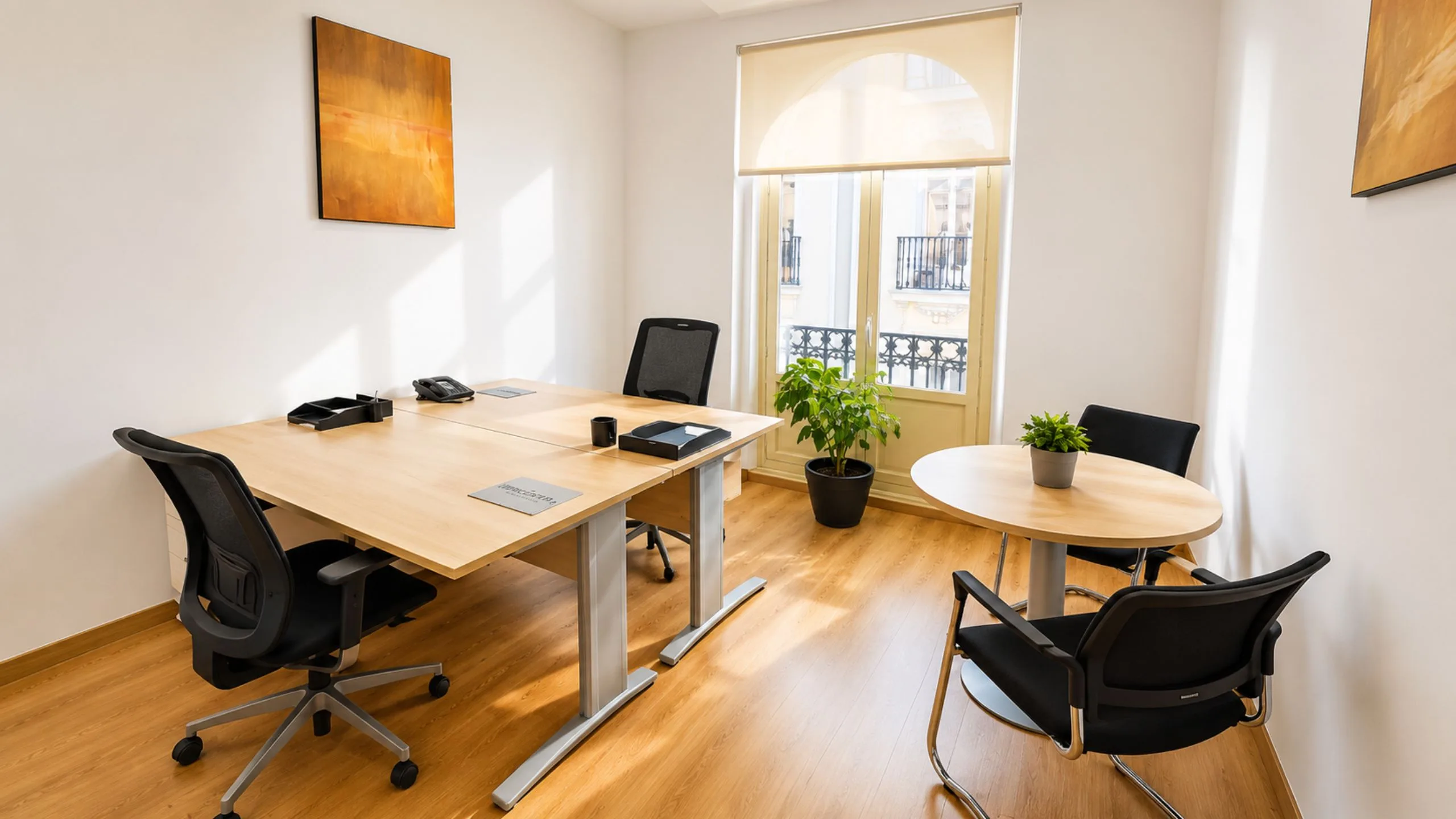
A professional environment directly influences the quality of meetings. Well-lit, comfortable, uninterrupted spaces with the necessary technology allow teams to focus on what is really important. It is of little use to have advanced tools if the connection fails, the space is not prepared or there are constant distractions. Artificial intelligence in work meetings needs a context that accompanies it, where everything works smoothly.
In addition, the space also projects image. For many companies, meetings are not only internal, but also with customers, partners or investors. In these cases, the environment conveys professionalism, trust and brand positioning. Having well-equipped meeting rooms in strategic locations reinforces the impact of each meeting and contributes to generating better results.
Another relevant aspect is flexibility. Not all meetings require the same type of space: from quick meetings to strategic meetings or trainings. Having different configurations allows the environment to be adapted to each need, something that fits perfectly with the use of artificial intelligence in work meetings, which already seeks to optimize every detail of the process.
At Ibercenter we have been understanding for years that the environment is a fundamental part of business success. That’s why our room spaces in Madrid are designed to offer not only comfort, but also efficiency: fully equipped rooms, optimal connectivity and a professional environment that boosts performance. When artificial intelligence is combined in work meetings with a space designed for companies, the result is clear: more agile, more productive meetings with a real impact on the business.
Conclusion
In the end, the reality in many companies is clear: we spend too many hours in meetings that don’t always bring in what they should. For this reason, artificial intelligence in work meetings is becoming a key ally in changing this dynamic. It is not only about saving time, but about making better use of it, having clearer meetings, with defined objectives and in which decisions are really made that move the business forward.
At Ibercenter we are very clear: when you combine technology, organization and a good work environment, everything flows differently. Artificial intelligence in work meetings, together with professional spaces designed to perform at their best, allows each meeting to make sense. Because in the end, the important thing is not to meet more, but to meet better and with results.