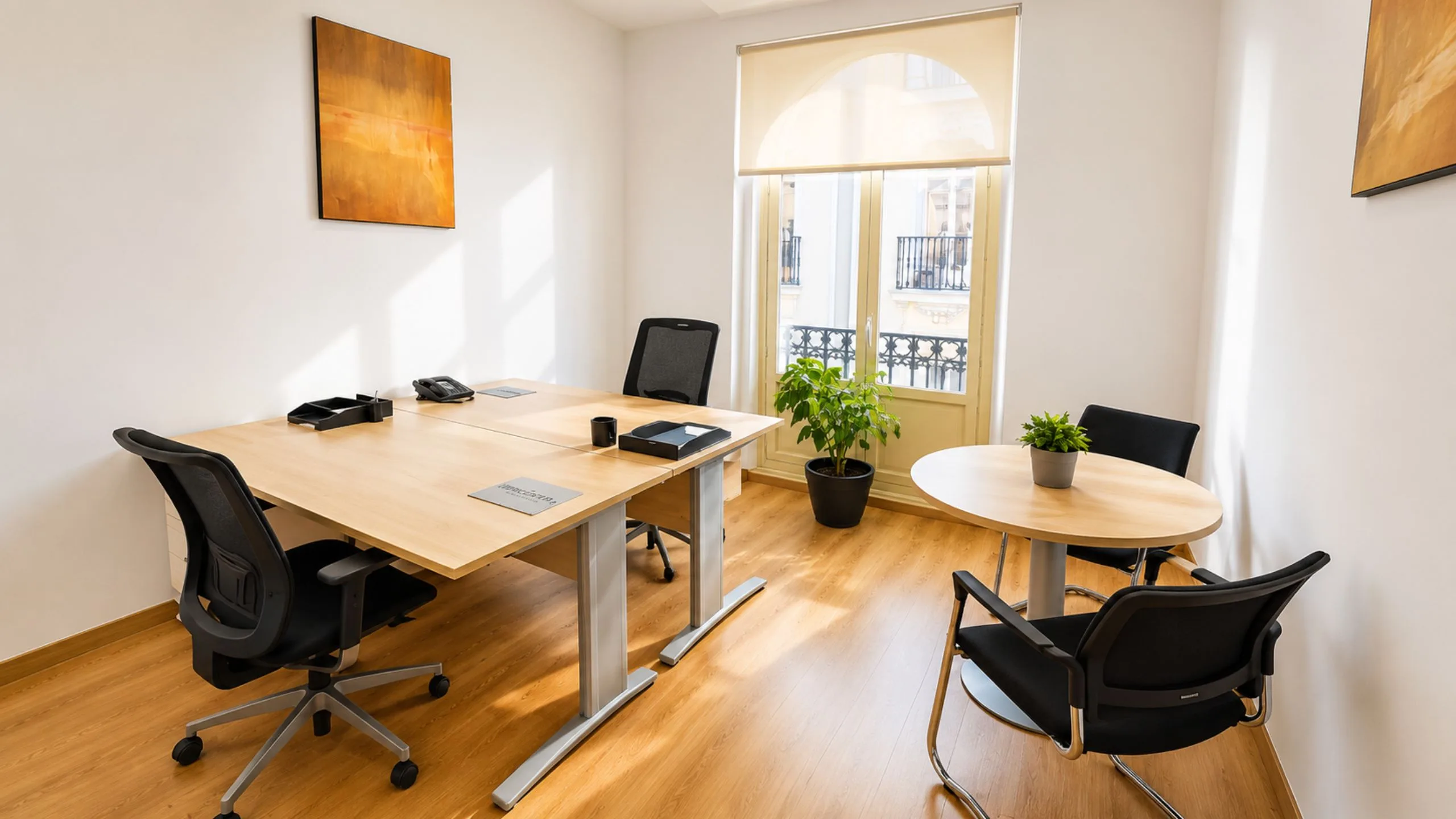
Office for a marketing agency in Madrid: how to choose a headquarters that projects solvency to clients
How to choose an office for a marketing agency in Madrid: areas, format, technical requirements, budget and typical mistakes. An honest guide for managers.

TL; DR
A marketing agency office in Madrid is not a mere fixed expense: it is a commercial tool that decides how many contracts the agency signs, how much talent it attracts and at what price it can sell its services. An agency's headquarters speaks volumes even before the client sees the deck, before the proposal and before the first meeting, because the average client investigates the provider's postal address before even asking for a demo. The right choice combines four variables: location that fits the client's profile, format of the space (private, mixed, virtual office), demanding technical requirements (connectivity, rooms with real AV, reception) and a cost that the agency can sustain without losing capital. At Ibercenter we have been accompanying marketing agencies for years in their evolution of headquarters, and the conclusion is clear: solvency is projected before speaking, and it is noticeable in the first physical contact with the headquarters.
Why does a marketing agency need to think of headquarters as a business asset?
Marketing agencies work in a sector with a structural reputational problem. After decades in which thousands of micro-agencies appeared and disappeared that sold without delivering, the marketing and general management managers of the companies that hire agencies arrive at the first meeting with a healthy distrust. This is not an ideological prejudice, but the accumulated learning of the sector: entry into the market has been so cheap for years that the average quality has gone down, and the variance has gone up. Even before evaluating technical capabilities, the client looks for signs of solvency that help separate the serious supplier from the opportunistic. And the first sign, almost always, is the headquarters.
The piece that many agencies underestimate is that that evaluation happens before the first meeting, not during. Today, the usual practice of the marketing manager who receives a proposal from an unknown agency is to look for three things in his first five minutes of research: the website, the team's LinkedIn and the postal address. If the address leads to a private flat, to a generic coworking space on the outskirts or to a headquarters shared with fifty different companies, the client's internal question changes from "are they good?" to "will they be next year's?". That question, once installed, conditions the entire negotiation, from the price you are willing to accept to the payment term.
The good news is that this first sign can be worked on judiciously without having to spend what an agency of a hundred people would spend. A marketing agency in Madrid can project solvency with a small but well-located office, with a good shared hall in a premium business center or with a mixed headquarters that combines physical presence in the prime area and remote work of the team. The critical thing is not square meters, it is coherence: the postal address, the building, the reception that attends to the client when he arrives and the room where the contract is signed have to communicate the same level of seriousness as the deck that the agency delivers.
What does an office project about the solvency of an agency?
The office communicates four different messages to the client who arrives at a first meeting, and each one weighs in the decision to hire. The first is permanence. An agency based in a recognizable building in the prime area, with stable signage in the directory and with a professional reception, conveys the idea that the company will continue to exist next year. This matters especially when what is signed is an annual contract or a recurring monthly fee: the client does not want to discover in March that their agency has changed its address, has renegotiated its way of working or, worse, has been dissolved. Visual permanence is the cheap substitute for the audited financial statement that the client will never ask for but will infer.
The second message is operational capacity. A client who enters the headquarters sees how many people are working, what tools they have on the table, what screens, what size of rooms for internal meetings or workshops with clients. You don't need to see an army: what you evaluate is coherence between what the agency says it does and the physical setup it has to do it. An agency that sells audiovisual production without a minimum space to record or edit raises an immediate question. One that claims to have dedicated paid media team without workstations with large monitors and visible tools has the same problem. The office acts as a walking test of the operative muscle.
The third message is confidentiality and information security. Brands that hire agencies share strategy, budget, client data, and sometimes sensitive information under NDAs. If the agency's headquarters is an open coworking where the conversation with a client can be heard by anyone, the serious operation is complicated from day one. A premium business center with soundproofed rooms, a reception that filters access and the option of private offices solves this problem without the agency having to invest in its own building. The client who signs a large contract wants to know where their information is, and that is decided with their eyes rather than with a questionnaire.
The fourth message, and the most subtle, is ambition. An office in Castellana, in Barrio de Salamanca, in Velázquez or in an area with a clear identity of serious business communicates to the client that the agency operates in the same league, that it understands the codes of the sector and that it aspires to contracts consistent with that location. For an agency that sells to medium-sized or corporate companies, that sign of ambition is the filter that avoids bad clients (those who pay little and burn out the team) and opens the door to good ones. An agency based in the prime zone attracts the client who pays premium rates and rejects the downward negotiation by default. It is an inexpensive filter that is installed before the first call.
Which areas of Madrid fit with which type of agency?
Madrid is not a single market, but several. Each area conveys a different message and attracts a different customer profile. It is advisable to choose wisely, because the wrong area penalizes even a brilliant agency. La Castellana, from Plaza Colón to Plaza de Castilla, is the natural hub for agencies that work with corporates, large brands and multinationals. Being there communicates institutional solvency and proximity to the headquarters of the major Spanish and European accounts. The cost is high, but the profitability per signed contract makes up for it for agencies with high average tickets.
The Salamanca district, especially Velázquez, Serrano, Goya and Recoletos streets, attracts premium clients from the luxury, fashion, hospitality, premium gastronomy and professional services sectors for high net worth. It is the ideal area for creative, branding or communication agencies that work with brands that take special care of aesthetics and detail. A client who asks a proposal from an agency based in Velázquez expects and accepts that the rate will be higher than usual: the postal address has already done part of the commercial work.
AZCA and the Cuzco-Castellana Norte area work best for B2B technology agencies, digital performance agencies with significant budgets, growth agencies for SaaS, and hybrid consultancies that touch marketing and technology. It is a less historic but more operational area, with modern office buildings, spacious rooms and better access by public and private transport. It fits with agencies whose typical client comes from the tech, fintech, telecommunications, energy or industry 4.0 sectors. Gran Vía, on the other hand, maintains a mixed character between commerce, hospitality and creativity: it is a good base for agencies that work with FMCG, physical retail, entertainment or culture brands. The movement of the street provides a message of closeness to the end consumer that is lost in more institutional areas.
There are areas that should be looked at carefully. Las Tablas, Manoteras and the north of Madrid work well if the agency's main clients are the large technology companies located there (Telefónica, Microsoft, IBM, Indra), but they lose their capacity for commercial projection compared to other profiles. The Castellana sur (areas Ríos Rosas, Glorieta de Cuatro Caminos) is a good middle ground: recognizable address, more reasonable price, professional atmosphere without the strict formality of the Castellana Norte. For growing agencies but with a contained budget, it is usually the area with the best price-perception ratio.
| Area | Agency Profile That Fits | Typical customer who attracts | Relative price range |
|---|---|---|---|
| Castellana (north) | Corporative, B2B large account | Multinationals, IBEX, banking | Very high |
| Salamanca district | Creative, branding, communication | Luxury, fashion, hospitality premium | High |
| AZCA / Cuzco | B2B tech, performance, growth | SaaS, fintech, energy, industry | Medium-high |
| Gran Vía | Consumer, retail, culture proximity | FMCG, physical retail, leisure | Medium |
| Castellana sur / Ríos Rosas | Growing agencies | Medium-sized SMEs, professionals | Medium |
| Las Tablas / norte tech | Specialists in tech HQ customers | Telco, IT enterprise | Medium-high |
What types of space work for an agency (private, mixed, or virtual office)?
Marketing agencies in Madrid have four main headquarters formats to choose from, and the decision depends on the current size, growth forecast, client profile, and way the team works. Private office within a business center is the most common format for agencies of 3 to 15 people. The agency has its own closed space, with its own identity, but it shares a reception, meeting rooms, an event room, a cafeteria and technical services with the rest of the building's tenants. The operational benefit is enormous: zero service management, zero investment in furniture, zero long-term commitment, and at the same time a real premium headquarters in prime area. It is the format that we recommend at Ibercenter for almost any agency that is between 5 and 20 profiles.
An out-of-house office in a shared building is the next step, for agencies that already have a stable team of 15 to 40 people and prefer to customise the space. Here the agency rents a floor or a delimited area, sets up its own configuration of workstations, its internal meeting room and its rest area. It maintains access to common services of the building (reception, large rooms for customer presentations, cafeteria) but gains its own visual identity for visiting customers. It is the intermediate formula between coworking and the exclusive headquarters.
The mixed space combines a small physical headquarters with remote work for the bulk of the team. The agency maintains a small office in the prime area for client meetings, proposal presentations and work of the management team, while the rest of the team works from home or from coworking spaces near their place of residence. This model, which is widespread after 2021, works well for agencies with an established remote culture and senior teams that don't need daily presence. The key is not to be fooled: if the model is remote but the manager receives the client in an office lent by a friend, the message is broken. You have to have your own headquarters, even if it is small.
The virtual office with on-demand meeting room is the minimum option for very small agencies (1-3 people) or for professionals who are building an agency. Tax and registered office at a prime address, professional reception for calls and mail, and the right to use meeting rooms by the hour when it is necessary to receive clients. It's the cheapest way to project the right postal address, but it only works if the team is small and if physical presence is only needed for one-off meetings.
"The right venue is the one that communicates that the team is still there in three years. For a small agency, that is achieved with strategy, not with square meters."
What technical requirements cannot be forgotten in an agency office?
A marketing agency works with large files, cloud tools, and video call meetings with clients who are in another country. The level of technical demand exceeds that of a classic professional firm and, on the other hand, it is common for the office that is contracted not to have the appropriate level. There are seven critical requirements that should be evaluated point by point before signing any rental agreement.
Symmetrical optical fibre with guaranteed true flow rate is the first. An agency that uploads videos to platforms, sends heavy pieces to clients, and holds meetings via Google Meet, Teams, or Zoom throughout the day needs at least 500 Mbps symmetrical, ideally 1 Gbps. The theoretical flow provided by the operator's offer is not the real one; It is advisable to ask for recent speed tests and check latency. There are coworking spaces and generic business centres in Madrid where fibre is shared between a hundred companies and drops to 30 Mbps during office hours; No agency can operate well there.
Business Wi-Fi with separate guest network is the second. An agency has suppliers who come, freelancers who come on board for short projects, and clients who need connection when they come to a meeting. Having a single Wi-Fi for everything is a security hole. Premium business centres operate two separate networks with distinct authentication, temporary password guest management, and the ability to isolate traffic per user. For an agency that manages access to client advertising accounts, this separation is not luxury, it is basic hygiene.
Meeting rooms with real audiovisual are the third requirement. A room with a monitor and HDMI cable is not enough: the agency needs a large screen, a sound system with built-in microphones that pick up from any point on the table, a good quality camera pointing at the group, and pre-installed software so that any client can launch their Teams, Meet or Zoom with a click. It is common to see presentations that begin with fifteen minutes of technical stumbles because the audiovisual system of the room is from 2015. That completely lowers a new client's perception of professionalism.
The fourth requirement is soundproofing. Confidential customer calls, internal strategy discussions, supplier negotiations, and internal planning meetings cannot filter into the hallway or office next door. A good agency office has real soundproofed rooms (not just decorative panels), individual focus spaces for private calls and, if it is a shared open office, at least soundproofed booths for short and bilateral meetings.
The right furniture for creative and operational profiles is the fifth. Designers and paid media managers need large monitors (27 inches minimum, ideally dual), deep desks that can hold those monitors, and ergonomic chairs that can withstand eight hours. A coworking space with narrow desks and tiny monitors is not operational for an agency, even if the price per position is attractive. You have to measure the cost of that furniture and compare it with a business center that already has it included in the quota.
The sixth requirement is professional reception. When a client arrives at the headquarters unannounced, the person who opens the door for them is the first complete impression of the agency. A receptionist who knows the name of the expected client, offers them water, accompanies them to the room and notifies the team projects a completely different level than a generic coworking doorbell. It is one of the least expensive services in relative terms and has the greatest commercial impact.
The seventh and last is the ability to grow without moving. A well-performing agency gains between two and five people a year in its expansion phase. If the current headquarters has rigid capacity and forces you to move every time a new team is incorporated, the operational friction and the loss of image in front of the customer are enormous. A good business center allows you to expand your office within the same building with a short notice and without changing your postal address. That elasticity is worth what it costs and is especially noticeable in agencies that win a large account and need to grow suddenly.
| Requirement | Minimum acceptable | Optimal |
|---|---|---|
| Symmetrical optical fibre | 500 Mbps actual speed | 1 Gbps + redundancy |
| Business Wi-Fi | Two separate networks (team/guests) | + Project Segmentation |
| AV Rooms | Screen + camera + integrated microphones | + multi-platform software + KVM |
| Soundproofing | Secluded meeting rooms | + individual focus booths |
| Furniture | 24" monitors, basic ergo chairs | Dual 27" monitors, premium chairs |
| Reception | Full-Time Staff | Multilingual staff with client protocol |
| Growth | Possibility of extension with 30-60 days | Immediate expansion within the same building |
How does the headquarters affect the recruitment and retention of creative talent?
The headquarters factor weighs heavily on senior creative and performance talent, who have employment options in many agencies and in-house brands. When a senior profile receives two offers equivalent in salary and projects, the headquarters frequently tips the scales. A profile with five to ten years of experience, who has already worked in mediocre agencies with offices in soulless industrial estates, especially values working in a building with personality, in an area where they can eat well at noon, where travel from home or public transport is reasonable and where receiving a client is not a cause for embarrassment.
Agencies that grow and then stagnate often have a common pattern in their talent management. They start in a coworking space or a makeshift space while turnover is modest, gain traction and decide to continue saving in the office thinking that the team will not notice. After two or three years they realize that they do notice it, that senior profiles leave the company for agencies with better headquarters under equal conditions, and that attracting replacements is complicated because good candidates consult the management before accepting the interview. By the time they decide to change venues, they have already lost three or four key talents and the transition is more expensive than if they had changed two years earlier.
The geographical dimension also weighs heavily. Madrid is a large city, and the distance between living in Vallecas and working in Las Tablas is very different from living in La Latina and working in Velázquez. A central location, well connected by metro, with healthy food services in the surroundings and with real urban life outside the office retains much better than a technically larger but isolated headquarters on the periphery. For an agency with a young or mostly urban team, this weighs more than the price per square meter. The cost/talent equation favours central areas even when nominal rent is higher.
One point that is rarely discussed is the perception of the team when it receives an important client. If the headquarters does not convey the same level as the proposal that is delivered, the team notices the dissonance and transfers it to the client without realizing it. Account managers are less confident, creatives justify their ideas more, and sales directors lower prices ahead of time. The headquarters does not determine, but it does condition the internal position of the team during sales meetings. A site that respects the level of work reinforces the team on each visit and increases the conversion from proposal to contract.
How much does a headquarters that does project solvency in Madrid cost (honest ranges)?
The cost ranges handled by marketing agencies in Madrid in 2026, depending on the format chosen, are as follows. We always talk about the total operating cost (rent + services included + air conditioning + cleaning + reception), not the brief figure of the isolated rental. For a virtual office with a tax address in the prime area and on-demand rooms, the usual range is from 100 to 300 euros per month for single-person or two-person agencies. It is the minimum viable option to project correct postal address without staff on-site daily.
A private office within a premium business centre, for an agency of 4 to 10 people, moves between 1,500 and 4,500 euros per month depending on the area, building and services. The lowest range corresponds to compact offices in good but not top buildings, and the high range to offices in Castellana or Salamanca district with full services. For a medium-sized agency (10-20 people), the range goes up to €4,500-€10,000 per month, depending on the number of private rooms the agency needs to have permanently available and the size of the shared office.
An own office equipped in a shared building, for agencies of 20 to 50 people, usually moves between 12,000 and 35,000 euros per month in prime areas, including all services. This is where significant initial installation costs (furniture, visual identity, own presentation room) come in, which can exceed 50,000 euros the first time. It is the format that only works if the agency's annual turnover is at least 1.5-2 million euros and the stability of the workforce is high.
Finally, the exclusive own office (renting an entire premises or an entire floor with one hundred percent own identity) has very variable ranges depending on location, but rarely falls below 25,000 euros per month in the prime area of central Madrid with minimum services, and can reach 80,000-120,000 euros in large corporate headquarters. It is the option of mature agencies with fifty or more people and with a turnover that justifies the disbursement. Here comes an additional decision: the initial investment in furniture, renovations and identity can exceed the rent of the first eighteen months, and it is advisable to amortise before considering the change.
| Format | Team size | Indicative monthly range | Comment |
|---|---|---|---|
| Virtual office + on-demand rooms | 1-3 | 100-300 € | Minimum viable for premium headquarters |
| Private office in business center | 4-10 | 1.500-4.500 € | Recommended: optimal quality/cost ratio |
| Expanded office in business center | 10-20 | 4.500-10.000 € | For agencies in stable growth |
| Own office in shared building | 20-50 | 12.000-35.000 € | Requires initial investment 50K+ |
| Exclusive own office | 50+ | 25.000-120.000 € | Only mature agencies with critical mass |
What mistakes do agencies make when choosing an office?
The most expensive mistake we see is deciding only on price. An 8-person agency that saves 1,500 euros a month by renting a headquarters in a peripheral area versus a prime area saves 18,000 euros a year, but usually loses one or two contracts a year due to the perception of the client and two senior talents due to the difficulty of recruitment. The financial balance, made with real numbers over three years, is clearly negative. And yet, this mistake is repeated because the monthly savings are immediately visible, while the opportunity cost is invisible until it is measured.
The second mistake is to underestimate the reception and concierge factor. There are agencies that choose a building without a professional receptionist thinking that the savings are worth it. When a new customer arrives at the first meeting, they are met with a doorbell, an intercom, and an awkward wait. The first impression is contaminated and, even if the proposal is excellent, the client will remember the awkward entry and use it as an internal argument to negotiate downwards or to prefer another agency more professional in the delivery.
The third mistake is not measuring growth capacity well. An agency that signs a large account goes from 12 to 22 people in six months, and finds that its current office does not admit any more tables. The option of moving in the middle of a critical project is traumatic and the client finds out. It is always advisable, when choosing a headquarters, to make sure that the business centre or building allows you to expand your office with a short notice, without changing your postal address and without moving costs.
The fourth mistake is not auditing the actual quality of the internet connection before signing. There is a nominal offer of 1 Gbps that during office hours drops to 80 Mbps per share. There are buildings with fibre only in the basement and shared Wi-Fi throughout the floor. There are coworking spaces that promise redundancy and do not have it. It's a good idea to ask for recent speed tests, talk to other tenants in the building, and if possible, do an actual test during peak hours before committing. For a marketing agency, a two-hour connectivity outage during office hours can ruin the delivery of a campaign or destroy a client recording.
The fifth error, especially recurrent, is not reading the extension and permanence clauses. Many office contracts in business or coworking centres include automatic renewal with short notices, and a minimum stay of twelve months with a penalty if you leave early. An agency that decides quickly without reading the fine print may find itself tied to a headquarters that no longer fits its reality. It is always advisable to review the contract with legal counsel and negotiate reasonable exit clauses if the agency plans to grow or change its model.
When should you scale from coworking to your own office (and when not)?
The move from open coworking to a private office, and from a private office to one's own office, is not decided by pride or fashion: it is decided by numbers and by operational necessity. The most reliable sign to make the first leap, from coworking to a private office in a business center, is when the agency already has five people working in the same open coworking space and two different clients have commented, without anyone asking them, that it would be more comfortable to meet in a more private room. When these two comments coincide with a stable growth in turnover for six months, the time has come.
The second leap, from a private office to its own office in a shared building, comes when the agency has twenty or more people, the investment in the visual identity of the space begins to make sense (presentation room with the agency's brand, graphic identity in corridors, rest area with its own culture) and, above all, when the team needs more control over the space to work well. At 18-20 people in a private office in a business center, the common rooms begin to be insufficient and living with other tenants can take its toll.
The third leap, from shared own office to exclusive headquarters, is the least urgent and the most expensive. It only makes sense when the agency already has fifty or more stable people, when the annual turnover is above five million euros, when the life cycle of key talent is long and when the brand of the studio or agency has become a relevant commercial asset in itself. For all agencies below those thresholds, staying in a shared format reduces financial risk without detracting from the significant picture.
"Moving early costs the same as staying too much. The real signal is operational discomfort, not turnover."
A useful market fact, collected by the Spanish Association of Advertising Communication Agencies, is that agencies that change headquarters within the same building (without changing postal address or redoing statutes) report much smoother transitions than those that change entire building. This reinforces the value of choosing the right business center from the beginning, assuming that the initial space will be only the first of several formats contracted with the same provider. For an agency in a growth phase, that continuity of address and postal identity is a more important asset than it seems.
How does the headquarters affect the closing of commercial proposals in the agency?
The agency's headquarters has a particular influence at three points in the business cycle. The first is the first face-to-face meeting with the client, which in many B2B agencies occurs after one or two remote contacts. If the client goes to the agency's headquarters to meet it, everything they see during those forty minutes will weigh in the final decision. A reception that receives with its name, a room where the presentation works smoothly, a visible team working in the background: all this reinforces the proposal. Conversely, a venue with clutter, absent reception, or room with technical flaws undermines credibility even when the proposal is objectively better than a competitor's.
The second moment is the final rate negotiation. An agency with a solid headquarters in the prime zone can sustain its pricing without giving in. When the client tries to lower the rate, the implicit counterargument – that the structural cost of the agency justifies it – is reinforced by the physical presence of the headquarters. An agency with an invisible or questionable headquarters has a much harder time sustaining premium rates. It's unfair but it's real: the postal address enters the customer's mental equation when deciding how much they're willing to pay.
The third moment is the maintenance of the customer throughout the year. Quarterly reviews with clients, presentations of results, internal pitches of new service lines are best done in a comfortable headquarters, with a good reception, with space for the client to extend the meeting with a coffee or a nearby meal. A prime area location with services around (restaurants to eat with clients, taxis available, nearby parking if they come by car) makes each face-to-face interaction more fluid and reinforces the client's feeling that their agency operates at the level they expect.
Sectoral data from the Advertising Sector Trends Report published annually by the AEA show that agencies with premium headquarters in Madrid have significantly higher than average customer retention rates. It's hard to isolate how much of the effect is directly due to headquarters and how much to other correlated factors (size, seniority, senior team), but the correlation is consistent enough for the market to take for granted. This reinforces the idea that the headquarters is not an expense but a commercial investment with a measurable return in the medium term.
Case study: a digital marketing agency from Madrid that multiplied its acquisition after changing headquarters
At Ibercenter we attended a little over a year ago the case of a digital marketing agency of twelve people that had been growing for four years from an open coworking space in a peripheral area of Madrid. Turnover had gone from 400,000 euros per year in the first year to 1.1 million in the fourth. Growth was healthy, but the founding partners noticed two growing problems that coworking couldn't solve. The first was that new customers who came to a first meeting left with less confidence than expected; Several had asked to move to a neutral site for the second meeting, which was already an awkward sign. The second was the difficulty in attracting senior profiles: in one of the latest searches, a paid media director with six years of experience rejected a competitive offer due to "the feeling of provisionally" of the current space.
The decision was to move the headquarters to a private office in a building in the Salamanca district within our business centre. The contracted space was reasonable for the twelve employees, with a small internal meeting room, access to three large rooms in the building for client presentations, professional reception and postal address in the real prime area. The total monthly investment rose compared to coworking, but the absolute figure was still affordable for the agency's turnover. What was critical was that the postal address and the building now communicated a level of solvency consistent with the team and with the projects they were selling.
The result after a year was measurable. The agency signed three new large accounts that it expressly said that the change of headquarters had contributed to the decision (corporate clients who valued the address, the confidentiality of the rooms and the ease of going from their own offices in Castellana). It recruited two senior profiles that had previously rejected equivalent offers. And, above all, it kept the twelve members of the original team without rotation, against the usual turnover of the sector that is around 20% per year. The incremental cost of the change of venue was amortised in less than six months with the first new account signed. Today the agency has twenty-one people and has expanded its office within the same building, without changing its postal address or fiscal identity.
What to look for in a premium business centre if you manage a marketing agency?
When a marketing agency evaluates business centres in Madrid, the critical questions to ask on the first visit go beyond price. First, the real quality of large meeting rooms, not just your own office. The agency will use those rooms to receive clients in presentations where the audiovisual quality and atmosphere matter as much as the content. Asking to see two or three rooms, turn on the systems, try a video conference and check the soundproofing is essential.
Second, the flexibility to grow within the building. An agency that plans to grow from twelve to twenty people in twelve months needs to know that the building has adjoining or nearby offices available, that the postal address can be maintained if it is relocated internally and that the contract allows for expansion without penalty. This is asked directly and, if the answer is rigid, it is advisable to look for an alternative.
Third, the presence of complementary services: multilingual reception if the agency serves international clients, cafeteria for informal meetings, accessible parking for visitors who come by car, fast connection with metro or bus for the team, possibility of specific events (catering, specific room assembly) without having to resort to external suppliers. Each of these services, looked at separately, seems minor; Seen together, it makes the difference between a correct headquarters and a headquarters that really works in favour of the business.
Fourth, the culture of the business center itself. There are buildings where companies with very different profiles coexist (law firms, consultancies, creative agencies, consultancies) and the general atmosphere is one of professional seriousness. There are others where the atmosphere is more mixed, with high turnover of tenants, noise in corridors and little consistency in the general level. For a marketing agency that receives clients regularly, the first typology reinforces the image; the second dilutes it. It is advisable to spend thirty minutes in the building outside the office that is going to be hired to feel the atmosphere before signing.
Frequently Asked Questions
Is it better for a marketing agency to have its own office or be in a business center?
For most marketing agencies in Madrid with between four and twenty-five people, the business center is the optimal option. It allows you to have your own office with a clear identity for the team, postal address in the prime area, access to large rooms to receive customers, professional reception and technical services without internal management. The own office is only worth it when the agency has more than thirty or forty permanent people, an annual turnover sufficient to amortise the initial investment and a volume of clients that justifies its own presentation room with a one hundred percent personalised identity.
Which area of Madrid is a best fit for a medium-sized digital marketing agency?
It depends on the main customer profile. For technological or digital performance B2B agencies with SaaS and fintech clients, AZCA and Cuzco are a balanced option for price, connectivity and proximity to tech clients. For creative and branding agencies with luxury or premium clients, Salamanca district and Velázquez are a better fit. For agencies working with corporates and multinationals, the Castellana remains the natural address. And for growing agencies with a contained budget, the Castellana Sur or Ríos Rosas area offers the best ratio between recognizable address and reasonable cost.
How much should a marketing agency invest in its headquarters as a percentage of turnover?
The reasonable range we see in well-managed agencies in Madrid moves between 5% and 9% of the annual turnover, including rent, services, air conditioning, maintenance, cleaning and reception. Below 4% usually indicates that the headquarters is underfunded with respect to the customer profile and limits growth. Above 12% indicates that the agency has overinvested in square meters or in area, and this structure can generate problems if turnover stagnates or falls temporarily. The optimal balance is around 7%.
How does the headquarters affect the valuation of the agency if at some point it is sold?
When an agency is sold, in whole or in part, the buyer looks at several intangible factors, and the headquarters is one of them. An agency with a stable premium headquarters, long-term contracts associated with that headquarters and a portfolio of clients that regularly arrives at that address is worth more, on equal terms of turnover, than an agency that operates from an improvised format or that has changed headquarters three times in four years. Headquarters communicates operational continuity, and continuity is one of the few assets that a buyer can truly value when buying an agency.
What if the agency needs to grow fast after signing a large account?
In a serious premium business center, the possibility of expanding an office within the same building without changing a postal address and with a short notice (between thirty and sixty days) is one of the differential services. At Ibercenter, for example, we serve several times a year with agencies that have a large account and need to incorporate four or five profiles in two months. The usual operation is to hire an adjoining office or a second room as an extension, without changing the postal identity or the base contract. This elasticity is difficult to achieve in traditional rentals, where any extension involves a new contract and often a complete move.
Does it make sense for an agency with a 100% remote team to have an office in Madrid?
Yes, with nuances. An agency with an established remote culture and a distributed team also needs a physical headquarters for three main functions: actual postal and fiscal address, reception of clients when there are face-to-face meetings, and work of the management team or partners that require physical space. The formula that best fits is the virtual office with an on-demand meeting room, complemented by a small office for partners or the management team. The investment is contained, the image is kept in the prime zone and the remote model can operate without friction. What doesn't work is not having a physical headquarters at all: the average customer penalizes the lack of verifiable address.
What mistakes do young agencies make when signing their first office contract?
The three most frequent mistakes are: renting square meters that will not be used, signing long stays at the first headquarters without knowing how the team will evolve, and not budgeting correctly for expenses not included (additional electrical installations, own furniture, improved connectivity, minimum identity decoration). The most useful advice for an agency that is going to sign its first serious headquarters is to choose a format that allows reasonable departure with short notice (60-90 days without heavy penalty), avoid stays longer than twelve months the first time and leave a budget cushion of twenty percent for unforeseen expenses.