Tax-Deductible Expenses for Freelancers and SMEs in Spain in 2026: A Practical Guide
Discover which business expenses freelancers and SMEs can deduct in Spain in 2026, including office rent, home utilities, vehicles, VAT, insurance and tax deduction limits.
TL;DR
An expense is tax-deductible when it is related to the business activity, supported by an invoice issued in the name of the person or entity claiming the deduction, recorded in the accounts or mandatory tax records, and allocated to the appropriate tax year. On this basis, self-employed professionals using the direct assessment method can deduct, among other expenses, their self-employed Social Security contributions, office or business premises rent, accounting services, marketing, training, insurance and depreciation. Certain expenses have specific limits: utilities for a home partly used for business are deductible at 30% of the proportion of floor space allocated to the activity; meal expenses have daily limits (€26.67 without an overnight stay in Spain); and, under the simplified direct assessment method, difficult-to-substantiate expenses are calculated at 5% of net income, up to a maximum of €2,000 per year.
For SMEs subject to Corporate Income Tax, the principle is similar, but the starting point is the accounting profit: any expense that is properly recorded and substantiated is deductible unless expressly excluded by law, such as fines, donations or Corporate Income Tax itself. VAT follows a separate set of rules, including the presumed 50% business use of a vehicle. This guide reviews the most common tax-deductible expenses using the figures applicable in 2026, based on information from the Spanish Tax Agency. This is general information: individual circumstances should be reviewed with a tax adviser, as legislation and its interpretation can change.
What are tax-deductible expenses and why do they matter in 2026?
Tax-deductible expenses are costs that tax legislation allows businesses to subtract from their income to calculate net business income, in the case of self-employed professionals, or taxable profits, in the case of companies. An incorrectly documented expense not only fails to reduce tax liability: it may also result in a tax adjustment, interest and, where applicable, a penalty.
It is important to distinguish from the outset between three taxes that coexist but treat expenses differently. Personal Income Tax (IRPF) applies to self-employed individuals; Corporate Income Tax applies to limited liability companies and public limited companies; and Value Added Tax (VAT) applies to almost all businesses and professionals. Many mistakes arise from confusing these three areas.
There is no general reform of tax-deductible expenses in 2026, but changes in the wider regulatory environment make it necessary to keep documentation organised: the annual adjustment of self-employed Social Security contributions and the adaptation of invoicing software. In our experience working with self-employed professionals, professional firms and SMEs based at our Madrid business centres, the business that manages its deductible expenses best is not the one that claims the most deductions, but the one that can substantiate every item without difficulty.
What requirements must an expense meet to be tax-deductible?
The Spanish Tax Agency summarises the requirements for an expense to be considered tax-deductible in three conditions that apply to all deductible expenses, regardless of their nature. The first is a connection with the business activity: the expense must be related to generating income. If that relationship with the business cannot be demonstrated, the expense is not deductible.
The second is documentary evidence. Deductible expenses should primarily be supported by an invoice issued by the supplier that meets the legal invoicing requirements: full details of the issuer and recipient, a description of the service, the taxable amount and the VAT charged. The Spanish Tax Agency warns that an invoice is not conclusive evidence: if there are reasonable grounds to question whether the transaction actually took place, the taxpayer must provide additional evidence, such as contracts or proof of payment.
The third is record-keeping: the expense must appear in the accounts or tax records that the taxpayer is required to maintain. These three conditions are supplemented by the requirement to allocate expenses to the correct period. As a general rule, income and expenses are recognised in the tax year in which they accrue, regardless of when payment is made. Self-employed professionals who do not maintain accounts in accordance with the Spanish Commercial Code may opt for the cash receipts and payments method, which is indicated in the tax return and must be maintained for at least three years.
There is one detail that surprises many entrepreneurs: for Personal Income Tax purposes, only expenses incurred after registering and starting the business activity are deductible. That is why we recommend completing the registration process before making significant investments.
How do tax-deductible expenses differ between simplified and standard direct assessment?
Self-employed professionals who calculate their taxable business income using the direct assessment method may fall under two systems. The simplified system can be used when the net turnover of all business activities did not exceed €600,000 in the previous year and the taxpayer has not opted out of it. The standard system is mandatory above that threshold or when the taxpayer opts out of the simplified system. Both follow the same general rules for deductible expenses, but there are important practical differences.
The first difference concerns difficult-to-substantiate expenses. According to the Spanish Tax Agency's page on simplified direct assessment, under this system the combined amount of deductible provisions and difficult-to-substantiate expenses is calculated by applying 5% to positive net income (before this deduction), up to a maximum of €2,000 per year. The 5% is calculated separately for each activity, but the €2,000 ceiling applies per taxpayer. This deduction is incompatible with the reduction available for certain business activities, such as those carried out by economically dependent self-employed professionals.
The second difference concerns depreciation. Under the simplified system, a specific, simpler depreciation schedule applies; under the standard system, the Corporate Income Tax depreciation schedule is used. The third difference concerns formal obligations: under the simplified system, tax record books are sufficient, while anyone carrying out a commercial activity under the standard system must maintain accounts in accordance with the Spanish Commercial Code.
| Item | Simplified direct assessment | Standard direct assessment | Corporate Income Tax |
|---|---|---|---|
| Who uses it | Self-employed professionals with turnover of €600,000 or less in the previous year | Other self-employed professionals using direct assessment | Companies (SL, SA, etc.) |
| Starting point | Income minus substantiated deductible expenses | Income minus substantiated deductible expenses | Accounting profit adjusted for tax purposes |
| Difficult-to-substantiate expenses | 5% of net income, maximum €2,000/year | Not applicable | Not applicable |
| Depreciation | Simplified schedule | Official Corporate Income Tax schedule | Official Corporate Income Tax schedule and other permitted methods |
| Client entertainment | Limit of 1% of turnover | Limit of 1% of turnover | Limit of 1% of turnover |
| Record-keeping | Tax record books | Tax record books or commercial accounts | Commercial accounting |
Which expenses can self-employed professionals deduct, and what are the limits?
The most common tax-deductible expenses for a self-employed professional using direct assessment are straightforward: purchases and consumables, rent for business premises or offices, repairs, accounting, advisory and notarial services, advertising and marketing, banking services, business-related training, business insurance, financing interest and depreciation of capital assets. If they are related to the business, correctly invoiced and recorded, they are deductible for their full amount.
However, certain expenses incurred by the business owner are subject to specific legal rules. Self-employed Social Security contributions (payments to the Special Scheme for Self-Employed Workers, or RETA, or contributions to a mutual insurance scheme when it operates as an alternative) are deductible expenses. Under the system of contributions based on actual income, if the annual adjustment requires an additional payment, that payment is treated as an additional expense in the year it is paid; if it results in a refund, the expense for that year is reduced.
Health insurance premiums for the self-employed professional, their spouse and children under 25 who live with them are also deductible, subject to a limit of €500 per person per year, or €1,500 per person with a disability. Meal expenses incurred by the self-employed professional are deductible if four conditions are met simultaneously: they arise in the course of the business activity, are incurred in restaurants or hospitality establishments, are paid electronically and do not exceed the following daily limits:
| Self-employed professional's meal expenses | In Spain | Abroad |
|---|---|---|
| With an overnight stay in a municipality other than the usual workplace and place of residence | €53.34/day | €91.35/day |
| Without an overnight stay | €26.67/day | €48.08/day |
Any amount exceeding these limits is not deductible. Accommodation is not included in this calculation: it is treated as an ordinary travel expense if it is related to the business activity. According to the Spanish Tax Agency, the fact that a meal takes place on a working day is not, by itself, sufficient to demonstrate its business purpose.
Finally, client or supplier entertainment expenses (business meals, gifts and invitations) are deductible up to a limit of 1% of net turnover for the period. Any amount above that percentage is not deductible.
Can I deduct utility bills if I work from home?
Yes, using a specific formula. When a self-employed professional allocates part of their main residence to business use, household utilities (water, gas, electricity, telephone and internet) are deductible at a percentage calculated by applying 30% to the proportion of floor space used for the business relative to the total floor area, unless a higher percentage can be demonstrated. This rule is established in the Spanish Personal Income Tax Law and explained in the Spanish Tax Agency's guidance on utilities.
The official example makes this clear: if a room used for work occupies 40 m² of a 100 m² home, the proportion is 40%. Applying 30% produces a deductible percentage of 12%. With annual utility expenses of €5,000, the deductible amount would be €600. The 30% is applied to the business-use proportion, not to the full amount of each bill.
Expenses associated with owning the property, such as depreciation, property tax (IBI) and building community fees, follow a different rule: they are deductible in proportion to the floor area used for business and the ownership percentage, without the 30% reduction. The business-use area must be used exclusively for the activity and should be declared in the relevant tax registration form. The VAT treatment of these utilities follows separate criteria that have evolved in recent years, so this is something to review with a tax adviser.
Working from home allows you to deduct a small proportion of utility expenses. By contrast, an office or private workspace rented for business purposes is deductible for its full amount, supported by a clear invoice and without floor-area calculations.
What about vehicles, mobile phones and computers?
Vehicles generate the most disputes. For Personal Income Tax purposes, passenger cars are considered business assets only if they are used exclusively for the activity; unlike other assets, even incidental private use is not permitted. The exceptions are specifically defined: mixed-use vehicles for transporting goods, vehicles used for passenger transport or paid driving instruction, vehicles used by sales representatives or commercial agents for professional travel, and vehicles regularly provided to others in exchange for payment. If a car qualifies as a business asset, its depreciation, fuel, repairs, insurance and parking are deductible expenses.
The VAT rule is different. The Spanish Tax Agency explains, on its page about which input VAT can be deducted, that VAT incurred on the purchase or lease of passenger cars, motorcycles and similar vehicles is presumed to relate to business use at a rate of 50%, unless a higher degree of use can be demonstrated. The presumption is 100% for mixed-use vehicles transporting goods, passenger transport vehicles, driving instruction vehicles, vehicles used by commercial agents for professional travel and security service vehicles.
Computers, tablets and telephones are more straightforward. Personal Income Tax rules allow a capital asset acquired for business purposes to be used privately on non-working days or outside working hours without losing its status as a business asset, and the official guidance specifically gives the example of an office computer. These assets are depreciated: under the official Corporate Income Tax schedule, computer equipment has a maximum annual depreciation rate of 25%, furniture 10%, and computer systems and software 33%.
Is renting an office, private workspace or virtual office tax-deductible?
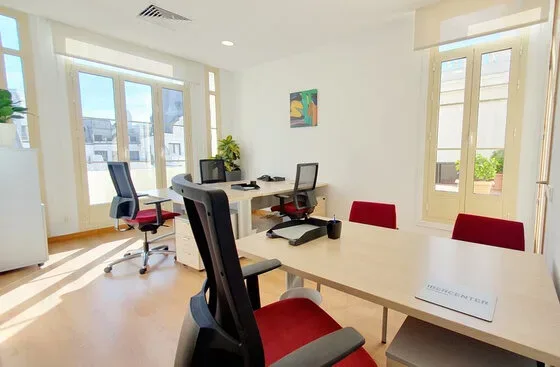
Yes. Renting or obtaining the right to use premises allocated to business activities is included among deductible expenses under direct assessment as a rental expense, and it is an ordinary accounting expense for Corporate Income Tax purposes. This includes an office or private workspace, a workstation in a flexible workspace, meeting or training room rental for a specific event, and business address or virtual office services, provided they meet a genuine business need and are invoiced in the name of the self-employed professional or company claiming the deduction.
The invoice must be issued in the name of the business owner or entity. We frequently see offices rented in the name of a shareholder but paid for by the company: in such cases, the expense lacks its principal supporting document. The invoice should also describe the space, rental period and services included.
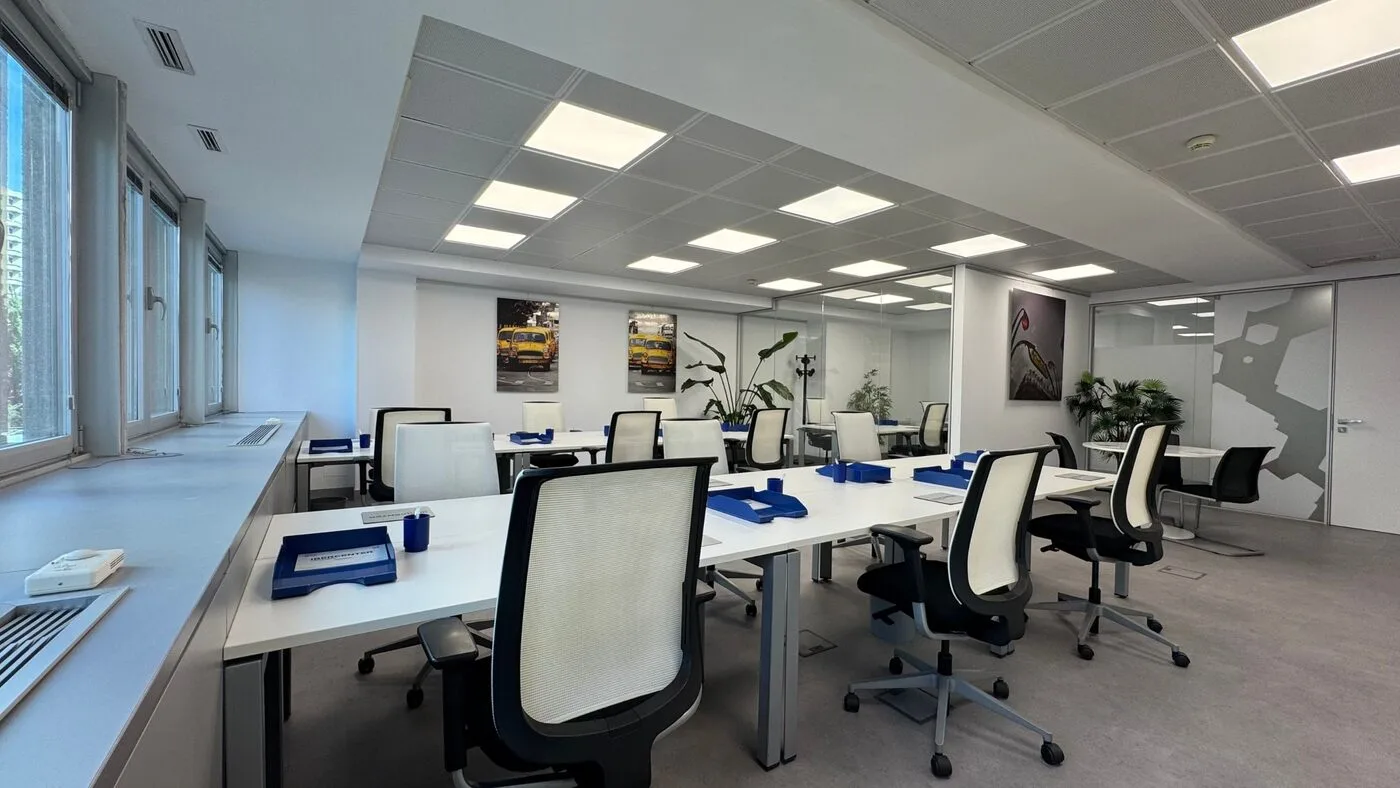
This is where flexible office rental offers an obvious administrative advantage: a single monthly fee covering the space, utilities, cleaning, connectivity and maintenance generates one invoice instead of five or six different suppliers, each with their own supporting documents. At our centres in Azca (Plaza Carlos Trías Bertrán, 4), Gran Vía (Gran Vía, 6) and Velázquez (Velázquez, 157), private offices start at €1,350 per month, while businesses that do not yet need physical premises can arrange a virtual office in Madrid or a business address plan from €40 + VAT per month. We do not promise any specific tax savings: the effect depends on each taxpayer's circumstances, but a single invoice certainly makes accounting simpler.
There is also a formal obligation that should not be overlooked. When a company or self-employed professional pays rent for an urban property used for business purposes, they must generally withhold tax from the rent and declare it using Form 115. The official 2026 withholding tax schedule sets the rate at 19%. Exceptions exist, and the treatment of business centre or virtual office services may differ from that of a straightforward property lease. We therefore recommend confirming the position with the provider and tax adviser before the first invoice. If you are considering a traditional office lease, this review is even more important.
Which expenses can an SME deduct for Corporate Income Tax purposes?
For Corporate Income Tax purposes, taxable profits are calculated from the accounting result, adjusted as required by law. This means that, in principle, a company's deductible expenses include all costs correctly recorded in the accounts, recognised on an accrual basis and properly substantiated, except those expressly excluded by law. Salaries and Social Security contributions, rent, utilities, professional services, marketing, insurance and depreciation form the usual basis of an SME's tax-deductible expenses.
Some expenses have quantitative limits. Client and supplier entertainment expenses are deductible up to 1% of net turnover. Net finance costs are deductible up to 30% of operating profit for the tax year, although up to €1 million is deductible in any case, meaning that the vast majority of SMEs are effectively unaffected by this restriction. Depreciation must reflect actual loss of value, which is presumed when the coefficients in the official schedule or another permitted method are applied.
For small companies whose turnover in the previous year was below €10 million, the law provides incentives affecting the timing of deductible expenses: new tangible fixed assets may be depreciated at twice the maximum straight-line rate in the schedules. As a general rule, new tangible fixed assets with an individual value not exceeding €300 may also be depreciated freely, up to a limit of €25,000 per tax period. These measures do not increase the total deductible expense; they bring the deduction forward.
One point for small companies where shareholders also work in the business: directors' and shareholders' remuneration, expenses paid by the company that are actually personal, and private use of company assets are subject to specific corporate and tax requirements. These matters deserve individual review with a tax adviser.
How does deductible VAT differ from deductible expenses for Personal Income Tax or Corporate Income Tax?
Input VAT is not an expense: it is a tax that a business pays in advance and, if the requirements are met, recovers by offsetting it against the VAT charged to customers. To deduct it, the Spanish Tax Agency requires the taxpayer to be a business or professional, carry out transactions giving rise to the right to deduct, use the goods or services for the business activity, hold an invoice meeting the legal requirements and recorded in the purchase invoice register, and exercise the right within four years of the VAT becoming chargeable.
Business use is treated differently from Personal Income Tax. For current goods and services, VAT is deductible only if they are used exclusively for business purposes; for capital goods, VAT is deductible in proportion to their degree of business use. In addition, some goods and services do not allow VAT deduction even when used in the business, unless they form the object of the business activity: jewellery and precious metal items, food, beverages and tobacco, entertainment and recreational services, and hospitality or gifts provided to customers, employees or third parties. VAT on travel, hotel and restaurant services is deductible only if the underlying expense is deductible for Personal Income Tax or Corporate Income Tax purposes.
This explains situations that may appear contradictory: a meal with a client may be a deductible expense for Personal Income Tax or Corporate Income Tax purposes, within the 1% limit, without the related VAT being deductible. That is why we recommend analysing each expense in two columns: direct tax and VAT.
Which expenses are never tax-deductible?
Corporate Income Tax legislation lists expenses that are not deductible, and the Personal Income Tax Law refers to those rules for self-employed professionals using direct assessment. The Spanish Tax Agency lists them on its page about non-deductible expenses: payments representing a return on equity, Corporate Income Tax itself, criminal and administrative fines and penalties, surcharges imposed during enforcement proceedings and surcharges for late filing without a prior request, gambling losses, donations and gifts, expenses arising from actions contrary to the legal system, and expenses for services involving tax havens where there is no evidence that they relate to genuine transactions.
There are important distinctions concerning donations and gifts. Client or supplier entertainment expenses (subject to the 1% limit), expenses customarily incurred for employees, sales promotion expenses and expenses linked to generating income are not considered gratuitous gifts and may therefore be tax-deductible.
In practice, the expenses most frequently rejected for self-employed professionals do not appear on that list but fail to meet the general requirements: personal or family expenses (everyday clothing, supermarket shopping, holidays), expenses without an invoice or with an invoice issued to someone else, mixed-use cars for Personal Income Tax purposes, traffic fines even when incurred while working, and expenses incurred before registering the business activity.
What are the most common mistakes involving tax-deductible expenses?
The first is confusing payment with supporting evidence. A charge to a business card does not prove that an expense relates to the business; it only proves that it was paid. Tax-deductible expenses require an invoice in the business owner's name and a connection with the activity. The second mistake is applying percentages based on hearsay: deducting 30% of the full household electricity bill, deducting 50% of car expenses for Personal Income Tax because that is how VAT works, or assuming that the 5% allowance for difficult-to-substantiate expenses applies under every tax system, when it exists only under simplified direct assessment.
The third mistake concerns timing. Allocating an expense to the wrong year, forgetting the annual adjustment of self-employed Social Security contributions, or mixing accrual accounting with the cash receipts and payments method creates discrepancies that the tax authorities can easily identify. Failing to retain documentation is also common: supporting documents must be kept throughout the limitation period, generally four years, and provided if requested.
The fourth mistake is failing to prepare for changes in invoicing requirements. According to the Spanish Tax Agency's information notice on extended deadlines, following Royal Decree-Law 15/2025, Corporate Income Tax taxpayers must adapt their computerised invoicing systems before 1 January 2027, while other affected taxpayers, including self-employed professionals, must do so before 1 July 2027. This is in addition to the forthcoming mandatory electronic invoicing between businesses, whose timetable depends on the implementing regulations. Both developments will make it easier for the tax authorities to cross-check declared deductible expenses against issued invoices, so it is advisable to verify the dates using official sources.
The final mistake is making decisions for tax reasons when they should be based on business needs. A deductible expense is still an expense: deducting it reduces tax liability, but does not make it free. If you have doubts about a particular expense, consult your tax adviser before claiming the deduction.
Frequently asked questions about tax-deductible expenses for self-employed professionals and SMEs
Which expenses can a self-employed professional deduct under direct assessment?
All expenses related to the business activity, supported by an invoice in their name and recorded in their books: self-employed Social Security contributions, rent for business premises or offices, accounting and advisory services, marketing, training, insurance, materials, business premises utilities, interest and depreciation, among others. Some are subject to specific limits, such as meals, health insurance, client entertainment and utilities for a home partly used for business.
How much electricity and internet can I deduct if I work from home?
30% of the proportion of the home's floor area allocated to business use, unless you can demonstrate a higher percentage. If your home office occupies 40% of the property, you can deduct 12% of utility expenses. Property-related expenses, such as property tax (IBI) or building community fees, are deductible in proportion to the business-use area, without that reduction.
What is the limit for difficult-to-substantiate expenses in 2026?
Under simplified direct assessment, 5% of positive net income, up to a maximum of €2,000 per year per taxpayer. It does not apply under standard direct assessment or Corporate Income Tax, and it is incompatible with the reduction available for certain business activities.
Is renting a private office or virtual office tax-deductible?
Yes, provided it meets a genuine business need and the invoice is issued in the name of the self-employed professional or company claiming the deduction. A single all-inclusive fee simplifies accounting. Renting urban property may entail an obligation to withhold tax and submit Form 115, which should be confirmed with a tax adviser.
Can I deduct my car if I also use it for personal purposes?
For Personal Income Tax purposes, generally not: passenger cars must be used exclusively for the business activity, subject to exceptions such as commercial agents or goods transport. For VAT purposes, however, business use is presumed to be 50%, allowing half of the VAT to be deducted, or more if a higher degree of business use can be demonstrated.
Is input VAT a tax-deductible expense?
No. If the requirements are met, input VAT is recovered by offsetting it against output VAT within four years of the tax becoming chargeable. Only when it is not deductible, for example in the case of client entertainment, may it form part of the cost of the expense. If in doubt, the relevant references are the Spanish Tax Agency's guidance and the advice of a tax professional.