How much does a flexible office cost in Madrid in 2026?
How much does a flexible office cost in Madrid? We break down the actual cost structure, explain what each model includes, and show you how to compare quotes without any nasty surprises.
TL; DR
The price of a flexible office depends on the cost structure, not a one-time fee. When someone asks how much a flexible office costs, the honest answer is "it depends on which model you choose and what's included in the fee." Under the umbrella of "flexible office" there is room for very different things: a virtual office (the cheapest model), a coworking space (intermediate cost) and a private office in the centre (the most expensive).
What really matters is not the figure that appears in the budget, but the total cost of occupancy: the fee plus everything that a traditional rental would force you to pay separately (reception, internet, cleaning, supplies, maintenance, furniture and rooms). In this article, we break down that structure, the factors that raise or lower the price, the hidden costs to ask before signing, and how to fairly compare quotes between suppliers.
What exactly is a "flexible office" and why doesn't its price compare "bareback"?
A flexible office is any workspace that is contracted as a service, with adaptable terms, rather than through a traditional long-term lease with an empty office. The key word is "flexible": you can start with a few positions and expand, hire for months instead of years, and go to work on the first day without having bought a single chair. Under that umbrella there are very different models, and that's exactly why asking how much a flexible office costs without specifying more is like asking how much a car costs: the range is so wide that the figure, on its own, doesn't tell you anything.
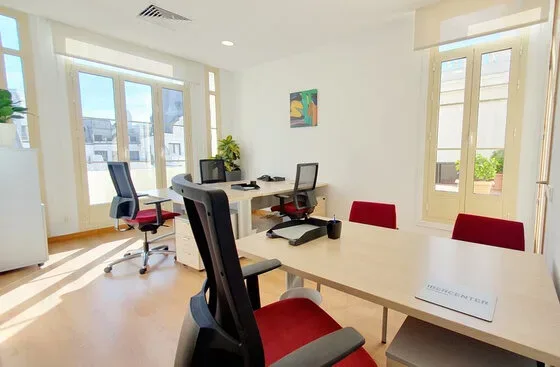
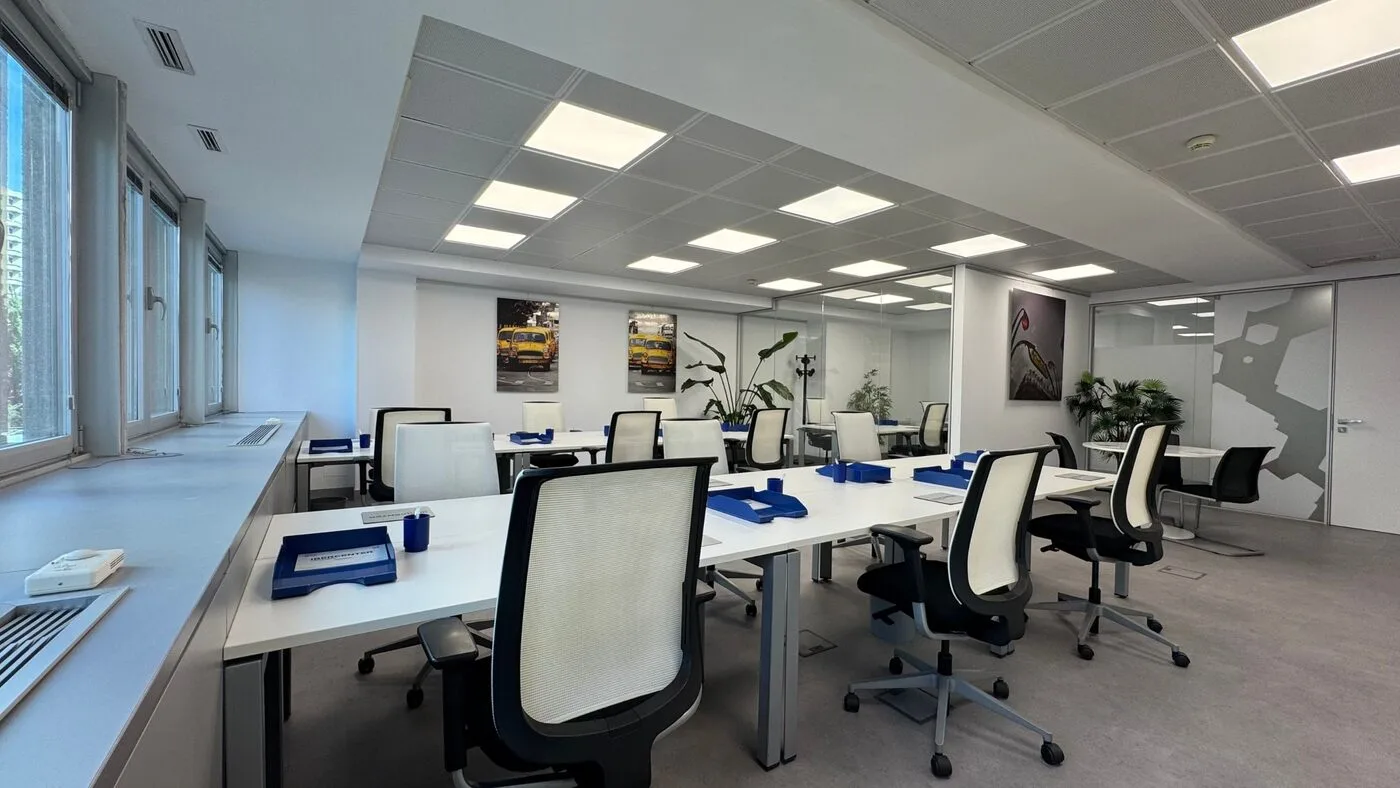
At Ibercenter, at our headquarters in Gran Vía, Azca and Velázquez, we attend every week to companies that arrive with the same question about the price of a flexible office and with a competitor's budget under their arm. The first thing we do is not give a number, but understand what they need: how many people, how often they go to the office, if they need a prestigious address to bill, how many meetings they have a week, if they plan to grow in six months. Without those answers, any price is a lottery. And the second thing we do is warn of something uncomfortable: two budgets that seem the same in the monthly payment can hide huge differences in what they include.
The sector is also in full expansion, which multiplies the variety of offers and makes it even more difficult to compare. According to the X-ray of the Coworking and Flexible Offices Sector in Spain by JLL and the Coworking Association, the stock of flexible space in Madrid exceeds 327,000 m² and operators contracted around 40,000 m² in Madrid and Barcelona during 2025, 5% of all office leases. With this growing supply, the buyer has more options than ever, but also more noise: the only way not to make a mistake is to understand the cost structure before looking at the tariff.
Which models fall under the flexible office umbrella?
Under the term "flexible office" there are at least four products with different pricing logics. The first is the virtual office: you do not occupy a permanent physical space, but you hire a professional address to domicile your company, receive correspondence and, depending on the plan, answer calls or use rooms occasionally. It is, by far, the most economical model, because you do not pay for exclusive use square meters. The second is coworking: a workstation in a shared space, with common areas, which you can hire for days or months. Its cost is intermediate and depends a lot on whether the position is fixed or "floating".
The third model is the private office within a business center: a closed office, for the exclusive use of your team, fully equipped and with all the services of the building included. It is the highest-cost model of the four, because you pay exclusivity, privacy and square meters, but also the one that comes closest to "having your own office" without any of the charges of a traditional rental. The fourth is the rental of rooms by the hour (meetings, training, interviews), which is not a permanent office but a one-off resource, and which many companies combine with a virtual office or coworking to avoid paying for meters that they would only use from time to time.
These four models are not watertight compartments: the interesting thing about a flexible office is precisely that they are combined and scaled. At Ibercenter we see freelancers who start with a virtual office to have a tax address at a prestigious address, migrate to a coworking position in Azca when they hire the first employees and end up in a private office when the team grows. The price evolves with them, without traumatic moves or broken contracts. That's why the right question is not only how much it costs today, but how much it will cost to accompany you in each phase.
Why is comparing only the monthly payment misleading?
Comparing flexible offices looking only at the monthly payment is the most expensive and most frequent mistake we see. The quota is the visible part of the iceberg; Below is everything that quota includes or leaves out. An office that "seems more expensive" can be cheaper in practice if it includes reception, high-speed internet, air conditioning, daily cleaning, furniture, maintenance, supplies and access to rooms, while another "cheaper" one forces you to hire and pay for all that separately. The quota figure, isolated, does not tell you which one comes out better.
The problem is compounded by the fact that each provider packages services differently. One includes X hours of room time per month; another always collects them separately. One provides symmetrical high-capacity internet; another offers a basic connection and sells you the "upgrade". One keeps the reception staffed by people all working hours; another has an empty counter and an app. All of that influences the actual outcome of working there, but it doesn't show up if you compare just the first line of the budget. It's like comparing two plane tickets without looking at whether one includes a suitcase, seat and changes and the other doesn't.
Our recommendation, when someone asks us how much a flexible office costs compared to an alternative, is always the same: don't compare installments, compare total occupancy cost and compare what each model includes. Later we break down both things concept by concept. The basic idea is that the price of a flexible office is the sum of decisions (model, area, meters, services, permanence) and that only by understanding that sum can you know if a budget is competitive or if it hides extras that will shoot up the bill the second month.
What do you actually pay for in a flexible office? The cost structure
What you pay in a flexible office is broken down into two large blocks: what is included in the fee and what is billed as an extra on demand. The beauty of the turnkey model is that most of the recurring costs of having a flexible office (those that in a traditional rental come to you in separate bills each month) are within a single predictable installment. That reduces surprises, simplifies accounting, and eliminates the management of a dozen suppliers. But "the majority" is not "everyone," and knowing where the border is is what allows you to budget well.
In the block of what is included there is usually: the use of the space (workstation or office), the reception and answering of calls, the internet connection, air conditioning, cleaning, maintenance of the building, furniture, electricity and water consumption, security and, very often, a quota of common areas (office, cafeteria, telephone booths). The block of extras usually includes: meeting room hours above an included deductible, advanced secretarial services, parking, catering for meetings, access during extended hours or holidays, and personalisation with your brand image. There is no universal standard: each center draws the line in a place.
At Ibercenter we start from a simple principle: the more the fee is included, the easier it is for the customer to foresee their expense and the fairer the comparison with a traditional rental. That's why, when we put together a budget, we clearly separate what is recurring and what is punctual, and we leave it in writing. The first table summarizes what each flexible office model typically includes; just after we added a second one with an indicative price range for Madrid in 2026. They are approximate and range figures, never closed rates: the amounts change with the area, the headquarters, the number of stalls, the services included and the market moment, so use them as a compass of the order of magnitude and always consult the updated rate.
| Model | What it usually includes | Who is it best suited for? |
|---|---|---|
| Virtual Office | Professional address, business address, mail and parcel reception, call answering according to plan, occasional use of rooms | Self-employed, online companies, businesses that invoice but do not need a daily physical position |
| Coworking | Workstation (fixed or floating), internet, air conditioning, cleaning, common areas, cabins, coffee | Freelancers, small teams, early-stage or growth companies |
| Private office | Closed office for exclusive use, furniture, all building services, reception, rooms according to franchise, maintenance | Teams that need privacy, confidentiality and their own headquarters without the burdens of rent |
| Rooms by the hour | Equipped room, projection/screen, Wi-Fi, reception service, coffee according to service | One-off meetings, trainings, interviews, committees; Virtual Office or Coworking Plugin |
It is convenient to read this table as a map, not as a closed label. In practice, almost all clients end up with a combination: a private office plus a franchise of rooms, or a virtual office plus room sessions when they receive clients. The cost of a flexible office is, in the end, the cost of that specific package that you design for your way of working, and that is why the same provider can give you very different figures depending on what you put inside.
To put magnitudes on this composition, this second table orders the flexible office models from lowest to highest cost with a monthly indicative range for Madrid in 2026. We insist on the nuance: they are wide and approximate ranges, designed only to give you an idea of the order of magnitude, not Ibercenter rates or closed figures that you can take for granted.
| Model | Monthly indicative range in Madrid (2026)* | What moves the range |
|---|---|---|
| Virtual Office | From about €30-50 per month in its most basic version; around €100-150 per month with call answering and room hours included | Service level: direct debit, call management, room hours |
| Coworking Booth | Approximately €150 to €400 per month per stall, depending on whether it is floating or fixed | Floating or fixed station, location and number of days of use |
| Private office | Around €300-600 per month per position or person, depending on location and team size | Location, number of seats, meters and service allowance included |
| Meeting room by hours | From about 30-60 € per hour, depending on size, venue and equipment | Room size, venue, equipment and catering |
*Indicative and approximate figures for Madrid in 2026; They vary according to area, headquarters, number of stalls, services included and time of the market. These are not Ibercenter rates: check the updated rate for your specific case.
As you can see, the leap from a virtual office to a private office is not a percentage, but an order of magnitude, and within each flexible office model the range is once again wide. That's why none of these figures should be read as a firm price: they're the starting point for asking for a flexible office budget adjusted to your actual setup, never the end of the conversation.
What concepts make up the fee of a private office?
The fee for a private office in a business centre brings together, in a single monthly amount, a list of items that in a traditional rent you would pay separately and manage yourself. The first and most obvious is the use of space: the meters of the closed office, for the exclusive use of your team. From there, the quota incorporates the technological infrastructure (high-speed internet, Wi-Fi, network), supplies (electricity, water, air conditioning) and building services (daily cleaning, maintenance, security, waste management). None of that comes to you in single bills: it goes inside.
The second major block is that of shared professional services. This includes the attended reception that answers calls with the name of your company, the management of correspondence and parcels, the reception of visitors, access to common areas (office, cafeteria, soundproofed telephone booths) and, usually, a franchise of meeting room hours included per month. These are services that, assembled one by one on your own, would cost time and money, and that in the turnkey model are already operational from day one. Furniture is also part of the package: tables, ergonomic chairs, cabinets; you don't buy anything.
The third block, more variable, is that of customization and optional extras. You can label the office with your brand, expand the franchise of rooms, hire parking, order catering for an important meeting or activate access during extended hours. These concepts do not usually go in the base fee because not everyone needs them, and including them "as standard" would make the offer more expensive for those who do not use them. Understanding this three-block architecture (space + shared services + extras) is the best way to read any budget for offices for rent in Madrid and know exactly what you are comparing.
What does a turnkey business center include vs. a traditional rental?
The difference between a turnkey business center and a traditional rental is not one of price, it is of model: one sells you an operational service and the other sells you empty meters. In a traditional rental you sign a long-term contract, you receive four walls and, from there, everything is on your account: the renovation, the furniture, the switchboard, the internet, the electricity contract, the cleaning contract, the maintenance, the insurance, the reception. Each of those things is a supplier, an invoice, and a potential problem. The rental fee is just the tip; Below is a complete operation that you have to assemble and hold yourself. A flexible office turns that logic on its head: instead of empty meters, you contract the entire operation already resolved.
In a business center, on the other hand, all that is already set up and running, and it comes into a single installment. That is why comparing the "rent per square meter" of a traditional rental with the fee of a flexible office is misleading: they do not include the same thing. In rent, the square meter is cheaper on paper, but bare; In the flexible office, the square meter is dressed with all the services on top. The fair comparison requires adding, in the rental scenario, everything you would have to pay separately, and then the distance becomes very narrow, especially for small and medium-sized teams that do not have anyone dedicated to managing an office.
At Ibercenter we experience this constantly when a client compares one of our offices for rent in Madrid with a premises under a traditional regime. The conversation always starts with the quota and always ends with the same question: "and what does this save me in time and bills?". The answer is the table below, which compares concepts, not matters: who assumes each item in each model. It is probably the most useful tool in the entire article to understand why the price of a flexible office cannot be read without this context.
| Concept | Turnkey business center | Traditional rental |
|---|---|---|
| Work and refurbishment | Not applicable: you go to work | At your expense before you start |
| Furniture | Includes | You buy it yourself |
| Internet and network | Included and operational | You hire and install it yourself |
| Receiving and calling | Included, attended | Hire staff or service |
| Cleaning and maintenance | Included | Own suppliers |
| Utilities (light, water, weather) | Included in the quota | Registrations and invoices in your name |
| Meeting rooms | Excess included + extra on request | You ride or rent them outside |
| Domiciliation and address | Included | You manage it on your own |
| Permanence | Short and scalable | Long, with penalties |
| Time to Operate | Days | Weeks or months |
When a customer sees that table, they suddenly understand why two numbers that "don't look alike" can mean the same thing or even why the apparently expensive one is more cost-effective. The business center doesn't compete on price per meter; Compete on total cost and time. And in a market where opening a traditional office can take weeks of work and dozens of paperwork, starting work in days has a very real economic value that almost never appears when someone asks, simply, how much a flexible office costs.
What factors make the price of a flexible office go up or down?
The price of a flexible office moves according to a handful of identifiable levers, and knowing them gives you negotiating and design power. It's not a number that falls from the sky: it's the result of decisions you can adjust. If you understand what moves each lever, you can build a flexible office that fits into your budget without giving up the essentials, rather than accepting the first package you're offered. In this section we go over the main levers, one by one, with the logic of why each one goes up or down in cost.
The idea we want to convey is that the price of a flexible office in Madrid is not high or low in the abstract, but appropriate or not for your specific configuration. An office for eight people on the best corner of Gran Vía, with unlimited rooms and 24/7 hours, will be expensive by definition, and it will be good that it is, because you are paying exactly that. The same equipment in an excellent venue but with a franchise of rooms adjusted to its real use and standard schedule will have a significantly lower cost. Neither option is "the right one": it depends on what you need the office for.
Before we get into each factor, a method warning. When asking for a quote, don't ask for "the price of an office": ask for the price of your office, describing the levers that you will see below. A good supplier will ask you precisely those questions before giving you a figure, and if someone drops you a number without asking you anything, be suspicious: either they are rounding up to cover themselves, or they will give you a price that will then be filled with extras. Transparency in the levers is the first sign of an honest budget.
How much influence do the area and the specific venue have?
Location is the lever that moves the price of a flexible office the most, and by far. The heart of Gran Vía, the financial hub of Azca or the Salamanca neighbourhood in Velázquez is not the same as a peripheral or secondary area. Prime locations concentrate demand, prestige and connectivity, and this is reflected in the cost per position or per office. You pay for an address that says something when you put it on a card, on a bill or in your email signature, and for being five minutes from the metro, banks, customers and restaurants to close a meeting.
Within the same city, and even within the same operator, the specific headquarters introduces nuances. A top floor with views, an emblematic façade or a recently renovated building have a plus compared to an interior floor or a more functional property. The maturity of the area as a business hub also plays a role: Azca, for example, is a consolidated financial district, and that has value for companies that want to be where their peers, their banks and their advisors are. The headquarters is not an aesthetic detail: it is part of the product you buy.
Now, location is also the easiest lever to calibrate according to your priority. If what you need is a prestigious address to invoice and receive mail, but you work remotely, a virtual office in a prime location gives you prestige without paying for the meters. If your team goes daily and values connectivity, it makes sense to invest in the best location. If prestige matters less than budget, you can look for an excellent venue but not the most sought-after. At Ibercenter, having three locations in different areas of Madrid allows us to do just that: to offer the level of location that each customer needs, without forcing them to pay for one that they would not take advantage of.
How do the meters and the number of stalls affect it?
The square meters and the number of seats are the most intuitive lever: the more space and more people, the higher the absolute cost. But there are two nuances that almost no one takes into account and that change the result a lot. The first is that the cost per position tends to fall as the team grows: an office for ten people rarely costs twice as much as one for five, because many shared services (reception, common areas, internet) are distributed among more people. Climbing has an economy in its favor that should be taken advantage of.
The second nuance is that of underutilized space. Many companies pay for unused meters because they size the office for the busiest day, which occurs once a month. With hybrid models, in which not all the equipment goes on a daily basis, it makes more sense to hire a space adjusted to real use and complement it with rooms by the hour or with flexible positions for peaks. Paying for a meeting room of your own that you use two hours a week is throwing money away; hiring those two hours when you need them is efficiency. Smart sizing is one of the fastest ways to lower the cost of a flexible office without losing capacity.
In the projects we accompany, we spend time precisely on this calculation before proposing anything. We ask how many people will go daily, how many occasionally, how many weekly meetings there are and of what size. With this data, we size the space so that you don't overpay or fall short, and we leave room to grow without moving. A good flexible office provider doesn't sell you the largest office they can: they help you get the size right, because they know that a well-sized client stays for years and a client who pays dead meters leaves as soon as they renew.
Why do the type of space and the services included change the bill so much?
The type of space (virtual, shared workstation, closed office) sets the floor for the price of a flexible office, and the services included mark how much "all-inclusive" that floor really is. We have already seen it: a virtual office is the most economical model because you do not pay for exclusive use of meters; coworking is intermediate; The private office is the most expensive because you add exclusivity, privacy and surface area. Choosing the right type of space is the decision with the most impact on the bill, even above the area, because it defines the nature of what you pay.
Within each type, the level of services included does the rest. The same office can have a very different fee depending on whether it includes a large franchise of rooms or none at all, reception attended by people or an automated counter, basic internet or symmetrical high-capacity connection, daily or weekly cleaning. This is where the comparison between suppliers comes into play the most: two identical offices in meters and area can have different prices simply because one comes "more dressed". And the most dressed is not always the best for you: if you are almost never going to use theaters, paying a huge franchise is absurd.
Our way of working at Ibercenter is modular: we start from a core of services that we consider essential (attended reception, quality internet, cleaning, maintenance, common areas) and we let the client adjust the rest to their real use. Thus, those who receive clients on a daily basis hire a generous franchise of meeting rooms in Madrid , and those who hardly use them hardly pay for them. That fine-tuning is what turns a generic price into a fair price, and it's impossible to do if you're comparing closed packages without breaking down what's inside.
How much does permanence and the degree of flexibility weigh?
Permanence and flexibility have a direct and inverse relationship with the price of a flexible office, and understanding it helps you negotiate. As a general rule, the longer you stay (longer contracts), the better quota you can get, because the provider ensures income and can adjust. And the other way around: extreme flexibility (coming in and out month by month, expanding and reducing whenever you want) has a small extra cost, because the supplier assumes the uncertainty of your turnover. It's not an abuse: it's the price of the option to change your mind, just as a refundable ticket costs more than one that isn't.
Here is a strategic decision that every company must make consciously. If you have clear visibility that you're going to be in the same place and the same size for a long time, committing to a longer term can improve your share. If you're in an uncertain moment (a startup that doesn't know if it will double staff or pivot, a company that opens a trial branch, a project with an expiration date), paying a little more for total flexibility is an investment, not an expense: it saves you the risk of being tied to a space that no longer fits. Flexibility has an economic value that is paid for in the installment but is recovered in peace of mind and in the absence of penalties.
What is worth looking at with a magnifying glass is the small print of permanence: what is the minimum period, what notice must be given to leave, what penalty exists if you leave early, and whether the increase in positions is guaranteed or subject to availability. A "flexible" contract that actually ties you down with penalties isn't flexible, it's traditional rent in disguise. At Ibercenter we defend real flexibility (short stays, scaling without traumas) because we believe that a free customer is more loyal than a trapped one, but we recommend that everyone read these clauses in any provider before signing.
What extras should you look out for: opening hours, rooms and other services?
The extras of a flexible office are the item that gives the most discomfort when they are not agreed in advance, because they are the concepts that "did not come in the quota" and that accumulate month by month. The opening hours come first: many centres include access during standard working hours and charge separately for access at night, on weekends or holidays. If your team works after hours, that extra is no longer anecdotal. It is worth asking explicitly: what schedule is included and what is billed as extended?
Meeting rooms are the second classic extra. Almost all models include an excess of hours per month, and hours above that are charged. If you receive customers or make committees frequently, calculate your real consumption of rooms and compare it with the franchise included, because there can be a big difference from one provider to another. The same applies to services such as parking (rarely included, almost always extra in the centre of Madrid), catering for meetings, advanced secretarial, branded signage or special parcel services. None is an abuse; they are simply not universal and that is why they are charged separately.
Our recommendation is to turn those extras into a list of questions before signing, and ask that the budget reflect them even if you don't hire them at the beginning, so you know what to expect if you ever need them. A transparent provider will give you that list without a problem; one that dodges it is probably hiding right there the margin. Asking about extras is not distrustful: it is the professional way to know how much a flexible office really costs in your real scenario, not in the ideal scenario of the brochure.
What is total cost of occupancy and why does it matter more than the fee?
The total cost of occupancy is the sum of everything it costs you to occupy a space: the fee plus each additional item needed to operate. It's the only number that allows you to compare pears to pears between a flexible office and a traditional rental, or between two flexible office providers that package differently. While the quota is a partial data, the total cost of occupancy is the complete data, and it is the one you should have in front of you before deciding. If you only look at the odds, you're deciding with half the information.
Calculating it is conceptually simple: you take the quota and add everything that in that scenario you would have to pay separately to work. In a well-packaged, flexible office, that sum is almost equal to the quota, because almost everything goes inside. In a traditional rental, on the other hand, the rent must be added to amortized furniture, internet, electricity, water, cleaning, maintenance, reception, rooms, insurance and the cost (in time and money) of managing all these suppliers. When you put both scenarios in the same unit of measurement, the comparison becomes honest and often surprising. The following table lists the concepts that must be added so as not to leave anything, without amounts: the exercise is yours, with your real figures.
| Block | Items to be added to the total cost of occupancy |
|---|---|
| Space | Fee or rent for the stall/office, fee for common areas |
| Infrastructure | Internet, network, telephone, air conditioning |
| Supplies | Electricity, water, waste management |
| Services | Reception, cleaning, maintenance, security |
| Equipment | Furniture (purchase or depreciation), replacement |
| Meetings | Cinemas above franchise, catering, projection |
| Commissioning | Work, moving, utility registrations, network installation |
| Management | Team time spent managing the office |
Look at the last two rows, which almost no one counts. The start-up of a traditional rental (work, moving, registrations, wiring) is an initial outlay that can be considerable and that in a flexible office simply does not exist: you go in and work. And management (the time someone on your team spends dealing with the electrician, cleaning company, and operator) is a real cost even if it doesn't appear on any bills. When you add these two rows together, the flexible office wins out for most small and medium-sized teams, who don't have anyone to spare to act as an office manager.
How is the total cost of occupancy calculated in practice?
In practice, calculating the total cost of occupancy starts by deciding on a time horizon (e.g. one year) and listing, for each option you compare, all the items in the table above with your best estimate. For the flexible office, most of those rows will say "included in the quota," so the exercise is quick. For traditional rental, you will have to ask for quotes from each provider (internet, cleaning, maintenance, furniture) and estimate the management time. That contrast, made honestly, is the comparison that really matters.
We recommend annualizing start-up costs so that the comparison is fair. The work and furniture of a traditional rental are one-time outlays, but they represent a cost that must be spread over the time you are going to use the space. If you amortize an expensive renovation in a few years, the annual cost rises a lot; If you divide it over many, it goes down, but you assume that you will stay there that long, which clashes with the uncertainty that a growing company usually has. The flexible office avoids this dilemma because it does not require an initial investment: its cost is transparent from month one.
The result of this exercise is not always in favour of the flexible office, and being honest with that is part of our job. For a large corporation that needs thousands of meters in the very long term and with its own identity, traditional renting (or even buying) may be better per meter. The flexible office shines in the terrain where most companies live: teams that grow, that value predictability, that don't want to tie up capital in a renovation and that prefer to pay to use rather than to own. Knowing which case you are in is what turns the calculation into a decision, and not an intuition.
What are the most common hidden costs when renting a flexible office?
The hidden costs of a flexible office are not illegal traps, but legitimate concepts that some providers do not highlight in the first conversation and that, when added together, alter the real price. The most common is permanence and its penalties: a contract with a long minimum term and an early exit penalty turns an "attractive installment" into an expensive commitment if your plans change. Always ask for the minimum term, the notice and the penalty before looking at the fee, not after.
The second group of hidden costs is insufficient service allowances. A short cinema franchise that sells out in the middle of the month, a time limit that forces you to pay for access, a basic internet that you need to improve: these are predictable extras that do not appear in the base fee and that accumulate. The third is deposits and deposits, which are not a lost cost but an initial outlay that should be known when planning cash flow. And the fourth, more subtle, are the increases and revisions: how and when the quota can be raised, and if there are update clauses. The table below brings together the questions we recommend you ask, expressly, before signing any flexible office contract.
| Potential hidden cost | Question to ask before signing |
|---|---|
| Permanence | What is the minimum term and penalty for leaving early? |
| Advance notice | How far in advance do I have to give if I don't renew? |
| Rooms | How many hours of room time are included in the fee and how are the extra ones charged? |
| Opening hours | What schedule is included and how much does extended access cost? |
| **Supplies ** | Are they all included or is there any consumption that is billed separately? |
| Bail | What deposit is required and when is it returned? |
| Reviews | How and when can the quota be updated during the contract? |
| Parking and extras | Are parking, catering or signage separate? |
Asking these eight questions takes you five minutes and saves you surprises throughout the contract. A serious supplier will answer all of them bluntly and in fact appreciate you doing them, because a customer who understands what they sign is a customer who stays. If you notice evasiveness, vague answers, or "we'll see about that," there's probably the hidden cost. At Ibercenter we put these answers in writing in the budget precisely so that the comparison with any other provider is transparent and so that no one discovers an extra in the second month.
Our experience says that the most expensive hidden cost is not any of those in the table, but an intangible one: choosing the wrong model. Hiring a large office when a coworking space was enough, or tying yourself to a long stay when the business was still uncertain, costs much more than any franchise of rooms. That is why we insist so much on diagnosing well before contributing. The cheapest budget in the world is expensive if it's for the wrong space, and the best savings aren't in haggling over the odds, but in getting the setup right from the start.
How much is flexibility worth? The cost that does not appear in the quota
Flexibility has a specific economic value that does not appear in any line of the budget of a flexible office but that has a full impact on your income statement. That value comes in three main ways: avoiding upfront investment, avoiding getting tied down, and being able to scale frictionlessly. None of them appear as a game with an amount, but all three are real money, and often more money than separates two monthly installments. Ignoring the value of flexibility is a reflection of the same mistake of looking only at the quota: you look at what is visible and miss what is important.
Avoiding the initial investment means not tying up capital in a renovation, in furniture and facilities that, if the business changes, you do not recover. That capital that you don't spend on setting up an office can be used for products, sales or hiring, which is where a company really grows. For a young or expanding company, not tying up a sizable amount on the walls is a huge financial advantage, even if it doesn't show up in the odds comparison. The flexible office turns a large capital investment into a predictable operating expense, and that, in terms of cash, is worth a lot.
Avoiding being tied down and being able to climb is the flip side. A team that grows from five to fifteen people in a year cannot afford a rigid contract that forces them to break penalties or move with work in between. In a flexible office, that team adds positions and offices as they sign people, without trauma. And a team that contracts can reduce without being trapped by paying empty meters. That ability to adapt the space to the real size of the business, month by month, is exactly what traditional renting lacks and what justifies the flexibility being paid a little more in the installment: because it returns much more than it costs.
A real example of why comparing only the odds is expensive?
We illustrate this with an anonymized case that summarizes a conversation we often have. A tech team of about seven people came in comparing a coworking booth to a traditional rental of a small venue, and their spreadsheet only had two numbers: the coworking fee and the rent of the venue. On those two numbers, the home team "won". But when we broke down the rental scenario, the picture changed: we had to add reform, furniture, registration and internet contract, electricity, water, cleaning, a reception service or someone's time attending, and rooms for meetings with clients that they did almost daily.
When both scenarios were converted to total occupancy cost and annualized start-up, the difference was reversed. The rent required a heavy initial outlay and several weeks of work before being able to work; The flexible office left them operational in days, without investment and with everything included. But the argument that really convinced them was not money: it was uncertainty. They hoped to close a round and perhaps double the workforce in a year, and tying themselves to a premises sized for seven people with a long contract was a risk they could not take. The flexibility of growing without moving was worth more than any savings in the installment for them.
This case does not mean that the flexible office always wins; It means that honest comparison requires looking beyond the quota. That team made an informed decision because it put all the variables on the table, not just the most visible. That's exactly the exercise we propose to anyone who asks us how much a flexible office costs: don't stay with the headline, break down the total cost, assess the flexibility and decide with the whole picture. The correct answer depends on your case, and it only appears when you really compare.
How to compare flexible office budgets fairly?
Comparing flexible office budgets fairly is all about matching the scope before comparing the price: make sure every quote includes the same thing, and only then look at the figure. Most comparisons fail because they face different packages as if they were the same. The solution is simple but requires method: first define what you need (model, stalls, area, services, schedule, rooms, permanence) and ask each supplier to quote exactly that, with the extras broken down. This way you compare equivalent configurations, not brochures.
The second principle is to translate everything into total annual occupancy cost. A quote may seem cheaper in the installment and more expensive once you add deposit, room extras, schedule and start-up. Annualize each option, include what each scenario would require you to pay separately, and compare the totals. This exercise, which people rarely do, is what separates a well-made decision from a regret after three months. It's no more work than you'd put into comparing two cars or two mortgages, and a flexible office is a similarly important compromise.
The third principle is to value what is not paid in money but counts: the quality of the service, the actual location, the flexibility of the contract and the trust in the supplier. A centre with a reception staffed by people, responsive maintenance and a team that knows you is worth more than one that is identical on paper but unattended in practice. At Ibercenter, with more than thirty years operating flexible offices in Madrid, we have learned that the customer who compares well (equal reach, total cost, service included) is the one who stays for years, because they made their decision with criteria and not with a headline. To help you do that, here's a final checklist before you sign:
• Equalize the scope: same model, stalls, area, services, schedule, rooms and permanence in each budget.
• It translates everything into total annual occupancy cost, not monthly fees.
• Add up the start-up and annualize it if you compare it to a traditional rental.
• Ask for the extras itemized in writing, even if you don't hire them at the beginning.
• It reviews permanence, notice, penalty and quota review clauses.
• Value service, real location, and flexibility, not just the number.
• Ask for a visit: the feeling of working there doesn't fit in a spreadsheet.
Which flexible office model is suitable for the phase of your company?
The right flexible office model depends less on budget and more on the phase and way of working in your company. There is no such thing as "the best model" in the abstract: there is the one that fits your moment. A self-employed person who invoices from home, a five-person startup that grows fast and a consolidated company that opens a branch in Madrid have such different needs that the price response is also different. Choosing by phase, and not by the lowest figure, is what avoids overpaying or falling short.
For those who do not need a daily physical position (remote professionals, online businesses, companies that want a prestigious address to invoice), the virtual office is almost always the most efficient answer: prestige and services without paying meters. For small or early-stage teams that do go to the office but value lightness, coworking offers workstation, community, and total flexibility without committing to an office. And for teams that need privacy, confidentiality or their own headquarters (by number of people, by type of work or by image), the private office is the model that gives all that without the burdens of traditional rent.
The powerful thing about a good flexible office is that it accompanies you between phases without forcing you to start from scratch every time. At Ibercenter we see this journey continuously: the virtual address that becomes a coworking station, the position that becomes an office, the office that grows to two when the team doubles. Each jump is made within the same provider, without traumatic move, maintaining direction and relationships. That continuity has a value that is rarely calculated but that saves money and disappointment. The following table gives qualitative guidance as to which model usually fits into each phase.
| Company phase | Model that usually fits | Why |
|---|---|---|
| Self-employed or online business | Virtual Office | Domicile and prestige without paying for a physical position |
| Very small team / early stage | Coworking | Total flexibility, community, zero investment |
| Growing team | Coworking or small, scalable office | Add seats as you sign |
| Company that needs privacy | Private office | Confidentiality and own headquarters without traditional rental |
| Consolidated company delegation | Private office at prime venue | Image, location and operation ready in days |
The practical conclusion is that the question "which model should I choose?" be solved before "how much does it cost?", because the model determines the price range. Getting the flexible office model right is 80% of getting the cost right. That's why, when someone asks us for a quote, the first thing we do is not quote, but understand their phase, and only then do we put numbers. It's slower, but it's the only way that the price we give is the price of your office, not that of a generic flexible office that doesn't exist.
Where to start if you want a figure adjusted to your case?
Starting off right is about coming into the budget conversation with your variables clear, because a good supplier quotes on data, not assumptions. Before asking for a price, have at hand how many people will go to the office (daily and occasionally), in which area you want to be, how many meetings you have per week and of what size, what hours you work and what growth forecast you have for the coming months. With those answers, any serious provider can give you an adjusted figure instead of a generic range that doesn't serve to decide.
The sector is in your favour in terms of supply. Market reports from consultancies such as CBRE on flexible offices in Madrid and Barcelona confirm that the contracting of flexible space continues to grow and that private law firms have consolidated their position as the dominant product, with high and stable occupancy levels. More choice and more maturity mean more options for you and more professionalised suppliers, but also more need to compare flexible offices judiciously so as not to get lost in packages that look the same and are not. That's where this cost structure breakdown gives you an advantage.
At Ibercenter, when we are asked how much a flexible office costs, we do not respond with a brochure fee: we respond with questions, diagnose the phase and the need, and only then do we propose a tight configuration and price, with everything broken down and in writing. We believe that's the only honest way to quote a workspace, because the right price is for your concrete flexible office, not an abstract office. If you have come this far understanding how that price is formed, you are already in a position to ask for a quote and compare like a professional. The next step is simple: tell us about your case and we will give you an updated, adjusted figure with no surprises.
Frequently Asked Questions
How much exactly does a flexible office cost in Madrid?
There is no single exact price, and be wary of whoever gives it to you without asking you anything first. How much a flexible office costs depends on the model (virtual, coworking or private office), the area and headquarters, the number of seats and meters, the services included, the schedule, the rooms and the permanence you choose.
Changing any of these levers moves the price, so the same question can have very different answers for two companies that, at first glance, seem the same. That said, we can offer you an indicative range of the price of a flexible office for Madrid in 2026: a virtual office starts at around €30-50 per month; a coworking space moves, approximately, between €150 and €400 per month; and a private office in a business centre is in the order of €300-600 per month per person, depending on the headquarters and size. These are indicative and range figures, which vary according to area, headquarters, number of stalls, services included and time of the market; These are not fixed rates, so check the updated rate for your case. The honest thing to do is not to give a prospectus figure, but to explain what the price of a flexible office depends on and calculate it on your actual configuration.
Our recommendation is not to look for "the price" but to ask for a quote adjusted to your specific configuration, with the extras broken down and translated into total cost of occupancy. This way you get a figure that is useful for deciding and comparing, instead of a generic range that would be outdated as soon as the market changes. If you tell us how many people you are, what area you want to be in and how you work, we give you an updated and realistic figure. Any number you see out there without that context is indicative and varies according to location, services and market moment; Always check the updated rate.
Is a flexible office cheaper than a traditional rental?
It depends on how you measure it, and that's the key. If you compare only the monthly fee for the flexible office with the rent per square meter of the traditional rental, the rent usually seems cheaper, because its fee is "naked": it does not include furniture, internet, cleaning, reception, supplies or rooms. But that comparison is misleading, because you're not comparing the same thing. In rent, you pay for and manage all these services separately, and you have to add them up.
When you transfer both scenarios to total occupancy cost (fee plus everything that each model requires to be paid separately, including commissioning and management time), the distance becomes very narrow and, for small and medium-sized teams, the flexible office is often cost-effective or even cheaper. In addition, it avoids the initial investment in construction and furniture and eliminates the risk of getting tied down. For a large corporation with thousands of meters in the very long term, traditional rental may be better per meter; For most growing companies that value predictability, the flexible office wins in the overall count.
Which is cheaper: virtual office, coworking or private office?
In increasing order of cost, the virtual office is the most economical model, coworking is at an intermediate level and the private office is the most expensive. The logic is simple: the virtual office does not include exclusive use of physical meters, only management and services, which is why it is the cheapest; coworking gives you a place in a shared space, with which you pay for some surface area but distributed; and the private office adds exclusivity, privacy and meters of own use, which makes it the most expensive of the three.
However, "cheaper" does not mean "better for you". A private office can be the most profitable option if you need confidentiality, receive clients on a daily basis or give an image of your own headquarters, because coworking would not give you that. And a virtual office can be a waste of money if you really need a physical workstation to work at every day. The right question is not which one is the cheapest in the abstract, but which one fits your phase and your way of working, because that fit is what determines whether the price is fair or wasted.
What hidden costs should I ask before signing?
Before signing any flexible office contract, explicitly ask about seven things: the minimum length of stay and the penalty for leaving early, the notice not to renew, how many room hours are included in the fee and how the extra are charged, what hours are included and how much extended access costs, if all supplies are included, what deposit is required, and how the fee can be updated during the contract. To that he adds parking and other extras such as catering or signage, which are rarely in the base fee.
None of these concepts is a trap; These are legitimate items that some suppliers do not highlight in the first conversation and that, when added together, change the real price of a flexible office. A transparent supplier will answer all of them bluntly and write them down in the quote, precisely so that you can compare with others fairly. If you notice evasiveness or vague answers, the cost that they are not telling you is usually hidden. Asking these questions takes you five minutes and saves you surprises throughout the contract.
Can I start with a few seats and expand later?
Yes, and that is precisely one of the greatest advantages of a flexible office compared to a traditional rental. The flexible office is designed to scale: you can start with a virtual address or a couple of coworking seats, and as your team grows, add positions and move to a private office without traumatic moves or broken contracts. You maintain direction, relationships, and operations, and only adjust the space to the actual size of your company at any given time.
This scaling also has a favorable economy: the cost per position in a flexible office tends to fall as the team grows, because shared services are distributed among more people. It is advisable, however, to confirm with the supplier that the expansion of positions is guaranteed or at least contemplated, and not subject to uncertain availability. At Ibercenter we constantly accompany this journey: the virtual address that becomes a position, the position that becomes an office and the office that grows when the team is folded, all within the same provider and without starting from scratch.
Does the area (Gran Vía, Azca, Velázquez) change the price much?
Yes, location is the lever that moves the price of a flexible office the most. The prime areas of Madrid, such as Gran Vía in the heart of the city, Azca as a financial district or Velázquez in the Salamanca district, concentrate demand, prestige and connectivity, and this is reflected in the cost. You pay for an address that adds image when you put it on a card or on a bill, and for being five minutes from the metro, customers and services. A peripheral or secondary area will always have a lower cost, but also a different value.
The good news is that zone is also the easiest lever to calibrate based on your priority. If you need the prestigious address to invoice but you work remotely, a virtual office in a prime office gives you the image without paying for the meters. If your team goes daily and values connectivity, investing in the best location makes sense. Having several locations in different areas, as is our case in Madrid, allows you to offer the level of location that each customer needs without forcing you to pay for one that you would not take advantage of.
How do I ask for a flexible office quote that I can compare?
To request a comparable flexible office quote, first define your exact configuration and ask each provider to quote just that: model (virtual, coworking or office), number of workstations, area, services you need, opening hours, franchise of rooms and permanence. If each supplier quotes a different package, you won't be comparing pears to pears. Equalizing the scope before looking at the figure is the step that almost no one takes and the one that avoids most decision errors.
Then, translate each budget into total annual occupancy cost, adding up the extras broken down and, if you compare to a traditional rental, the annualized start-up and management time. It reviews the fine print of permanence, notice and quota revisions, and also assesses what does not fit in a spreadsheet: the quality of the service, the actual location and the flexibility of the contract. With that method you compare like a pro. And if you want a figure adjusted to your specific case, tell us how many there are, where you want to be and how you work, and we will prepare an updated, broken down budget without surprises.