Virtual office vs coworking vs business center: which one fits with your business phase
Virtual office vs coworking vs business centre in Madrid: what each model includes, 2026 prices, tax implications and which to choose depending on your company’s stage.

TL; DR
**The virtual office is a professional home and correspondence management service without a physical workstation; the coworking is a shared space with a real workstation; the business center is a turnkey private office with corporate services included. **The virtual office vs coworking vs business center dilemma is not solved by looking for "the best", but by identifying the phase: idea and freelancer → virtual office; 1-2 people → virtual office plus flexible days; 3-10 growing → coworking or small office; 10-30 or foreign subsidiary → business center. Most companies go through all three models in four or five years, so virtual office vs coworking is rarely a definitive choice. At Ibercenter, the three of them live together in the same headquarters on Gran Vía, Azca and Velázquez, so changing the model does not require a change of address.
Why is the virtual office vs coworking debate almost always posed badly?
At Ibercenter, after accompanying companies in each of these phases from its headquarters in Gran Vía, Azca and Velázquez, there is a conversation that is repeated every week: someone asks which of the three models is "the good one". Thus formulated, the question has no answer. Coworking is no better than the virtual office, nor is the business center a premium version of coworking: they are three different products that in the same month can all be correct for three different companies.
The fundamental error is to treat the choice as a cost decision when it is a phase decision. A two-person company that bills from the salon doesn't need meters: it needs an address other than its portal and someone to receive the notifications. A company of twelve people with a recently won contract does not need another table in a common room: it needs an office where it can talk about numbers without lowering its voice. The virtual office vs coworking approach becomes productive when you stop comparing prices and start comparing moments.
There is also a factor that almost no one puts on the table: the cost of switching. Moving involves changing the address in the Mercantile Registry, in the Treasury, in the bank, in the invoices and in the email signature of the entire team. Whoever visits three suppliers in four years pays three times that toll. That is why the useful question is not only what is needed today, but what will be needed in 12 or 24 months. That's the lens of this guide on virtual office vs coworking vs business center.
What exactly is a virtual office and what is it NOT?
**A virtual office is a service that gives a company a real professional address in an office building, with reception and management of its correspondence, not including a workstation of continuous use. **It is presence without meters: the company exists at an address on Gran Vía or Velázquez for postal, commercial and commercial purposes, while the work takes place at home or at the client's home. It is the starting point of almost every virtual office vs coworking approach.
A well-set up virtual office includes an address in an identifiable building, receipt of ordinary and certified mail by physical personnel, custody or forwarding of that correspondence, the possibility of using it as a registered and fiscal address through a specific contract and, almost always, a voucher for room hours. The telephone service with the name of the company is what separates a serious service from a mailbox.
What it is NOT: it is not a job, it does not give the right to be there every day and it is not a tax trick. A contracted address does not make deductible what is not. Nor is it a post office box with a nice name: if the provider does not have staff receiving notifications during office hours, the service fails just the day one arrives with a deadline. In the virtual office vs coworking comparison, the virtual office wins when there is a lack of representation and email management, and loses when there is no real place to work.
What is a coworking and who does it really work for?
A coworking space is a shared workspace where positions – flexible or fixed – are hired within a common room managed by an operator, with furniture, connectivity, common areas and services included in a monthly fee. Unlike the virtual office, here there are meters: table, chair and a place to go in the morning.
It really works for three profiles: the independent professional who has a hard time focusing or mental health working at home; the team of two to six people that grows irregularly and cannot sign a three-year lease; and the remote team of a company based in another city or country that needs a physical anchor in Madrid without opening a delegation. For them, the virtual office vs coworking question resolves itself.
Now the honest part, because an item that only sells does not help to decide. Coworking is not a good idea when the job consists of talking on the phone six hours a day, or when handling sensitive data – histories, files, payslips – because an open screen at a shared table is a real risk of confidentiality. Nor when the team meets internally several times a day: it will consume rooms that are paid separately. Many people solve the virtual office vs coworking dilemma by jumping into coworking to gain representation and discover that they needed a closed office. The difference is seen by comparing a coworking space in Azca with a private office in the same building.
What is a business center and how is it different from a coworking space?
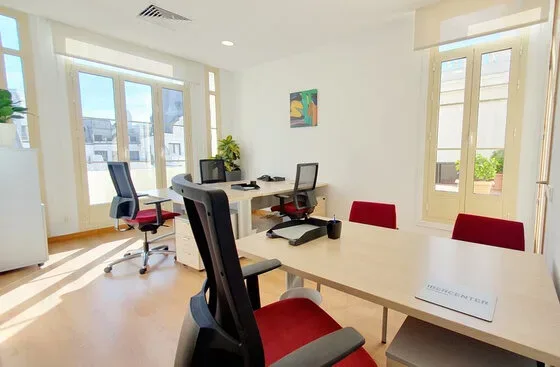
A business centre is a building or floor managed by an operator that offers closed and equipped private offices, with attended reception, meeting rooms, cleaning, maintenance, security and business connectivity, under a contract for the provision of services and not for leasing. The difference with coworking is not the price: it is the privacy, the service and the type of contract. It is also the third vertex that turns the virtual office vs coworking binomial into a three-option decision.
In coworking, the central product is the position within a community; In a business center, it is the company's office within a corporate environment. They change details that on paper seem minor and on a day-to-day basis they decide: the door locks, the reception identifies the company to visitors and the noise is controlled. It is usually completed with training classrooms, hourly offices and executive offices.
The third difference is less visible: the nature of the agreement. The business centre works with flexible service contracts, without a six-month guarantee, without works, without licences and without supply registrations; The company enters with its laptops and operates the next day. Compared to traditional rental, it saves weeks and tens of thousands of euros in implementation; In the face of coworking, some community is lost and control, image and silence are gained. Anyone who is in this branch of the virtual office vs coworking vs business centre debate will find the formats on the office rental page in Madrid.
How do the three models compare at a glance?
This table summarises how the comparison of virtual office vs coworking vs business centre behaves in the Madrid market in 2026. The ranges are indicative and vary according to area, building, contracted services and duration of the commitment.
| **** | Virtual Office | Coworking | Business Center |
|---|---|---|---|
| Includes | Professional address, reception and management of mail and notifications, optional telephone service, bonus for room hours | Flexible or fixed workstation in shared room, business Wi-Fi, common areas, access to rooms with reservation | Private closed and equipped office, reception attended, rooms, cleaning, maintenance, security, corporate services |
| Approximate cost/month Madrid 2026 | 40 – 150 € | 150 – 400 € per position | €350 – €700 per seat; 900 – 4.000 € per office |
| Ideal for | Idea phase, freelance, newly incorporated company, remote company that only needs management | Freelancers, teams of 2 to 10 people, remote teams, projects with uncertain growth | Teams of 5 to 30, companies that receive clients, foreign subsidiaries, sectors with confidentiality |
| Limitations | No daily use station; does not solve equipment needs or frequent meetings | Noise, lack of privacy, rooms that are paid separately, limited image to corporate clients | Higher cost per seat, less immediate upward flexibility, lower community component |
| Allows registered office | Yes, with a specific direct debit contract | According to operator; many offer it as an added service | Yes, naturally as there is effective occupation |
Three quick reads of the virtual office vs coworking vs business center comparison. The price jump between the first two models is an order of magnitude, while the one that goes from coworking to business center rarely doubles. The only row where the three tie is that of the registered office, so that criterion should never decide. And limitations inform more than inclusions: what makes an election fail is almost always something that was not in the brochure.
It is convenient to read it in terms of trajectory and not of a still photo: almost no company stays in a single column. For many companies, the question virtual office vs coworking is only the first of two; The second one arrives two years later and is called Coworking vs Business Center.
How much does each model cost per month in Madrid in 2026?
**In Madrid in 2026, a virtual office moves between €40 and €150 per month, a coworking space between €150 and €400, and a private office in a business center between €350 and €700 per person. **They are market forks, not tariffs: the same product can double in price between a building on Gran Vía or Azca and a peripheral industrial estate.
In the virtual office, it's not the direction that moves the price the most: it's the level of service. A basic email receiving plan with email notification is at the bottom. Adding personalized telephone attention, management of certified notifications, digitization of correspondence and voucher of rooms pushes towards registration. The domiciliation of companies is priced separately because it implies responsibility for the receipt of official notifications; real levels can be contrasted in Ibercenter's virtual office plans.
In coworking, the range depends on three factors: floating or fixed workstation, day or 24/7 access, and whether it includes room hours. A floating stall in the secondary area is around €150-180; a fixed one with box office, permanent access and voucher for rooms in the prime area is close to €350-400. This differential is what usually decides the economic pulse between virtual office vs coworking. In a business centre, you pay per office: one for four people in Madrid's prime area is between €1,600 and €2,800 per month all-inclusive, i.e. €400-700 per person.
And the nuance that almost never appears in virtual office vs coworking comparisons: the published price is not the real cost. A traditional rental adds deposit, guarantee, work, furniture, licenses, supplies, cleaning, insurance, maintenance and management time; In flexible models, all of this goes in the quota. Honest comparison pits "all-inclusive" against the total cost of occupancy, not rent against the fee. CBRE's reports on the flex market in Spain and JLL 's x-ray of coworking and flexible offices point in the same direction: private offices within flexible operators already account for most of the sector's surface area and revenues.
Which model do you need according to the phase of your company?
Here the headline is really answered. The comparison of virtual office vs coworking vs business center becomes actionable when it crosses it with the real phase of the company: number of people, type of client, level of confidentiality, growth forecast and image requirement.
A piece of information helps to dimension the starting point. According to the INE's Central Directory of Companies, 54.4% of Spanish companies do not have any employees and 81.6% have two or fewer. The majority of the business fabric lives in the first two phases of this scale, and that explains why the virtual office vs coworking debate is so frequent today: it is not a fad, it is that the average size of company in Spain fits exactly there.
These are the five phases that the Ibercenter team sees most frequently, summarized in a matrix and then developed one by one.
| Enterprise phase | Recommended Model | Why |
|---|---|---|
| 1. Idea, pre-constitution and freelance | Virtual Office | Needs professional address and mail reception, not meters. A permanent position is not justified with irregular billing. |
| 2. Newly incorporated, 0-2 people | Virtual office + flexible coworking days | Stable registered office and occasional use of the position. You pay only for what you use while the deal is being validated. |
| 3. Growing 3-10 Team | Coworking with fixed workstations or small office | Daily work and rooms for internal meetings are needed. Upward flexibility is critical: the team changes every quarter. |
| 4. Consolidated 10-30 team | Business center, private office | Confidentiality, noise, culture and image in front of customers outweigh the savings per position. |
| 5. Critical corporate image or foreign subsidiary | Business center in prime area | Direction is positioning. You need attended reception, quality rooms and operating from day one. |
Phase 1: what does an idea or a freelancer need in pre-constitution?
In this phase, the company is not yet a company: it is a person with a project, one or two clients and a lot of uncertainty. The last thing you need is a fixed commitment of space, and that's why the virtual office vs coworking debate here almost always goes the same way. What you do need, urgently, is to stop using your home address as a business address, because it will end up in the contract, on the invoice, on the website, in the Mercantile Registry and in any search engine.
The virtual office solves that for less than the cost of a business lunch a month: an address in an office building in Madrid, someone who receives the mail and the option to book a room when you have to see a client without taking him to a cafeteria. For many freelancers, that last point is the most valuable: receiving someone in a decent room twice a month changes the perception of seriousness at no structural cost.
The typical mistake here is the opposite of what is thought: it is not to fall short, it is to overinvest. Professionals are often seen hiring a permanent position "to have discipline" and after three months they use it four days a month. In the virtual office vs coworking dilemma, in phase 1 the answer is almost always virtual office with a small bonus of flexible days. Tax domiciliation in Madrid is usually the first service contracted at this point.
Phase 2: What about a newly formed company without a team or with 1-2 people?
Here there is already a company, NIF, census obligations and an advisor asking where the notifications will be received. The need for management ceases to be aesthetic and becomes operational: requirements, bank communications, notifications from the Registry and mail from suppliers arrive. That this falls into a private mailbox checked when it is possible is a real risk, and missing a deadline costs much more than the annual service.
In this phase, virtual office vs coworking is not a dilemma but a sum: virtual office with domiciliation as a stable base, plus a pack of flexible days for when you need to work outside the home. Contracting it with the same operator has an obvious advantage: an invoice, an address and the option to climb without touching anything in the Mercantile Registry on the day that the equipment goes from two to five.
The sign that the phase is running out is simple: when the use of flexible days consistently exceeds ten or twelve a month, a permanent position is cheaper. That is the exact point at which the balance of virtual office vs coworking leans towards the latter, and it is advisable to review the real accesses before deciding by intuition.
Phase 3: What fits with a growing team of 3 to 10 people?
It is the most uncomfortable phase and where more mistakes are made. The team is already a team: there are internal meetings, onboarding and conversations that cannot be heard in a common room. But the twelve-month workforce forecast is a range, not a number: it can be six or fourteen, and signing a three-year lease with that uncertainty is an expensive bet.
Now that the virtual office vs coworking debate has been resolved in favour of the latter, the answer is usually coworking with grouped fixed workstations or, better, a small private office in a centre that allows you to expand. The important thing is not today's space, but the capacity for growth: if the operator can offer a larger office in the same building in six months, the problem disappears.
Here also appears the serious need for meeting rooms in Madrid with functional audiovisual equipment. A team of eight people makes video calls with clients several times a week, and making them from a shared table with headphones generates a bad image. It is advisable to calculate the monthly room hours: from twenty, a closed office is almost always worth it for single workstations plus reservations, and the virtual office vs coworking approach is definitively overcome.
Phase 4: What does a consolidated team of 10 to 30 people need?
When more than ten people go over, the space ceases to be an expense and becomes infrastructure. There is a culture to sustain, processes that need proximity, sensitive information circulating – payroll, contracts, customer data – and frequent external visits. The argument of saving per position loses strength in the face of three factors: confidentiality, acoustic control and the ability to represent the company without depending on anyone.
The business centre with a private office is the format that best resolves this combination without assuming a conventional lease. The company has its office closed, with its mark on the door if desired, while the operator takes care of reception, cleaning, maintenance, security and connectivity. Management stops managing the building and returns to managing the business; At this point, the Virtual Office vs Coworking discussion has long since been left behind.
There are honest exceptions. If the activity requires a warehouse, laboratory, workshop or showroom, no flexible model fits and traditional rental is the way. If the team is fully remote and only meets one day a month, an empty office for twenty-eight days is money thrown away and it makes more sense to combine a virtual office with a one-off booking of rental offices in Madrid. The analysis virtual office vs coworking vs business center is only useful if it is admitted that sometimes the answer is outside the three options.
Phase 5: What about a company with a critical corporate image or a foreign subsidiary landing?
There are companies for which management is not logistics, it is positioning: law firms, private banks, management consultancies, family offices, funds, luxury brands. Their client associates solvency with location, and choosing between Gran Vía, Azca or Barrio de Salamanca has measurable commercial weight. For them, the virtual office vs coworking debate does not apply directly: they need a private office in a corporate environment from day one.
The case of the foreign subsidiary is especially clear. Landing in Spain requires operating in weeks, not months: setting up a company, setting it up a direct debit, opening a bank account, hiring the first people and starting to receive customers. Setting up your own office involves six months of paperwork before invoicing the first euro. A business center eliminates that bottleneck: service contract, immediate entry, multilingual reception and ready dispatch.
What these companies value over price is predictability: knowing that there will be rooms when the board comes from the headquarters and that the reception will identify the company well in the event of an important visit. A saving of two hundred euros per month per seat does not compensate for a meeting spoiled by a poorly equipped room. Here the criterion is risk, not cost, and the virtual office vs coworking debate is replaced by a conversation about service level.
What signs indicate that your current model has become too small?
The most reliable indicator that a model has fallen short isn't the number of people: it's how often the team improvises. It is valid both for those who are in a virtual office vs coworking and for those who already occupy an office. When meetings are held in the corridor, when someone takes their laptop to a cafeteria to talk quietly or when a room is booked three times a week because there is no room, the current model no longer works.
In the virtual office, there are three signs: rooms are reserved more than four or five times a month, which indicates face-to-face activity that the model does not cover; one or two people have joined the team and coordinating them remotely costs more than it saves; and customers ask if they can visit "the office" with an already awkward frequency. Any of the three, sustained for two or three months, indicates that it is time to rethink the binomial virtual office vs coworking in favor of a real position.
In coworking the signs are different. The team arrives earlier to get a seat. Important conversations are postponed because there is nowhere to have them. Noise complaints appear or, worse, the team stops talking to each other so as not to disturb them, which kills the advantage of being together. And the most definitive: someone from management avoids bringing an important client into the space. There, coworking no longer supports the company's image: the conversation ceases to be virtual office vs coworking and becomes coworking vs private office.
What are the tax and legal implications of each model?
**The registered office is the address that appears in the articles of association and registered in the Commercial Registry; the tax address is the one that the Tax Agency uses to notify. They usually coincide, but they are not the same. **The three models – virtual office vs coworking vs business centre – can cover both, with nuances that should be known before signing.
In commercial matters, the regulation requires that the registered office be the place of the center of effective administration and management of the company, or where its main establishment is located. A well-planned domiciliation service does not contradict that when the management is actually exercised from there or the space is at the disposal of the company. What does not work is to hire a nominal address for an activity carried out entirely in another province. Changing your address after that involves a public deed, registration and form 036, according to the AEAT's electronic headquarters on census changes of address. Practical translation: each move costs a notary, registration and agency.
Receiving notifications is where the difference between suppliers is most noticeable. A notification from the Treasury or a court opens deadlines that run even if no one has opened it. A serious operator receives, identifies, registers and warns the same day; An unattended mailbox does not. When comparing virtual office vs coworking, this criterion weighs more than the price: you have to ask if there are staff receiving certificates during office hours and how each notice is documented.
Regarding deductibility, the general criterion is that virtual office, coworking or business center expenses are deductible when they are correlated with income, invoiced in the name of the company and recorded in the accounts. It is a much cleaner expense than the partial affectation of the main residence, which generates recurrent friction with the Administration. Fiscally, therefore, the virtual office vs coworking dilemma is neutral: neither of the two is ahead of the other, and it is advisable not to let deductibility decide.
What mistakes are made when choosing a workspace?
The number one mistake when planning virtual office vs coworking is to choose by cover price. The published fee does not include the same for two operators, and the difference appears on the third month's bill: room hours, printing, guests, after-hours access, parking. Comparing €220 against €260 without breaking down what's inside is not comparing anything. The correct thing to do is to estimate the actual monthly consumption and ask each supplier for the total cost with that consumption.
The second mistake, very common when closing the virtual office vs coworking comparison, is to choose for today's team and not for the one a year from now. Nobody wants to pay for empty chairs, but the cost of staying small is not cheap, it is operational: time looking for space, dismounting and remounting, changing direction everywhere and internal noise. A rule that works: hire for the current team, but only with an operator capable of absorbing 50% more staff in the same building.
The third is to underestimate the location in terms of retention. A space twenty minutes further away means, per person, about one hundred and sixty hours a year. Where location is a real argument for hiring, saving a hundred euros per position in a worse area is expensive in rotation. And the fourth, more subtle: solve the doubt virtual office vs coworking without having counted how many days a month you are really going to leave. The stated intention and the actual use are little alike; measuring it two months before signing avoids most regrets.
Can more than one model be combined at a time?
Yes: in practice, many companies do not solve the virtual office vs coworking debate by choosing, but by combining both models, which is usually more efficient. It is not a rare exception, it is a common configuration in companies with distributed teams, seasonality or very different work profiles between departments.
The combinations that work best are three. The first resolves the virtual office vs coworking debate by adding both: virtual office as a stable registered office plus flexible workstations for real use, typical of the small blended company. The second: small private office for the core of the team plus coworking spaces for those who go two days a week, paying for privacy only where it is needed. The third: own headquarters plus virtual office in another city to have a commercial presence without opening a delegation.
There's a fourth fast-growing use: the fully remote company that doesn't want an office but needs to get the team together once a month. Hire a virtual office as a legal basis and reserve an office or large room for days for meetings. It's probably the most efficient formula today for distributed teams of less than twenty people, and an elegant way out of the virtual office vs coworking dilemma when neither quite fits.
The advantage of solving these combinations with a single operator is practical: an address, an invoice, a partner and the possibility of moving the configuration without touching the Commercial Registry or the Tax Office. When the same building offers all three things – as in the Gran Vía, Azca and Velázquez headquarters of Ibercenter – going from a virtual office to coworking and from there to a private office ceases to be a move and becomes a change of contract. It is the most relevant practical difference of the entire virtual office vs coworking vs business center analysis.
What to ask before signing any of the three?
When closing the virtual office vs coworking decision, there is a short list of questions that separates an informed choice from a surprise after three months. It is advisable to write them down and keep the answers, because many do not appear in the standard contract and do determine the daily experience.
About contract and cost: what is the minimum stay and how far in advance is the withdrawal noticed? What price revision is applied when renewing? What exactly is included and what is billed separately – rooms, guests, printing, 24/7 access, parking? Is there a deposit and under what conditions is it returned? Can the number of positions be reduced or only expanded?
About operations and growth, which is what decides if the virtual office vs coworking approach will last next year: what occupancy does the center have now and what availability will there be in six and twelve months? Can you go from coworking to a private office in the same building without penalty? How many rooms are there for every hundred seats and how are they booked? What happens if the team grows by 50%? Is there on-site technical support?
And on the legal and administrative side, which is where the most mistakes are made: can the company be domiciled and with what contract? Who receives the certified notifications and at what time? What traceability is notified? How many other companies do you share the management with? Is the company listed in the building directory? The latter seems minor until the day an inspector, a courier or a customer arrives and no one knows who the company is. Anyone seriously evaluating the virtual office vs coworking comparison should rate each provider in these three blocks before looking at the rate.
What if the correct answer is not yet to decide completely?
After years of watching companies enter, grow and sometimes shrink within the same buildings, the pattern that is most repeated is not that people choose badly: it is that they choose too soon and with too much permanence. The temptation to leave it resolved leads to signing three-year commitments just when the company has less information about what it will need. The workspace is not a decision that is made: virtual office vs coworking is a decision that is reviewed every twelve months.
That is why the most useful criterion for those who compare virtual office vs coworking vs business center is not which costs less or which gives a better image, but which one allows cheap mistakes. A model that can be changed in thirty days is worth more than one 15% cheaper that binds for thirty-six months. Flexibility isn't a startup luxury: it's a concrete way to reduce risk as the company grows.
And there is a practical consequence that should be put bluntly: choosing the right model matters less than choosing the right provider capable of giving you all three. The company that needs a management today will probably need a position in a year and a half and a closed office in three. If these steps occur in the same building, growing does not cost paperwork; If they occur in three different suppliers, each advance of the business is paid at the notary, registration, moving and address time. This is the only conclusion worth remembering from the virtual office vs coworking analysis.