Workplace Wellbeing in the Office: How to Support Mental Health
Discover how to improve workplace wellbeing and mental health in the office through better work organisation, healthy workspaces and psychosocial risk prevention.

TL;DR
Workplace wellbeing in the office does not depend on free fruit or a table football table: it depends on how work is organised and the conditions of the space in which it takes place. Spain's Occupational Risk Prevention Act requires businesses to assess psychosocial risks, including workload, autonomy, relationships and working time, while Royal Decree 486/1997 establishes minimum requirements for temperature, air quality and lighting in workplaces. The World Health Organization estimates that 12 billion working days are lost every year due to depression and anxiety, and the European Agency for Safety and Health at Work has dedicated its 2026–2028 campaign to mental health.
In practice, improving workplace wellbeing requires a combination of three elements: work organisation (realistic workloads, clear objectives and digital disconnection), the physical environment (natural light, good air quality, noise control and spaces for concentration and relaxation), and early detection (trained managers and a clear way to ask for help). Below, we explain what the legislation requires, the most common office risks, which measures genuinely work and which are merely cosmetic, and provide a checklist to help you get started. This article is for informational purposes and does not replace an assessment by a healthcare professional or an occupational risk prevention service.
What is workplace wellbeing, and why does the office matter?
Workplace wellbeing refers to people's physical, mental and social health in relation to their work. It is not simply the absence of illness, but the ability to work with a manageable workload, in a suitable environment and with relationships that do not cause emotional strain. Mental health is a central component of workplace wellbeing and also the most difficult to identify, because its warning signs often appear late and are rarely discussed openly.
Official figures explain why this issue is no longer optional. The WHO fact sheet on mental health at work estimates that 16% of working-age adults had a mental disorder in 2023 and that 12 billion working days are lost every year due to depression and anxiety. In Europe, the EU-OSHA Healthy Workplaces Campaign 2026–2028, launched in October 2026 under the theme of working together for mental health, reports that 45% of workers say they are exposed to risks to their mental wellbeing at work, while 29% experience stress, anxiety or depression caused or aggravated by their work.
So, what role does the office play in all this? Much more than it might seem. The physical workspace influences noise levels, lighting, temperature, the ability to concentrate or speak privately, and the extent to which work and relaxation overlap.
In our experience managing business centres in Madrid since 1996, workplace wellbeing in the office is often determined by details that never appear in a strategic plan: an available meeting room when a difficult conversation is needed, a private office where the door can be closed, or a break room where employees can eat without a screen in front of them.
What does Spanish law require businesses to do about mental health and psychosocial risks?
The legal foundation is Act 31/1995 on Occupational Risk Prevention. It recognises workers' right to effective protection in matters of occupational health and safety and requires employers to assess risks and plan preventive measures that incorporate work organisation, social relationships and environmental factors.
In other words, workplace wellbeing and mental health are not optional extras. They form part of the same duty of prevention as electrical hazards or the risk of falls.
Spain's National Institute for Safety and Health at Work (INSST) explains how to put this into practice. On its page about psychosocial risks, it explains that psychosocial factors are conditions related to work organisation, the nature of tasks and the social environment, and that they become risks when poorly designed or implemented.
To assess these factors, the INSST provides the FPSICO method and a specific method for small businesses, designed for organisations without their own occupational risk prevention department. The legislation does not prescribe a particular method, but it does require an assessment to be carried out, documented and followed by appropriate measures.
Other legal requirements also contribute to workplace wellbeing:
- Digital disconnection. Organic Law 3/2018 on Personal Data Protection and the Guarantee of Digital Rights recognises the right not to respond to work-related communications outside working hours. It also requires employers to develop an internal policy, after consulting workers' representatives, that includes training and awareness-raising measures to prevent digital fatigue.
- Harassment. Organic Law 3/2007 on Equality requires businesses to promote working conditions that prevent sexual harassment and harassment on grounds of sex, and to establish procedures for prevention and reporting.
- Display screen equipment. Royal Decree 488/1997 regulates work involving display screens and requires activities to be organised so that screen-based work alternates with other tasks or, where this is not possible, with breaks.
An important note: employment legislation changes frequently, and individual collective bargaining agreements may introduce additional obligations. For your particular circumstances, consult your occupational risk prevention service or employment law adviser.
What are the most common psychosocial risks in an office?
The INSST groups psychosocial factors into eight categories: job content, workload and pace, working time, participation and control, role performance, professional development, relationships and social support, and equipment and the physical environment.
In an office, most workplace wellbeing problems originate in the first four categories, although their symptoms may become apparent in the last one. Someone who says they "cannot stand the noise" may actually be struggling with accumulated pressure.
These are the risks we most frequently encounter in office teams and how they manifest themselves:
| Psychosocial risk factor | How it appears in the office | A reasonable first measure |
|---|---|---|
| Workload and pace | Impossible deadlines, constant multitasking and interruptions every few minutes | Set priorities with managers, introduce uninterrupted work periods and review staffing levels |
| Working time | Emails at 11 pm and extended working hours that go unrecorded | Introduce a digital disconnection policy and accurate working time records |
| Participation and control | Employees have no say in how they organise their tasks, and changes are imposed without explanation | Consult the team before changing processes and allow greater autonomy |
| Role performance | Unclear objectives and two managers with conflicting priorities | Document responsibilities and objectives, and establish a single set of priorities |
| Relationships and social support | Isolation, unmanaged conflicts and humiliating comments | Train managers in conflict management and establish an anti-harassment protocol |
| Physical environment | Background noise, excessive heat or cold, poor lighting and no available rooms for conversations | Measure environmental conditions and provide quiet areas, meeting rooms and enclosed offices |
This table does not replace a formal assessment, but it helps structure the conversation. Typically, two or three factors dominate. Addressing these has a much greater impact on workplace wellbeing than spreading small initiatives across every area.
One important distinction is that a psychosocial risk assessment evaluates working conditions; it does not diagnose individuals. The INSST emphasises that assessment methods should focus on the organisation rather than individual health.
Asking employees "Are you stressed?" is not an assessment. Asking "Do you have enough time to complete your work?" or "Do you know what is expected of you?" is.
How does the physical workspace influence workplace wellbeing?
Royal Decree 486/1997 on workplaces establishes minimum requirements that many offices fail to meet without realising it.
In premises where sedentary office work is carried out, temperatures must remain between 17 and 27°C, relative humidity must be between 30% and 70%, and the minimum ventilation rate is 30 cubic metres of fresh air per hour per worker in environments that are neither hot nor polluted. Air currents from air conditioning must not exceed 0.25 metres per second for sedentary work.
Regarding lighting, the same Royal Decree states that natural light should be prioritised and supplemented by artificial lighting. Minimum lighting levels range from 200 lux for tasks with moderate visual demands to 500 lux for tasks with high visual demands, such as continuous document reading.
It is worth measuring these conditions: the difference between a desk next to a window and one at the back of an office floor can be considerable. We have already explained in detail how natural light in the office influences mood and visual fatigue.
Beyond minimum legal requirements, the physical environment affects workplace wellbeing through the accumulation of small discomforts. A poorly adjusted chair, a screen positioned too low or a cramped workstation may not cause a problem on the first day, but they contribute to fatigue week after week.
Our guide to office ergonomics explains how to adjust desks, chairs and screens correctly.
Occupancy density also matters: a workspace with too many people per square metre simultaneously worsens noise levels, air quality and the sense of control. If you are planning your workspace, consider how much office space per employee you actually need.
Workplace wellbeing is not achieved by installing a mindfulness screen in reception. It is built through a reasonable workload, air that is comfortable to breathe and a door that can be closed when necessary.
At our business centres in Azca, Gran Vía and Velázquez, each workspace has its own thermostat, allowing teams to adjust the temperature within a range they find comfortable rather than arguing over the air conditioning controls.
It may seem like a minor detail, but temperature is one of the most common complaints in shared offices and a constant source of minor conflicts.
Why do noise and interruptions have such a negative impact on workplace wellbeing?
Office noise rarely reaches levels that damage hearing, but it does not need to be that loud to cause exhaustion. Other people's conversations are particularly difficult to ignore because the brain attempts to process them, making concentration more difficult and tasks more time-consuming.
This is why the INSST includes adverse physical environments, including noise, among psychosocial risk factors.
Interruptions have a similar effect. A "quick" question every ten minutes, constant notifications and back-to-back meetings fragment the working day until tasks requiring sustained concentration can only be completed outside normal working hours.
At that point, the workplace wellbeing problem is no longer simply about noise; it becomes an issue of working time.
Effective measures include meeting-free periods, team agreements on when to use instant messaging and when to use email, and designated spaces where employees know they will not be interrupted.
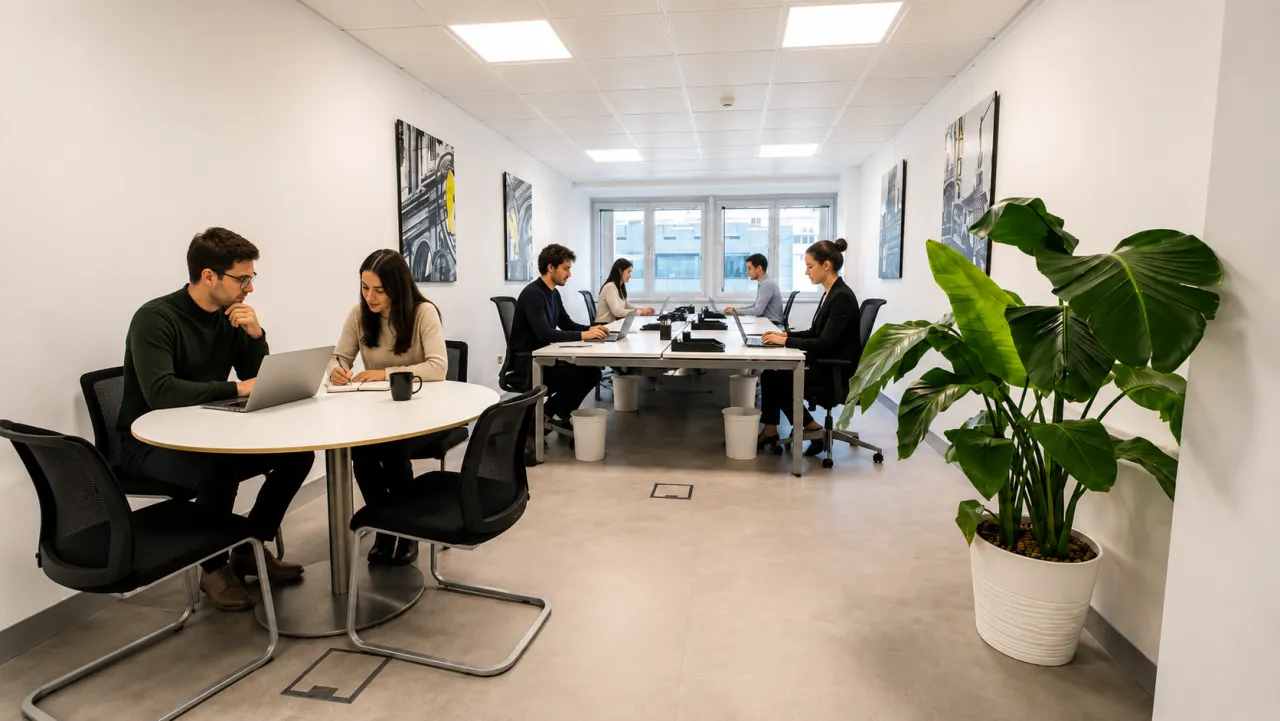
Workspace design is the other half of the solution. Open-plan offices make sense for collaboration, but not for every activity. A healthy team needs three types of space: somewhere to concentrate, somewhere to talk without disturbing others and somewhere to switch off.
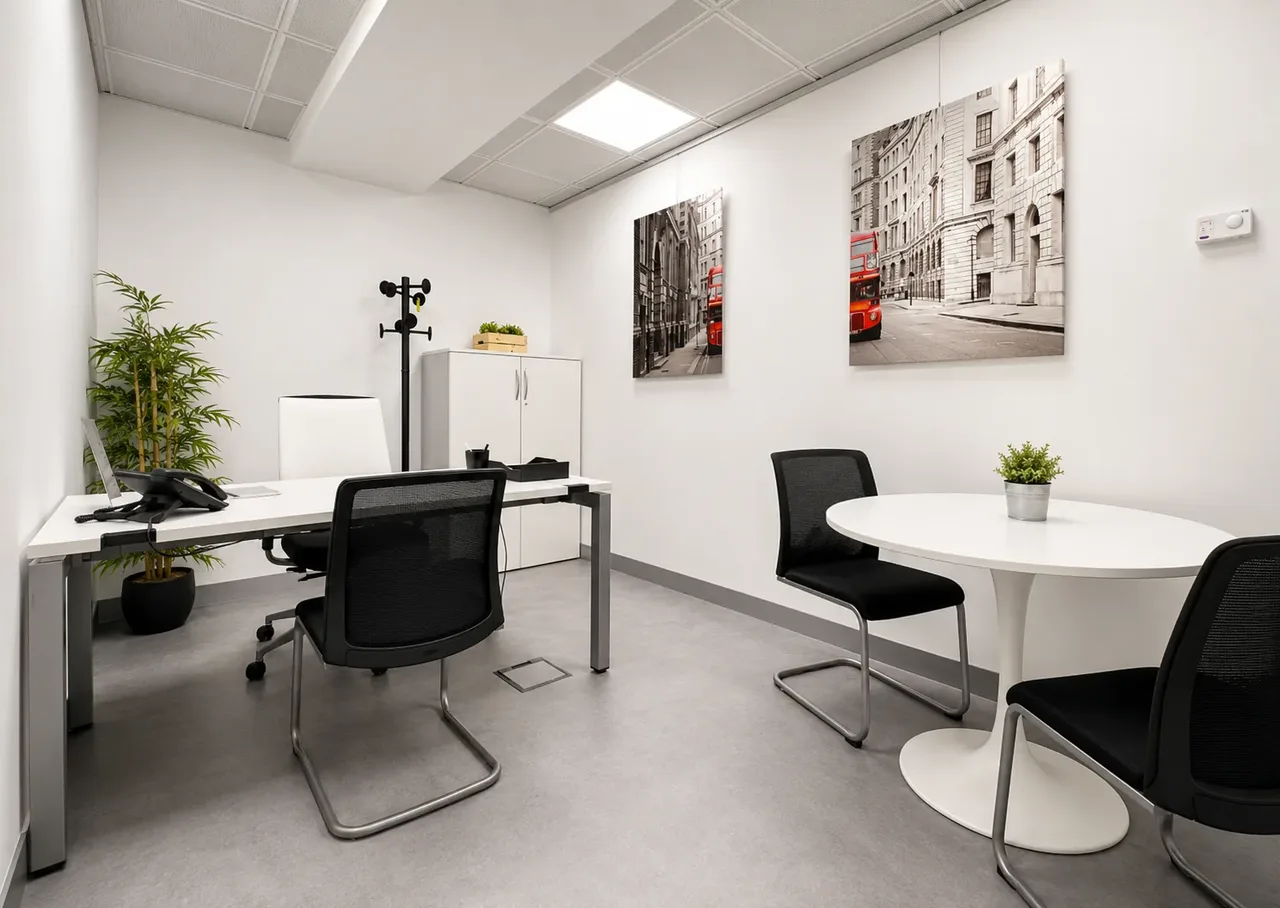
A private office addresses the first two needs for small teams. It provides a dedicated door and key, a workspace that is not shared with anyone else, and the opportunity to make a sensitive phone call without searching for an empty corridor.
At Gran Vía, there are also phone booths and an outdoor terrace, while all three locations offer break rooms and spaces designed for breakfast, lunch or relaxation.
For sensitive conversations, such as performance reviews, discussions about returning to work after sick leave or conflicts between colleagues, privacy is not a luxury.
If your usual workspace does not provide it, one of our meeting rooms in Madrid can be booked by the hour, ensuring that these conversations do not take place half a metre away from the rest of the team.
What role do digital disconnection and working time organisation play?
Digital disconnection is probably the workplace wellbeing measure with the best cost-to-impact ratio.
The right has existed since 2018 under Spain's Organic Law on Personal Data Protection and the Guarantee of Digital Rights (LOPDGDD), and Act 10/2021 on Remote Working strengthened it for remote workers. However, in many businesses, it remains little more than a sentence in a document that nobody has read.
The internal policy must define how this right is exercised and must also include senior management, which is often where the policy breaks down. If managers send messages at midnight, the implicit message is that employees are expected to respond.
An effective policy is short and specific. It defines the hours during which a response is expected, what constitutes an emergency and which communication channel should be used (usually a phone call rather than an email), how out-of-hours messages should be scheduled and what happens during holidays.
In our experience, the rules that work best are those that can be verified. "Meetings are not scheduled before 9:30 am or after 5:30 pm" is much more likely to be followed than "We respect employees' rest time".
Actual working time should also be measured. Working time records were not originally designed as a workplace wellbeing tool, but they serve as a useful indicator.
If recorded hours do not reflect the amount of time employees believe they are working, there is a workload problem that no wellbeing initiative can conceal.
Reviewing these figures quarterly with managers is an inexpensive way to identify teams under excessive pressure before employees begin taking sick leave.
How can chronic stress and burnout be identified early?
The WHO includes burnout in the ICD-11 as an occupational phenomenon, rather than a medical condition.
It describes burnout as a syndrome resulting from chronic workplace stress that has not been successfully managed, characterised by three dimensions:
- Feelings of energy depletion or exhaustion.
- Increased mental distance from one's job, or feelings of negativity or cynicism towards it.
- Reduced professional efficacy.
The key lies in the words "not successfully managed": burnout is the consequence of a sustained workplace wellbeing problem, not a personal failing of the individual experiencing it.
In an office, warning signs often appear in the following order: behavioural changes (a previously engaged employee stops contributing to meetings, becomes irritable or makes more mistakes), changes in working patterns (arriving late or, conversely, never leaving the office, and repeated short absences), and eventually sick leave.
A manager with basic workplace wellbeing training may recognise the first two stages and initiate a conversation.
The WHO specifically recommends mental health training for managers because they are well placed to identify problems and have a significant influence on the working conditions that contribute to them.
That conversation has clear boundaries. The employer's role is not to diagnose or provide therapy, but to listen, review working conditions (workload, deadlines and conflicts) and direct employees towards professional support.
This may include the occupational risk prevention service, occupational health services, a primary care doctor or, if available within the company, an employee assistance programme.
If someone's life is at risk, Spain's Ministry of Health provides the 024 helpline, which is free, confidential and available 24 hours a day. In the event of an immediate life-threatening emergency, call 112.
Which workplace wellbeing measures genuinely work, and which are merely cosmetic?
The WHO distinguishes between three levels of intervention: organisational interventions (changing working conditions and the work environment), management training, and individual interventions that help people manage stress more effectively.
All three have a role to play, but their order matters. A breathing exercise workshop cannot compensate for an impossible workload.
The following comparison summarises the measures we encounter most frequently:
| Measure | Type | What it addresses | Assessment |
|---|---|---|---|
| Reviewing workloads, staffing levels and deadlines | Organisational | The main cause of chronic stress | Essential, even if it is the most uncomfortable measure to implement |
| Digital disconnection policy with verifiable rules | Organisational | Working time and rest | Highly effective and virtually cost-free |
| Management training in mental health and conflict management | Training | Early detection and team relationships | Highly effective when managers are empowered to take action |
| Quiet workspaces, available meeting rooms and break areas | Physical environment | Noise, interruptions and insufficient breaks | Effective, with visible benefits from the first day |
| Flexible working hours and reasonable adjustments | Organisational | Work-life balance and returning to work | Effective when genuinely available rather than dependent on a manager's goodwill |
| Stress management or mindfulness workshops | Individual | Personal coping resources | Useful as a complement, never as a substitute |
| Free fruit, table football and themed days | Cosmetic | Company image and atmosphere | Pleasant, but ineffective if working conditions are inadequate |
Reasonable adjustments deserve particular attention. The WHO defines them as adaptations to the working environment that accommodate an individual's abilities and needs.
Examples include flexible working hours during treatment, a phased return to work following sick leave or a quieter workstation for a certain period.
These are inexpensive and highly effective workplace wellbeing measures, provided they are agreed with the individual and supported by the occupational risk prevention or occupational health service.
Finally, measure the results. A short survey twice a year, short-term absences, staff turnover and recorded working hours are sufficient to establish whether workplace wellbeing is improving or deteriorating.
Without data, businesses risk rewarding the most visible initiative rather than the most useful one.
What can freelancers and small teams without an HR department do?
A business with five or ten employees may not have a human resources department or an in-house occupational risk prevention specialist, but its prevention obligations still apply. These are often fulfilled through an external occupational risk prevention service.
The advantage of small teams is that workplace wellbeing problems become visible sooner and decisions can be made more quickly.
The INSST method for small businesses is designed precisely for this situation: it is straightforward, involves employee participation and results in a manageable action plan.
For freelancers and self-employed professionals, the main workplace wellbeing risk is often different: isolation and a lack of boundaries.
Working exclusively from home blurs the distinction between work and rest, while the absence of colleagues removes the social support that the INSST identifies as one of the key protective factors.
Having a dedicated place to go, even if only a few days a week, helps separate working time from personal time and creates opportunities to interact with other professionals.
In both cases, the workspace is something that can be improved without significant investment.
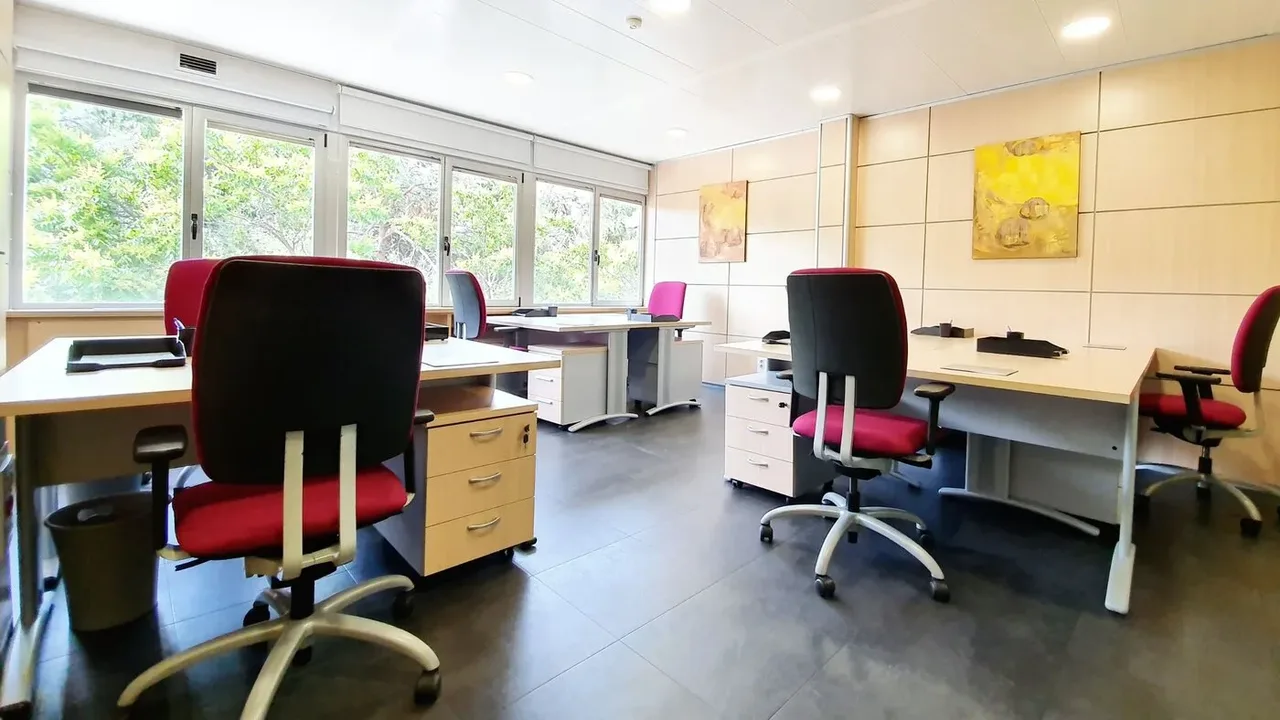
An office in a business centre includes furniture, air conditioning, daily cleaning, reception services and communal areas within a single fee, removing part of the mental burden of managing an office: maintenance issues, suppliers and utility bills.
And if you only need a quiet workspace occasionally, hourly office rental allows you to book a peaceful place for a day of focused work or to meet a client without having to do so in a café.
How does hybrid working affect workplace wellbeing?
Hybrid working can have both positive and negative effects. It reduces commuting and provides greater autonomy, two factors that support workplace wellbeing. However, it can also increase isolation, extend the digital working day and turn office days into a marathon of meetings.
The outcome depends on how the arrangement is designed, rather than on the working model itself.
The recommendation we make most often is to give each day a purpose. If the team comes together in the office on Tuesdays and Thursdays, those days should be used for activities that are better carried out in person: team meetings, training, conflict resolution and one-to-one conversations.
Tasks requiring concentration can be left for home or a quiet workspace.
When employees travel to the office only to spend the entire day wearing headphones on video calls, the commute feels like a waste of time, and workplace wellbeing deteriorates rather than improves.
The remote working element also requires attention. Spain's Act 10/2021 requires an assessment of risks associated with remote workstations, including psychosocial risks, and the right to digital disconnection applies equally when working from home.
If you are designing or reviewing a mixed working model, our article on hybrid working explains how to organise office attendance, workspace and team rules.
What checklist should you follow to improve workplace wellbeing in the office?
This checklist summarises the recommendations above. You do not need to implement everything at once: identify the two or three areas where your team is struggling most and start there.
Review the checklist once a year or whenever you change your workspace, team size or working model.
Work organisation and legal compliance
- A psychosocial risk assessment has been completed and documented using the INSST method or the method provided by your occupational risk prevention service.
- An action plan is in place, with designated responsibilities and deadlines, rather than simply a report filed away.
- A written digital disconnection policy includes senior management and establishes verifiable rules.
- All employees are familiar with the anti-harassment protocol and have access to a clear reporting channel.
- Working time records are reviewed regularly to identify excessive workloads.
Physical workspace
- Temperature, humidity, air quality and lighting meet the minimum requirements of Royal Decree 486/1997, based on actual measurements rather than assumptions.
- Workstations are positioned close to natural light wherever possible, and ergonomics have been reviewed at each workstation.
- Quiet workspaces, rooms for private conversations and a break area separate from workstations are available.
- Occupancy density is reasonable, with nobody working in cramped conditions or circulation areas.
People and early detection
- Managers are trained in mental health, communication and conflict management.
- There is a clear way to ask for help, through the occupational risk prevention service, occupational health services or an employee assistance programme.
- Reasonable adjustments and phased returns to work following sick leave are agreed with employees.
- Workplace wellbeing indicators, including short surveys, absences and staff turnover, are reviewed at least twice a year.
Frequently asked questions about workplace wellbeing in the office
Is it mandatory to assess psychosocial risks in a small business?
Yes. Spain's Occupational Risk Prevention Act requires businesses to assess all risks, including psychosocial risks, regardless of company size. The INSST provides a specific method for small businesses, and an external occupational risk prevention service can carry out the assessment.
What temperature should an office maintain by law?
Royal Decree 486/1997 establishes that premises where sedentary office work is carried out must maintain a temperature between 17 and 27°C, with relative humidity between 30% and 70%. It also establishes a minimum ventilation rate of 30 cubic metres of fresh air per hour per worker in environments that are neither hot nor polluted.
Is burnout a medical condition?
Not according to the WHO, which classifies it in the ICD-11 as an occupational phenomenon resulting from chronic workplace stress that has not been successfully managed. It is characterised by exhaustion, mental distance or cynicism towards work, and reduced professional efficacy. If symptoms arise, an assessment should be carried out by a healthcare professional.
What should a digital disconnection policy include?
Under Spain's LOPDGDD, employers must develop the policy after consulting workers' representatives. It must include senior management, define how the right to digital disconnection is exercised and provide training on the reasonable use of technology.
In practice, it is advisable to establish expected response times, define what constitutes an emergency and specify which communication channel should be used.
Which workplace wellbeing measures have the greatest impact?
Organisational measures have the greatest impact: reviewing workloads and deadlines, clarifying responsibilities, implementing digital disconnection and training managers.
Workspace improvements, such as natural light, good air quality, quiet areas, private rooms and break spaces, reinforce their effectiveness.
Individual initiatives, such as stress management workshops, are a useful complement but cannot replace these measures.
Does a private office improve workplace wellbeing compared with an open-plan office?
For tasks requiring concentration or confidential conversations, an enclosed workspace reduces noise, interruptions and the feeling of being exposed.
It does not resolve organisational problems on its own, but it makes it easier to work calmly. Ideally, businesses should combine enclosed spaces for concentration, meeting rooms for conversations and communal areas where employees can switch off.