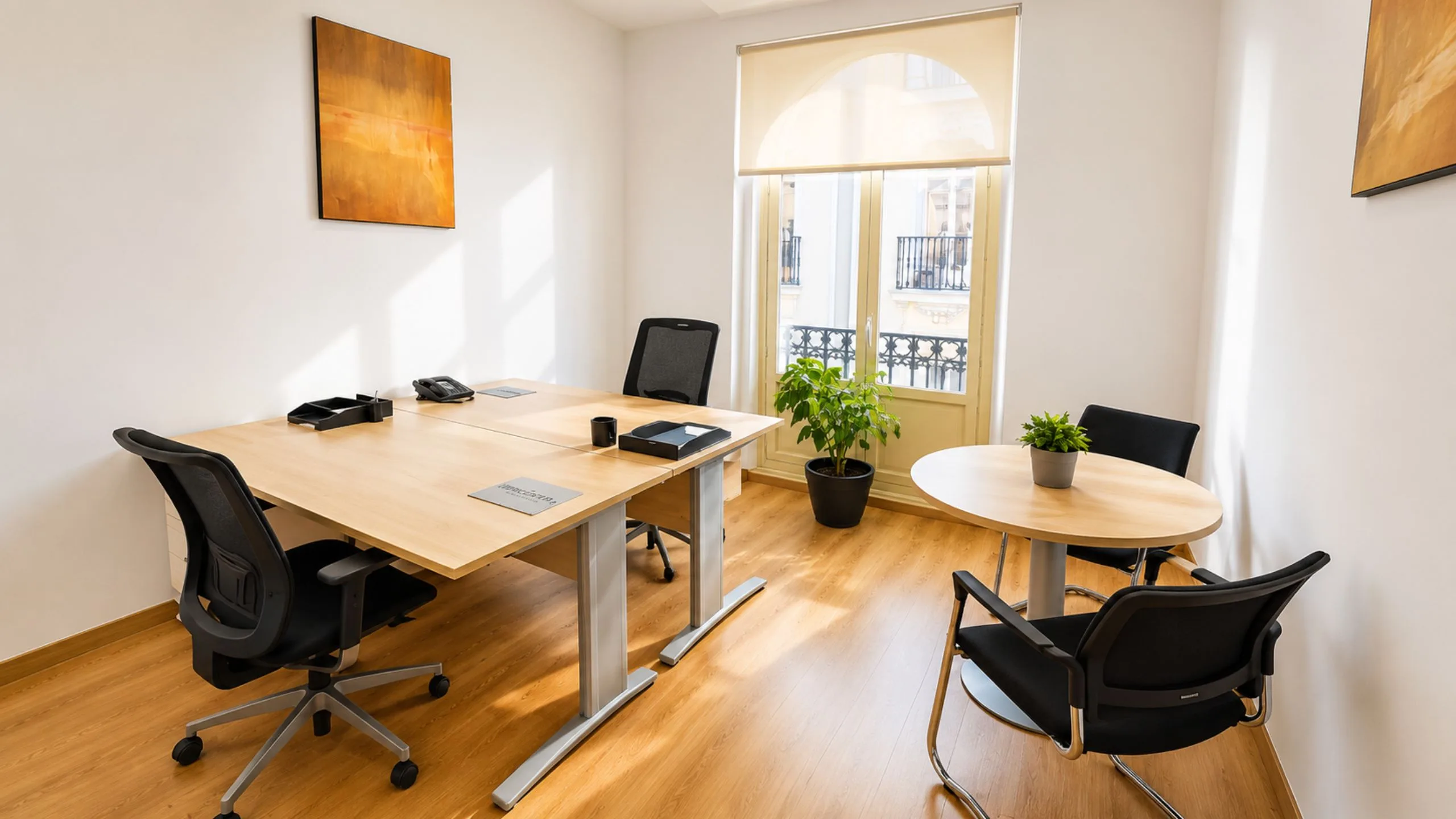
Startup office in Madrid
We tell you what a startup office in Madrid should have In recent years we have seen a very clear […]

We tell you what a startup office in Madrid should have
In recent years we have seen a very clear pattern repeat itself in our Gran Vía, Azca and Velázquez headquarters. A startup starts in an open coworking space or, directly, in the living room of one of the founders. It works for months, sometimes more than a year. And one fine day something crackles: a conversation with an investor that takes place in the coworking cafeteria and is heard from the table next to it, a team that no longer enters the shared room, a corporate client who asks to sign an NDA and look where their data is stored. At that moment, the founding team began to look for a startup office in Madrid and discovered that the market was not as simple as it seemed.
This article is born from that experience. It is not a theoretical piece or a listicle with the “10 best coworkings”. This is what we at Ibercenter have learned in more than 30 years accompanying growing companies from its three premium centers in Madrid. We are going to break down when a startup really needs to move to its own office, what formulas it has in the Madrid market, which area fits with each type of project, how much it really costs and what mistakes those who do it for the first time make. If you’re reading this as a founder or as a COO with the decision on the table, you’ll want to finish the article before you sign anything.
The intention is informative and honest. There are startups that after reading it will decide to stay six more months in their current coworking, and that will also be a success. And others will discover that they have been paying for months a hidden cost in image and focus that they can no longer afford. The boundary between the two cases is thinner than it seems and it is worth looking at it with data.
When does a startup need to move from open coworking to a private office?
The question is not “when do I feel like having an office?”. The question is “what signs from the business are telling me that I can no longer stay where I am?”. In our experience, there are six signs that appear almost every time, and when three or more accumulate, the decision is made even if the founder doesn’t want to see it yet.
The first is the size of the team. While a startup has 2 or 3 people, almost any long table will work. From 5 people working simultaneously, noise, the flow of visitors and the coordination of calls no longer fit into a shared area. We have seen teams of 7 people trying to endure in a flex room designed for 4 and end up burned out by constant interruptions. The second sign is operational privacy: when cap sheets, layoff conversations, billing numbers or details of a pivot start circulating, that information cannot live in a glass room a meter from another competing startup.
The third signal is investors. A serious first round involves face-to-face meetings, due diligence, presentations to committees and, above all, an image that conveys that the money is going to be well managed. A fund that comes in with 500,000 euros or more does not want to meet in a coworking office amid the noise of the coffee. The fourth is the corporate customer: banks, insurance companies, energy companies or public administration sign NDAs and, increasingly, ask to see where their data is stored before closing a contract. If your startup sells to enterprise, you need a space that passes that control. The fifth is accelerated hiring: when 20 candidates are interviewed per month, the image of the space and the possibility of onboarding without fighting for a room become a competitive advantage in talent.
The sixth signal is the most difficult to measure and the most important: culture. In an open coworking space, the culture is that of the operator, not yours. If you think your startup has its own way of working, celebrating milestones, discussing, doing retros, you need a space where that culture can live without asking permission. In the projects we see in our three centers, startups that move to flexible private offices usually report a clear increase in internal cohesion in the first three months. It’s not magic: it’s having your own place to put your logo on the door.
Ibercenter’s decision rule: if your startup accumulates three or more of these six signals – >5 team, ongoing conversations with investors, NDAs with clients, sensitive data, accelerated hiring, willingness to own culture – the flexible private office ceases to be a luxury and becomes critical infrastructure.
To make the internal conversation easy, we leave a table with the literal checklist that we use with the startups that visit us. If you score 3 or more, it is advisable to make a move in the next 60-90 days.
| Signal | Does it apply to your startup? |
| Team working simultaneously >5 people | Yes / No |
| Active conversations with investors (pre-seed, seed or series A) | Yes / No |
| NDAs signed with corporate clients | Yes / No |
| Handling of sensitive data (financial, health, personal) | Yes / No |
| More than 10 hiring interviews per month | Yes / No |
| Explicit desire to build one’s own culture | Yes / No |
What real options does a startup have in Madrid to set up?
The Madrid market basically offers four formulas for a startup to occupy physical space. Each solves a different problem and has very different financial, contractual and operational implications. Mixing them up or choosing them badly costs money and, above all, management time that a founding team cannot afford.
The first is the traditional 5+5 rental, the classic contract for offices in corporate buildings. It provides maximum personalisation of the space and a consolidated image, but it involves a high deposit, adaptation work, furniture on behalf of the tenant, a five-year contract that is mandatory and another five years extendable, registration of supplies, contracting of cleaning, security and reception. For a growing startup, 5+5 is practically always a bad idea until the team exceeds 40-50 stable people and the business model is more than validated. Before that, the opportunity cost of not being able to change is enormous.
The second formula is the coworking open, those open spaces with hot or fixed tables in a shared area. They work great for freelancers, one-off remote teams, and startups in market validation with 1 to 4 people. From that size, the limitations begin to weigh heavily: noise, lack of privacy, Meeting rooms On-demand with uncertain availability, inability to customize, and in many cases, a difficult image to present to an Enterprise customer. The third formula is the Flexible Private Office Inside a business center: an office closed in the name of the startup, with its logo if you want, furniture included, company internet, professional reception, meeting rooms on request, attention to visitors and a typically monthly or quarterly contract. It is the one that best fits in the transition phase because it combines privacy with real flexibility of growth.
The fourth is the virtual office with an on-demand room, which is technically not a continuous physical office but a fiscal address, mail management and the possibility of reserving rooms when necessary. It works as a bridge for remote-first startups that need a registered office in Madrid, attend to occasional visits and maintain a professional image without paying for square meters that they do not use. Many startups internationalize Madrid with a virtual office first and after six months, when they hire the first local team, they make the leap to a flexible private office.
| Formula | Privacy | Flexibility | Approximate monthly cost Madrid centre | Best For |
| Traditional 5+5 rental | Maximum | Very low | Variable + high initial CAPEX (work, furniture, bonds) | Startups with +40 people and a validated model |
| Open coworking | Low | High | €150–350 per position | Freelancers and teams of 1–4 people in validation |
| Flexible private office (business center) | High | High | From approx. €600–900 per position depending on location and size | Startups 5–30 people growing |
| Virtual office + on-demand rooms | Variable | Maximum | €60–250 + use of rooms | Remote-first, internationalization, phase 0 |
Atomic market data: according to operators such as JLL in its analysis of the flexible market in Madrid, flexible spaces in Madrid’s CBD reach reference rents significantly higher than peripheral areas, which confirms that the decision of the area conditions the cost much more than that of the formula.
Which area of Madrid fits each type of startup?
Madrid is not a uniform city for a startup. The neighbourhood in which you put your office determines the image in the eyes of the investor, the travel time of the team, the proximity to target customers, the availability of talent and, yes, also the cost. At Ibercenter we operate three centers in three very different areas because we have found that each startup profile fits better in one of them. A B2C scale-up in digital hospitality is not the same as a B-series fintech project.
Gran Vía is the area of maximum visibility and transport connection. It is surrounded by first-class hotels, embassies, institutional buildings and direct connection with Sol, Atocha and Chamartín. It works especially well for B2C startups that receive a lot of visits, for projects related to tourism, digital retail, content, events and media, and for teams that travel a lot and need to get to and from the airport quickly. A startup that organizes events for users or receives international partners earns a lot with an address on Gran Vía.
Azca is the financial district par excellence: the area between Santiago Bernabéu, Nuevos Ministerios and Castellana where the headquarters of banking, insurance, consulting firms and many of the investment funds that operate in Madrid are located. If your startup is fintech, insurtech, regtech, B2B SaaS for large corporations or you need to be close to the investment ecosystem, Azca has an invisible but real advantage: the “quick coffee meeting” with a fund or an enterprise client becomes possible because they are a 5-minute walk away. For a team lifting the round, geography matters more than it seems.
Velázquez, in the heart of the Salamanca district, conveys a consolidated premium image. It works very well for deeptech with industrial clients, high-value consulting, legal-technological startups (legaltech), digital health and projects where the corporate image in front of the end customer weighs heavily. The area has its own parking in some buildings, a fast connection to the airport and a tenant profile that provides quality networking. A startup that sells to offices, family offices or large industrialists benefits from having an address in Velázquez even if the team is only 8 people.
| Madrid Zone | Ideal startup profile | What it brings | Good to know |
| Gran Vía | B2C, tourism, content, events, media | Visibility, transport connection, hotels | More visitor traffic; Ideal for events |
| Azca | Fintech, insurtech, B2B enterprise, scale-ups en ronda | Proximity to funds, banking, consulting firms | Intense rhythm; Spontaneous networking |
| Velázquez | Deeptech, legaltech, healthtech, premium consulting | Corporate image, parking, airport connection | More institutional profile; High-value networking |
Ibercenter criteria for choosing an area: the address of your office must tell the same story as your pitch. If your pitch talks about transforming the bench, Azca reinforces it; if it talks about transforming retail, Gran Vía reinforces it; if he talks about transforming heavy industry or professional services, Velázquez reinforces it.
What we never recommend, and we see it too much, is to choose an area for ego: a founder who wants to “have his office in Salamanca” because it sounds good to him, without the client or the investor being there. That pays an extra cost that the startup cannot afford and does not generate any return. The rule is the other way around: the area is chosen by where the people you need to meet with each week are, not where you would like your brand to be.
How much does a startup office cost in Madrid?
The budget is the first point where almost all startups get it wrong. They do so because they compare rents per square meter of formulas that are not comparable. A traditional office in Madrid’s CBD at €35/m²/month seems cheaper than a flexible office at €60/m²/month, but the former does not include adaptation work, furniture, reception, cleaning, internet, insurance, maintenance or services. The second one does. Comparing prices without matching benefits is a recipe for error.
In 2026, the indicative ranges in central areas of Madrid move more or less like this. In flexible private offices within a premium business centre, the cost per position and month is usually between €600 and €900 in areas such as Gran Vía, Azca or Velázquez, depending on the size of the office, the number of rooms included and the extras contracted. A permanent position in open coworking in those same areas moves between €250 and €450/month. A traditional rental, once all the hidden costs have been added (work, furniture, deposit of several monthly payments, supplies, cleaning, insurance, maintenance, reception if you want) usually exceeds €700-1,000/seat/month equivalent in the first three years, with the key difference that flexibility is practically zero.
| Team Size | Recommended formula | Indicative monthly range (Madrid centre) | Typical Engagement |
| 1–4 people | Open coworking or virtual office + rooms | 300–1,500 € total | Monthly |
| 5–10 people | Flexible private office 1 office | €3,500–€7,000 total | 3–12 months |
| 11–20 people | Flexible private office 2 offices | 7,000–14,000 € total | 6–24 months |
| 21–40 people | Expanded flexible private office or floor plan | €14,000–€30,000 total | 12–36 months |
| +40 people | Evaluation between extended flexible and traditional rental | Tailor-made | Tailor-made |
Ibercenter’s 10% rule: the total annual cost of the office (rent + services + rooms + extras) should not exceed 10% of the annualized MRR or the funded runway of the startup. Below that border, the office is infrastructure; On top of that, it is beginning to be a luxury that puts other levers at risk (talent, marketing, product).
A point that we insist on explaining: in a flexible office for startups, what the founding team saves is not just money, it is management time. You don’t have to give high electricity, you don’t have to hire cleaning, you don’t have to negotiate a contract with the internet operator, you don’t have to buy tables, you don’t have to manage reception, you don’t have to fight with multi-risk insurance. All that, in a startup with 8 people, is weekly hours of the CEO or COO that are better invested in anything else. In the projects we see daily in our three centers in Madrid, founders who have moved from a traditional rental to a business center usually report between 5 and 10 hours a week recovered. That’s pretty much half a Thursday.
What does a startup need in its office beyond square footage?
The most expensive mistake when choosing an office for a startup in Madrid is to fall in love with the square meters and forget everything that happens around it. A startup does not buy surface area: it buys the ability to operate well. And operating well has a physical component but also many others that rarely appear in the contract of a traditional rental and are integrated into a good business center.
The first thing is real enterprise internet: symmetrical, redundant, with real SLA, with network segmentation, with the capacity to support simultaneous videoconferences of the entire team without them going down. It is not the same as residential fibre that an improvised coworking space has. A startup that loses a meeting with an investor because it drops its Zoom pays a disproportionate price to save €30 per month. The second is the meeting rooms available, well equipped, with glass or without glass as needed, with screens that connect to the first, with camera and decent microphone for hybrid calls. In our centers, we have multiple meeting rooms of varying sizes precisely because we know that the wrong room ruins the meeting.
The third thing is the reception and attention of visitors. When an investor or client enters the building and is greeted by a professional reception with their name written down, the feeling they get before the meeting is completely different from having the founder open the door because no one is at the door. The fourth are the ancillary services: registered office, mail management, 24/7 access, adjustable air conditioning, decent coffee, security, cleaning, immediate technical maintenance. The fifth thing is something that is little valued until it is missing: real scalability. If your startup grows to 14 people in 12 months, can the center absorb that growth without forcing you to move? If it grows to 25, too? That is the key question.
And the last but not least: implicit networking. A good business center concentrates other companies and tenants who can be customers, suppliers, partners or references. It is not something that is contracted, but it happens. At Ibercenter we have seen multiple occasions in which two tenants end up closing an agreement simply because they coincided every morning in the common area. It is not a promise to sell, but it is a positive externality that an isolated rental does not have.
What frequent mistakes do we see in startups choosing an office in Madrid?
After more than 30 years accompanying startups in their different phases, there are a handful of mistakes that are repeated with disconcerting insistence. We list them not to scold anyone, but so that any founder who is about to sign can check if they are committing them.
The first is to oversize. The startup has just closed a round and, in the euphoria, rents an office for 25 people when there are 8 and the realistic forecast for 12 months is to be 14. The result: you pay double, the space looks empty and, if a bad quarter arrives, that fixed cost becomes a burden. The opposite, undersizing, also happens, especially when you choose by absolute price without counting the expected growth: after six months you have to move again, which costs money, time and energy of the team. The second mistake is to sign 5+5 too early, attracted by a seemingly low price per meter. When the business pivots, that contract becomes a cage that limits strategic decisions for years.
The third mistake is to choose an area for ego. We see it especially in founders with a certain trajectory who want “their office” in a prestigious area, even if their clients and investors are in another. The cost is twofold: extra rent and worse connection with those who should visit them every week. The fourth is to ignore the investment factor. A startup that is going to raise a round in the next 12 months has to think about where it is going to hold meetings with funds. If the answer is “at a Starbucks,” you’re leaving money on the table. The image of the space where due diligence occurs has a measurable impact on how the governance of the project is perceived.
The fifth mistake is not calculating growth. Startups that grow well usually multiply the team by 2 or 3 in 18 months. If the contract does not contemplate this possibility without penalties, the office will be obsolete before it is amortized. The sixth, and possibly the most underestimated, is to forget the human dimension. The office isn’t just where you work: it’s where culture is built, where you celebrate when a client closes, where you discuss when something goes wrong. A cold space, with bad light, without decent common areas or without the possibility of personalizing silently kills culture. And culture, in a startup, is the most expensive asset to rebuild.
A frequent mistake that we see all too often: treating the office as an exclusively financial decision. It is a financial decision, yes, but it is also a decision of the brand, of image before investors, of culture, of talent retention and of ability to execute. Whoever reduces it to euros per meter usually pays twice.
How do you choose a business center when there are so many options?
The business centre market in Madrid has been filled in recent years. There are from highly standardized international operators to highly specialized boutique spaces. For a startup that is going to make a decision that accompanies it for at least a year, it is advisable to apply a minimum checklist that goes beyond the price of the position.
The first criterion is the actual duration of the contract and the exit clause. A flexible office contract that on paper says “three months” but hides a permanence of twelve months is not flexible. You have to read the small print and, if necessary, negotiate. The second is real scalability within the same center: if your team grows, are there adjoining offices available? Are there larger offices on the same floor? Is there a priority plan for current tenants? This question avoids unnecessary moves. The third criterion is the operational quality of the rooms and reception: going to see them, booking a room before signing, looking at how the centre is maintained on a Friday at 6:00 p.m. when it is supposedly more relaxed.
The fourth criterion is the location adjusted to the profile of your startup, as we have already explained: the address has to tell the same story as your business. The fifth is the reputation of the operator: how long it has been there, what kind of tenants it has, what people say who have been there. An operator with 30 years of experience in Madrid is very different, in stability, to one that opened two years ago with capital from a fund in search of a quick exit. The sixth is the tenant mix: are there other companies with which it would make sense to network? Is it a profile compatible with the image that your startup wants to project?
And the seventh, which almost no one checks before signing, is the day-to-day management: who answers when the internet goes down, in how long, what happens if a room you had booked goes down at the last minute, how registered mail is managed, how unexpected visits are managed. These things, which seem minor, are what differentiates operating well from spending the week solving incidents in space. In our centres we have permanent teams in each location precisely because we know that the day-to-day is where the tenant’s trust is gained or lost.
Illustrative case: from 4 to 14 people without changing schools
A case that illustrates all of the above, anonymized for confidentiality. A B2B SaaS startup from the legal sector entered one of our headquarters in 2024 with a team of 4 people (two founders, a product person, a salesperson). They were referred by a fund that already had a portfolio in our center and that had recommended them to leave the open coworking space they were in because they were starting to have conversations with corporate clients in the financial sector and needed real privacy for those meetings.
They started with a private office for 4-5 people. In the first three months, the only thing that changed was the speed of commercial closing: with Ibercenter management and a decent meeting room, corporate clients agreed to come in person instead of postponing to video call. The average closing cycle fell significantly. Six months later, they closed seed and hired 4 more people: they expanded to the adjoining office, which we had verbally reserved for them when we saw the pace of growth. Twelve months later there were 14, they occupied three connected offices on the same floor and had incorporated a plan for the expanded use of rooms for selection interviews, which they carried out at a rate of about 15 a week.
The conclusion drawn by the founders, who told us about it in a review meeting, was that the hidden cost they had taken away by switching to a flexible private office had been mostly time and image. Time: neither of them had wasted a morning negotiating an internet registration, buying tables or managing a cleaning problem. Image: none of its corporate clients had any other objections to coming in person. The startup is still with us as we write this article and is already starting to evaluate whether it will need a full plant when they raise the next round.
What would be a reasonable roadmap for the first year in office?
For a startup that takes the leap, the most useful thing is usually to have a simple quarterly plan that avoids falling into two extremes: stressing about doing everything the first month, or missing opportunities because you haven’t thought about the space in advance. This is the roadmap we typically recommend when a new team enters one of our sites.
| Trimester | Main focus | Key actions |
| S1 | Installation and routines | Define face-to-face routines, equip the office, set room and visit policies, present the space to top clients |
| S2 | Leverage the image | Bring investor and client meetings to the center, organize internal culture session, evaluate real use of rooms |
| S3 | Capacity Review | Compare actual headcount with forecast, anticipate contiguous dispatch if there is growth, plan hiring |
| S4 | Optimize and project | Review the contracted service plan, negotiate renewal if necessary, decide whether to expand the area in the center |
This plan is not rigid. If the business accelerates, the milestones are brought forward; if there is a slow quarter, they are postponed. The idea is that the space accompanies the business, not the other way around. And that is only possible when the contract and the operator allow that real flexibility, which is exactly what differentiates a good business center from a traditional rental or a coworking that has become too small.
Do it alone or with a business center for startups?
At this point, the practical question is straightforward: should a startup in the growth phase manage its own office or rely on a business center for startups in Madrid? The honest answer is that it depends, and we want to be clear because our business is precisely to operate centers, but there are cases where it makes sense to do it alone and others where it does not.
It makes sense to manage your own office when the startup already has more than 40-50 stable people, the business model is more than validated, the team has an office manager or operations profile with time to manage everything that a building involves (supplies, maintenance, cleaning, security, rooms, furniture, reception), and when the company has a clear horizon of at least five years in the same location. At that point, assuming the fixed cost and rigidity pays off because flexibility is no longer the priority, fine tuning and customizing the space is.
At any other stage, the premium business center is usually the most efficient option. Because it allows scaling from 4 to 30 people without changing direction, because it frees the team from non-strategic tasks, because it offers a consolidated image from day 1 in front of investor and client, because it allows locations that would be unaffordable in traditional rental, and because it makes variable what would be fixed in traditional rental. At Ibercenter we have seen startups close series A rounds operating from one of our private offices; we have seen others grow from 6 to 22 people without changing floors; We have seen some decide that yes, they need their own building, and in that case we have accompanied them in the transition. Honesty is part of the job.
If you are evaluating these options and want to discuss it without obligation, the most useful is usually a visit to one of our three locations and a 30-minute conversation about your specific case. You can request it on our contact page.